













Sankalp moves briskly and keeps the tension alive with steady twists and compelling performances. Yet beneath its gripping moments, the story never quite reaches the depth it seems to promise. While the show maintains a strong pace and engaging political intrigue, its narrative occasionally leans on convenient developments that weaken its overall impact.
Back to Familiar Political Ground
With Sankalp, director Prakash Jha returns to the political landscape that has defined much of his career. The series also reunites him with Nana Patekar after nearly fifteen years, adding a sense of nostalgia and anticipation for audiences familiar with their earlier collaborations.
Spread across ten episodes, the series builds its narrative around an old rivalry that gradually escalates into a broader political battle. The world of Sankalp feels recognisable, echoing themes often explored in Indian political dramas. The storyline also draws inspiration from the historical relationship between Chanakya and Chandragupta Maurya, presenting a mentor–protégé dynamic that shapes the series’ central conflict.The pacing works strongly in the show’s favour. Events unfold quickly, and the narrative rarely slows down. Twists appear regularly, keeping viewers engaged even when some developments stretch plausibility. Performances by Nana Patekar, Neeraj Kabi, and Mohammed Zeeshan Ayub ensure the drama remains watchable, though the storytelling never fully reaches the scale it aims for.
A Teacher, His Students and a Web of Power
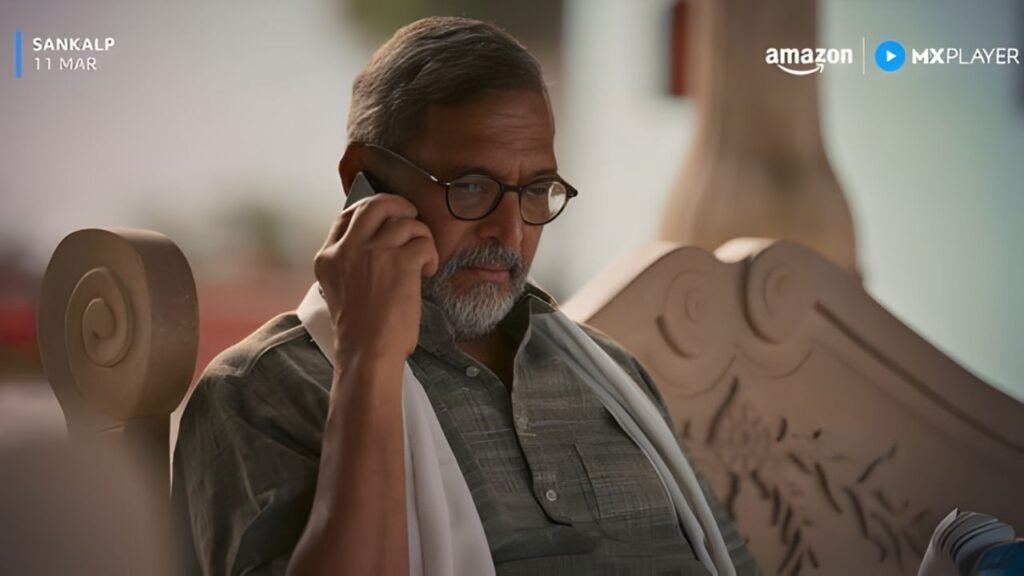
At the centre of the story is Kanhaiya Lal, played by Nana Patekar. A respected schoolteacher in Patna, he runs a small gurukul where he personally selects students from modest backgrounds. Beyond this, he also operates a UPSC coaching centre in Delhi that prepares aspirants for the civil services examination.
Over the years, several of his students have gone on to become IAS, IPS and IRS officers, occupying influential positions in government institutions. Despite their high-ranking roles, they remain deeply loyal to their mentor, whom they still call Master Sahab. This network of former students forms the foundation of Kanhaiya Lal’s influence.
The story gains momentum when a young vlogger named Jayanti attends an event organised by the son of Delhi Chief Minister Prashant Singh, played by Sanjay Kapoor. Her pointed questions publicly embarrass the chief minister, and the situation escalates when his son reacts with abusive language.
As Prashant Singh and his trusted associate Waqar—played by Neeraj Kabi—investigate the incident, they discover that Jayanti receives funding from an NGO based in Patna called Suhasini–Jaideep. The tension intensifies further when IPS officer Aditya, portrayed by Mohammed Zeeshan Ayub, unexpectedly fires his gun during Kanhaiya Lal’s birthday celebration.
An Intriguing Idea That Struggles to Convince
Sankalp attempts to present a different kind of political conflict, but the premise sometimes strains credibility. The idea that a single man operating from Patna could control or influence the government in Delhi through a loyal network of bureaucrats feels difficult to accept.
Director Prakash Jha fills the narrative with twists to sustain tension, yet several plot points appear briefly before fading away without resolution. For instance, a reporter discovers Kanhaiya Lal’s blood-stained clothes in a dump yard after he is injured by a bullet. Despite this discovery, his rivals remain strangely uncertain about what happened to him.
Moments like these create unanswered questions that weaken the show’s otherwise grounded political tone. At times, Kanhaiya Lal is portrayed almost as an untouchable figure who cannot be challenged, which further undermines the realism the series tries to maintain.
Nana Patekar Shines in His Streaming Debut
In his streaming debut, Nana Patekar brings authority and restraint to the character of Kanhaiya Lal. Instead of exaggerating the role, he relies on subtle expressions and quiet intensity to dominate many scenes.
Mohammed Zeeshan Ayub delivers a sincere performance as IPS officer Aditya, a man who eventually finds himself confronting the mentor he once admired. Meanwhile, Sanjay Kapoor portrays Delhi Chief Minister Prashant Singh with controlled arrogance, adding another layer to the political power struggle.
Neeraj Kabi stands out as Waqar, the calculating party president whose sharp expressions and measured performance make him a formidable rival to Kanhaiya Lal. Meghna Malik also leaves an impression as Suhasini, whose calm demeanour hides a perceptive and strategic mind.The series features a large supporting cast, and many of these characters manage to leave a mark despite limited screen time.
Jay-Ho Verdict
Sankalp offers a fast-paced political drama anchored by strong performances, particularly from Nana Patekar. The series keeps viewers engaged with constant developments and layered characters. However, its narrative struggles to fully justify its ambitious premise, leaving several questions unanswered.
Despite these shortcomings, the performances and brisk pacing ensure that Sankalp remains an engaging watch, even if it never quite reaches the depth its story initially promises.