






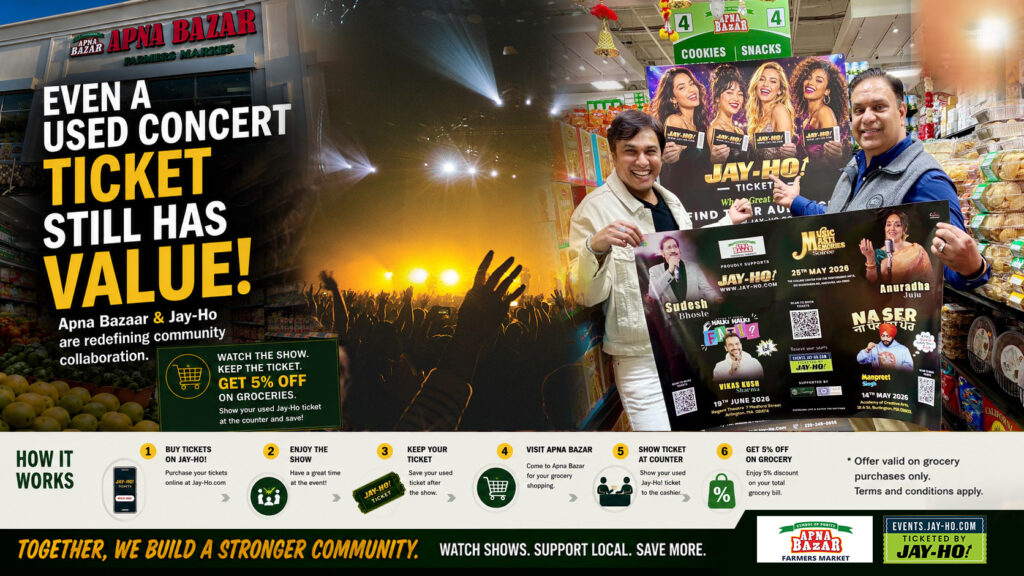

A simple 5% grocery reward may actually reflect a much larger shift in how local businesses, entertainment platforms, and immigrant communities are beginning to build interconnected ecosystems together.
A family attends a concert on Sunday evening. They sing along to old Bollywood songs, record videos during the best moments, take family pictures outside the venue, and laugh about a joke from the comedy act on the drive home.
By Monday morning, the clips are already on Instagram. WhatsApp groups are still discussing favorite songs. Someone is replaying Sudesh Bhosle tracks in the car, while another family is sharing memories from the evening over dinner.
And then a few days later, something unexpected happens.
That same event ticket quietly creates value again — this time at the grocery counter inside Apna Bazar.
At first glance, it sounds like a fun promotional idea. But according to modern business research, collaborations exactly like these are increasingly becoming one of the smartest ways local ecosystems grow.
Researchers at Harvard University and several leading business schools have extensively studied how “ecosystem partnerships” create stronger customer loyalty by connecting multiple experiences together instead of treating businesses as isolated transactions.
The idea is surprisingly simple: people no longer think only in terms of products. They think in terms of experiences, relationships, convenience, identity, and belonging.
And perhaps that is exactly why the recent collaboration between Jay-Ho! and Apna Bazar has started generating so much conversation inside Boston’s Indian community.
Because this is not just about groceries. And it is not just about concerts either.
It is about building an ecosystem where value circulates within the community itself.
“We Have Our Own In-Home Platform…”
During a recent Facebook LIVE, Romy Salhi, Head of Apna Bazar, passionately encouraged Boston audiences to support Jay-Ho Tickets while explaining the new collaboration.
And perhaps the most important line in his speech was this:
“We have our own in-home platform for all the ticket selling, Jay Ho Tickets.”
That sentence captured the real spirit behind the collaboration — not corporate marketing or aggressive selling, but community ownership.
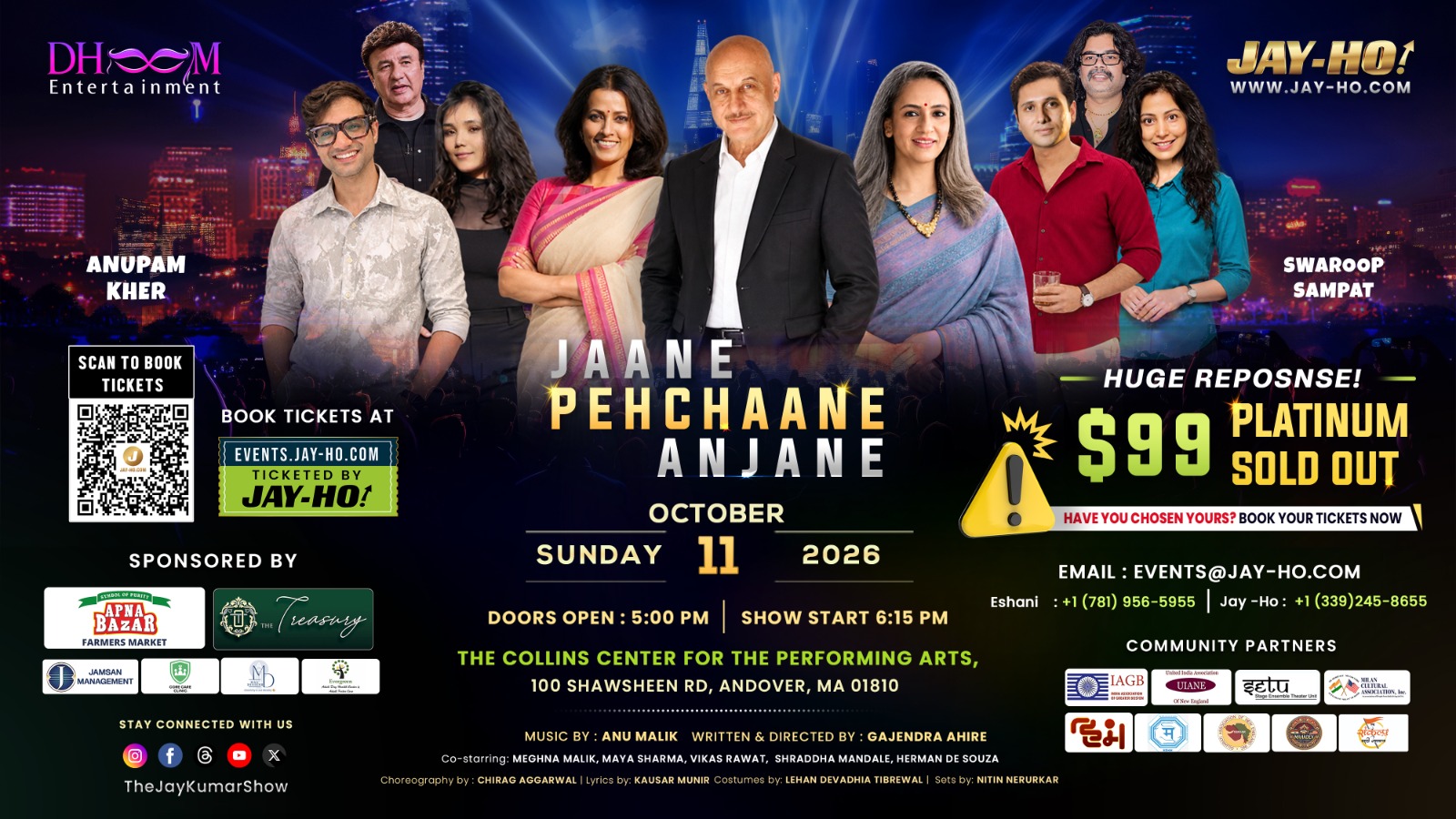
Romy then explained how customers purchasing tickets through Jay-Ho Tickets can later bring their used event ticket to either Apna Bazar location after attending the show and receive 5% off on groceries.
And then, in classic Romy style, came the line that instantly made audiences laugh:
“Even a used kartoos still has value.”
The humor landed immediately, but behind the joke sits a surprisingly intelligent business model.
Because in most industries, value creation ends after the transaction. You buy something, you use it, and the relationship ends.
But stronger ecosystems behave differently.
Airlines connect flights with hotel points. Credit cards integrate dining rewards. Streaming platforms bundle multiple services together.
And now, in its own local and community-driven way, Jay-Ho and Apna Bazar are experimenting with something similar: extending the lifecycle of the customer experience itself.
A concert ticket no longer represents just entry into an event. It becomes part of a continuing relationship between entertainment, local businesses, and community participation.
Romy also encouraged local organizers to consider hosting their events on Jay-Ho, emphasizing the importance of supporting a homegrown platform built within the community itself.
Innovation Is Not Always Technological
One of the most interesting aspects of this collaboration is that the innovation here is not primarily technological.
It is business-model innovation.
Innovation is not always about apps, AI, or software. Sometimes the most powerful innovations are business-model innovations that rethink how communities, experiences, and local businesses connect with one another.
That is exactly what makes this collaboration interesting.
Instead of functioning like isolated businesses, Jay-Ho and Apna Bazar are experimenting with ecosystem thinking. Entertainment supports local businesses, local businesses support entertainment, the audience receives continuing value, and the overall community experience becomes more interconnected.
That kind of ecosystem collaboration is still relatively rare in local entertainment spaces. And perhaps that is why the idea immediately resonated with people.
Because it does not feel corporate.
It feels local, practical, community-driven, and culturally understood.
The Thinking Behind Ecosystems
Interestingly, this ecosystem approach is not entirely new to Jay Kumar, founder of Jay-Ho!.
Long before Jay-Ho, Jay Kumar spent years in the technology industry helping build ecosystems around DSPs (Digital Signal Processors), where success depended not just on the hardware itself, but on creating strong interconnected environments involving developers, tools, integrations, partners, support systems, and long-term adoption.
In technology, the most successful platforms were rarely built around isolated products alone. They succeeded because ecosystems created continuing value around the experience.
And in many ways, that same thinking now appears inside Jay-Ho’s evolving approach toward entertainment, ticketing, food integration, local business collaboration, and community engagement.
The ticket itself is no longer the final product. It becomes the starting point of a larger connected experience.
Evolving Community Experiences — Without Losing Community Warmth
Historically, Indian community events across America have always operated through relationships, trust, direct communication, and personal networks. And honestly, that warmth remains one of the greatest strengths of immigrant communities.
As events continue growing larger and more sophisticated, platforms also require stronger infrastructure — customer support, reserved seating systems, payment processing, audience communication tools, and smoother event management.
What makes the Jay-Ho approach interesting is that instead of simply functioning as a ticketing platform, it is now experimenting with ways to return visible value back into the community ecosystem itself.
Jay-Ho already positions itself among the lower transaction-fee platforms while still supporting premium reserved seating maps and advanced event management capabilities for organizers.
And now, through collaborations like Apna Bazar’s grocery reward model, part of that value continues circulating within the community itself.
The goal is not to change the community. It is to evolve alongside it while making the overall experience feel more connected, rewarding, and beneficial for audiences, organizers, and local businesses alike.
From Ticketing Platform To Experience Ecosystem
The grocery collaboration is also not the only experiment quietly happening behind the scenes.
Jay-Ho has recently started integrating food and snack add-ons directly into the ticketing experience itself.
For years, community concerts have often faced familiar operational challenges including long cafeteria lines, short intermissions, cash handling confusion, and audiences missing portions of performances while waiting for snacks or meals.
The newer Jay-Ho approach attempts to simplify that through pre-booked food integration, allowing audiences to reserve snacks or meals during ticket purchase itself and later pick them up through streamlined QR-based systems at the venue.
Operationally, that creates benefits across the ecosystem.
For audiences, it means less waiting, less stress, and more convenience. For food vendors, it allows better preparation, better forecasting, and less waste. And for organizers, it creates a smoother overall event experience.
Quietly, Jay-Ho is evolving beyond simply selling tickets. It is beginning to build interconnected community experiences around entertainment itself.
More Than A Promotion
Perhaps that is why this collaboration suddenly feels larger than a normal promotional campaign.
Because ultimately, this is not just about groceries, discounts, or tickets.
It reflects something much larger: a homegrown ecosystem where value remains connected within the community instead of constantly flowing outward to giant national systems.
A grocery store supports entertainment. Entertainment supports local businesses. Food integrates with ticketing. And audiences continue receiving value even after the event itself ends.
That is not merely marketing.
That is ecosystem innovation.
Built locally, driven personally, and evolving naturally — one event, one relationship, and one experience at a time.
Terms & Conditions
- Offer valid only on tickets purchased through Jay-Ho Tickets.
- Customers must present a valid used Jay-Ho event ticket at the Apna Bazar counter after attending the event.
- Offer valid within 7 days of the event date.
- One ticket eligible for one-time use only.
- Discount applicable on grocery purchases only.
- Cannot be combined with other store-wide promotional offers.
- Apna Bazar reserves the right to verify ticket authenticity.
- Terms and conditions may be updated without prior notice.