













Inspired by waterfalls, short escapes and the memories we carry home, the new Hindi song celebrates the joy of slowing down—even when life refuses to stop
A waterfall never asks anyone to stop. Yet somehow, everyone does.
People may arrive carrying phones, cameras, travel plans and a list of places still waiting to be explored. But when they stand before a waterfall—whether it is Niagara Falls, a mountain cascade in Himachal or an unexpected stream discovered during a road trip—the sound of rushing water briefly takes over everything else.
Conversations become quieter. Cameras come out. People smile, get a little wet and remain there longer than they had planned.
That familiar experience lies at the heart of “Jharna – Do Pal Toh Thehar Na,” written by Jay Kumar and sung by Uvee of the Jay Ho Band. Presented by Jay Ho and released through Jay-Ho Originals, the Hindi song celebrates waterfalls, brief holidays, lighthearted romance and the precious moments that often become more memorable than the journey itself.
When a two-day holiday becomes a lasting memory
The song’s central thought is beautifully simple:
Jharna re jharna
Yun hi khulkar behna
Do din ki chhutti hai
Do pal toh thehar na
The words capture something almost every traveller understands. Holidays are often short. People spend weeks planning them, hours travelling and then rush from one destination to the next because there is never enough time to see everything.
“Do din ki chhutti hai, do pal toh thehar na” gently interrupts that hurry.
A waterfall cannot actually stop. That is what gives the line both its playfulness and deeper meaning. The request appears to be made to the waterfall, but it quietly reaches the listener: slow down, look around and remain present before the moment passes.
A holiday may last only two days, but one fully lived moment can remain with us for years.
Nature creates its own music

“Jharna” does not present the waterfall merely as a beautiful background. The water has movement, rhythm and personality. Stones, leaves and footsteps become part of its world:
Chhap-chhap paani
Mast rawaani
Har mod jaise
Nayi ik kahaani
“Chhap-chhap” recalls wet footsteps, playful splashes and the happiness people often rediscover around water. “Mast rawaani” gives the waterfall a carefree spirit—it continues on its way without hesitation, finding a new direction at every turn.
The song invites listeners to notice sounds usually hidden beneath the noise of daily life: water touching stones, leaves moving together and droplets creating their own rhythm.
Music, in this world, does not begin inside a studio. It is already present in nature.
Why the sound of water speaks to us
The emotional connection people feel with flowing water is not limited to poetry. Researchers have also examined how natural sounds may influence the way people feel.
A 2021 study published in the Proceedings of the National Academy of Sciences reviewed research into the effects of natural sounds. Among the categories examined, water sounds produced the largest average effect for health-related outcomes and positive emotions. The findings do not suggest that water is a medical treatment, but they help explain why rain, rivers and waterfalls can feel restorative to many people.
A separate study published in Scientific Reports examined responses from 19,806 adults in England. Those who reported spending at least 120 minutes in nature during the previous week were more likely to report good health and higher well-being than people reporting no nature contact. That time could be accumulated through one long visit or several shorter ones. The researchers cautioned that the study was observational, meaning it identified an association rather than proving that nature alone caused the difference.
“Jharna” reflects that desire to reconnect with the natural world without insisting on a long vacation or distant destination. It celebrates whatever time is available—even two days, even two moments.
Romance found in an ordinary moment
The romance in “Jharna” is equally uncomplicated.
A drop of water rests on someone’s eyelash. A smile makes the morning feel brighter. There are damp cheeks, wet hair, laughter and the familiar desire to capture everything in a photograph before the moment disappears.
The words “Thodi si kudrat, thodi nadaani” bring these feelings together. “Kudrat” is the beauty surrounding the travellers, while “nadaani” is their willingness to forget everything for a moment, get drenched, laugh freely and become children again.
Affection appears through observation, teasing and the small exchanges that happen naturally when two people travel together. There are no grand declarations because the moment itself says enough.
A song that belongs to every journey
From the power of Niagara Falls to the quiet beauty of a mountain stream, “Jharna” can become part of many different journeys.
It could accompany a romantic escape, a family holiday, an adventure with friends or a quiet solo trip. It could play beside a waterfall strengthened by the monsoon, surrounded by autumn colours or transformed by winter.
The song does not belong to one city, country, season or kind of traveller. It leaves enough space for every listener to place a different face, destination and memory inside it.
The invitation soon becomes collective:
Jharna re jharna
Humein bhi bhigo na
Boondon ki taalon pe
Jhoome ye zamaana
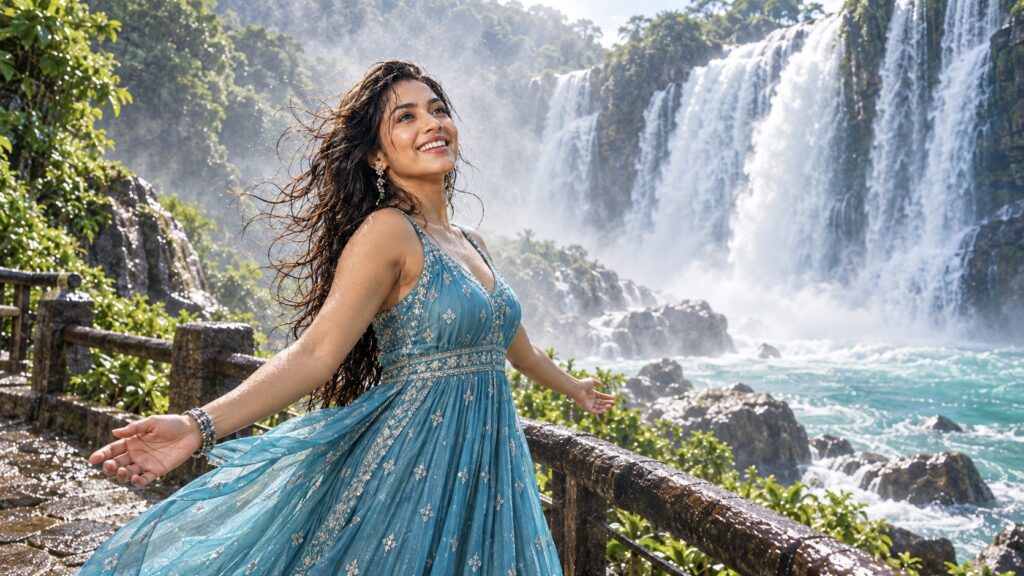
Anyone who has visited a large waterfall understands that feeling. The mist reaches you before you reach the water. Hair becomes wet, carefully planned photographs become imperfect and people begin laughing instead of worrying about how they look.
Those imperfect moments often become the best memories.
People from different countries, languages and backgrounds stand before the same sight. For a few minutes, everyone looks in the same direction and responds with the same sense of wonder.
Take the memory, leave the beauty
Alongside its joyful mood, “Jharna” also carries a message of responsibility toward nature:
Laye the jo bhi, wapas le jaana
Kudrat ko phir se aisa hi paana
The thought is simple: visitors should take their belongings and waste home so the next person can experience the place with the same beauty.
This message reflects established outdoor ethics. Leave No Trace encourages visitors to pack out their waste, remain on durable surfaces, respect wildlife and leave natural objects where they belong. Its guidance asks people to take photographs rather than rocks, plants or other souvenirs from nature.
Nature gives travellers beauty, freshness, laughter and memories. Caring for the place is a way of expressing gratitude—and ensuring that its magic remains available to everyone who arrives later.
A moving waterfall and a necessary pause
“Jharna – Do Pal Toh Thehar Na” carries a gentle contradiction.
The waterfall keeps moving, but someone asks it to wait. The holiday is ending, but the memory is only beginning. The travellers may not have counted the distance or worried about the destination, yet every turn has offered them a new story.
The waterfall does not allow the rocks in its path to end its journey; it finds a way around them and continues towards the river. In that movement lies a quiet motivation—obstacles do not always stop us; sometimes they help shape the direction in which we move.
Perhaps that is why waterfalls remain so fascinating. Their constant movement reminds us that time will not stop. Their beauty persuades us to stop anyway.
Through nature, travel, romance and responsibility, “Jharna” offers a simple invitation: step away from the schedule, notice the people beside you and enjoy the place where you are standing.
The journey will continue soon enough.
For now, give the moment two more minutes.
Listen to “Jharna – Do Pal Toh Thehar Na”
“Jharna – Do Pal Toh Thehar Na” is now available on Spotify, Apple Music, YouTube Music, Amazon Music and other major music-streaming platforms.
Listen to it during your next journey. Let it accompany a waterfall memory, a weekend escape or a peaceful moment beside the water.
And whenever life begins moving too quickly, remember:
Do din ki chhutti hai…
Do pal toh thehar na.
Jay Ho | Jay-Ho Originals
Here are the lyrics of Song:
Ohh
Jharna re jharna
Yun hi khulkar behna
Do din ki chhutti hai
Do pal to thehar na
Jharna re jharna
Humein bhi bhigo na
Boonon ki taaloon pe
Jhoome ye zamaana
Kankar pe paani ne dhun ye bajaai
Patton ne hilkar bhi taal milaai
Paanvon ne khud hi ye rasta chuna
Na manzil poochhi na doori gini
Chhap chhap paani
Mast rawaani
Har mod jaise
Nai ik kahaani
Jharna re jharna
Yun hi khulkar behna
Do din ki chhutti hai
Do pal to thehar na
Jharna re jharna
Humein bhi bhigo na
Boonon ki taaloon pe
Jhoome ye zamaana
Boond ek teri palkon pe thehri
Hans di tu to subah hui sunheri
Maine kaha palkon pe sajne do na
Tune kaha pehle tasveer lena
Bheege se baal
Gaalon pe paani
Thodi si kudrat
Thodi naadaani
Jharna re jharna
Yun hi khulkar behna
Do din ki chhutti hai
Do pal to thehar na
Jharna re jharna
Humein bhi bhigo na
Boonon ki taaloon pe
Jhoome ye zamaana
Oonchaai chhod aaya
Zameen se milne ko
Patthar bhi raah bane
Dariya se milne ko
Jo saath laaye the wapas le jaana
Kudrat ki khushboo sang le jaana
Jaisa mila tha waisa hi rakhna
Phir laut aane ka vaada nibhaana
Paani sa behna
Khulkar ye kehna
Aaj ka har pal
Dil mein hi rakhna
Jharna re jharna
Zara dheere behna
Do pal ki chhutti hai
Do pal to jay ho kehna
Jharna re jharna
Yun hi jay ho gaate rehna
Aaye jo bhi tere dar
Khushiyaan use dena
Jharna re jharna
Yun hi khulkar behna
Do din ki chhutti hai
Do pal to thehar na
Jharna re jharna
Humein bhi bhigo na
Boonon ki taaloon pe
Jhoome ye zamaana
Do pal to thehar na
Do pal to jay ho kehna
Jharna re jharna
Jharna re jharna