






The grandeur of Nitesh Tiwari’s Ramayana: Part 1 extends far beyond its visual effects. From Ravana’s lavish throne to Shurpanakha’s elaborate chariot and the enormous Pushpak Vimana, the film’s production design involved months of planning and construction. Art director Ramesh Andhale has now offered a glimpse into the effort behind these creations, revealing that Ravana’s throne alone cost approximately ₹1 crore, while Shurpanakha’s chariot was built at a reported cost of ₹1.5 crore.
In an interview with Prabhat Khabar, Andhale discussed the scale of the art department’s work and explained how his team helped construct the physical world of the mythological epic. According to him, the production involved more than 150 sets, with several structures undergoing multiple design revisions before receiving final approval.
The revelations offer a closer look at the craftsmanship behind a film that has attracted considerable attention for its scale. Rather than depending entirely on green screens and computer-generated environments, the team built several large structures and practical props to give the actors physical elements to interact with during filming.
Ramayana art director reveals how 150 sets were constructed
Andhale and his team joined the project in February 2024, while construction began in April at Prime Focus Studios in Mumbai’s Film City. The work involved creating elaborate environments while paying attention to smaller visual elements, including floor textures, wall patterns, architectural details and decorative finishes.
According to the art director, reaching the final design was rarely a straightforward process. Individual structures went through approximately 10 to 15 versions before the team settled on the designs that eventually appeared on screen. The revisions allowed the department to refine the appearance and proportions of each creation while ensuring that the structures could serve the practical requirements of filming.
The production’s approach also involved building physical elements wherever possible. Although green-screen technology and digital environments were used for certain sequences, the art department constructed several sets and props by hand. This gave the performers tangible surroundings and helped establish the scale of the film’s fictional world.
Ravana’s throne cost ₹1 crore and took four months to build
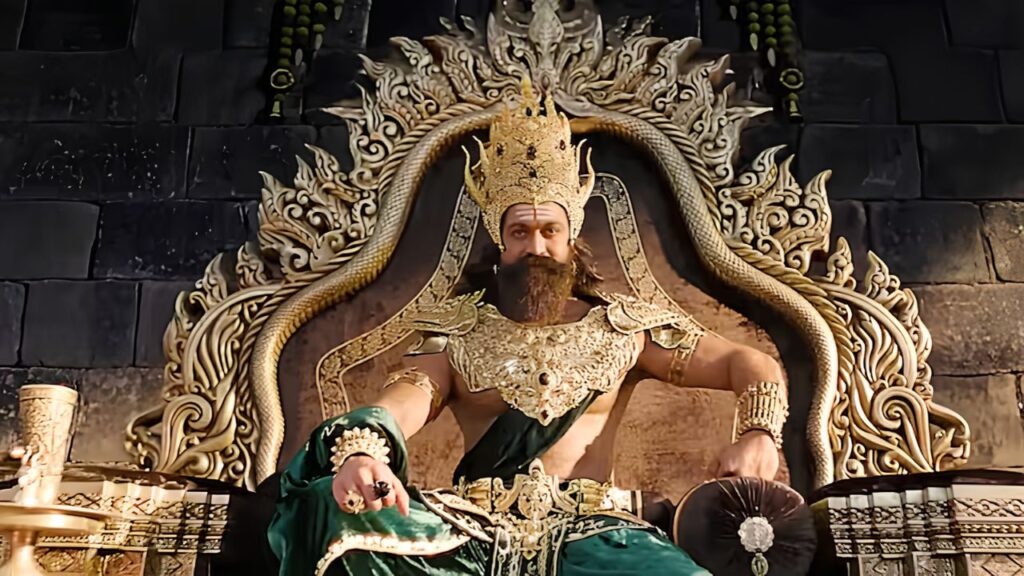
One of the most expensive individual creations was Ravana’s throne, designed to reflect the wealth and grandeur associated with his kingdom. Andhale revealed that the throne took approximately four months to complete and cost around ₹1 crore.
The construction process began with a clay model based on the approved design. The team then used the model to create the structure in fibre before completing its elaborate finish. The throne was decorated with 24-karat gold leafing, giving it the rich golden appearance required for Ravana’s royal setting.
The expenditure reflects the level of detail invested in a prop that plays an important visual role in establishing Ravana’s authority and the opulence of Lanka. Rather than creating the throne solely through digital effects, the team built a physical version for the film.
Shurpanakha’s chariot cost ₹1.5 crore despite appearing in one scene
Another major production-design undertaking was Shurpanakha’s chariot, associated with the character played by Rakul Preet Singh. Andhale revealed that the chariot cost approximately ₹1.5 crore and required around three months of work.
The challenge was not simply to make the vehicle look impressive. It also had to be functional for filming. The team therefore had to consider its weight, balance, structure and overall appearance while ensuring that it could operate as required on set.
The chariot features in the sequence in which Shurpanakha arrives at the forest dwelling of Lord Rama and Lakshman in Panchavati. Despite its limited screen appearance, the production team invested months in designing and constructing the elaborate model.
Its reported cost also highlights how much work can go into even a brief sequence in a large-scale film. The final result had to meet both the visual expectations of the story and the practical demands of the shoot.
50-foot Pushpak Vimana built in four separate sections
The Pushpak Vimana presented a different engineering challenge because of its enormous dimensions. Andhale revealed that the structure measured approximately 50 feet in diameter, making it too large to construct as a single unit inside the studio.
The team consequently divided it into four separate sections. The construction reportedly took around 40 to 50 days, with the sections designed to come together as one large structure for the production.
The concept also had a long development history. According to Andhale, director Nitesh Tiwari had been thinking about the design of the Pushpak Vimana for approximately six years. Bringing that vision to the screen required the art department to work around the limitations of the studio while maintaining the scale intended for the film.
The Pushpak Vimana was not the only oversized practical creation. The team also constructed a 24-foot-tall skeletal model of Jatayu. Having a physical model on set helped the actors establish their eye-lines and perform their scenes more naturally while interacting with the character.
Hundreds of workers helped build Lanka
The scale of the production extended to the workforce required to create its larger environments. Andhale revealed that the Lanka set alone involved approximately 500 to 600 workers at a time.
Large crowd sequences demanded additional coordination, with some scenes involving as many as 1,000 dancers and junior artists. These numbers underline the logistical effort involved in creating the film’s elaborate settings and bringing large-scale sequences to life.
Tiwari was also closely involved in the production-design process. According to Andhale, the director personally inspected the sets a day before filming. He also reviewed storyboards and concept art several days ahead of the shoot, allowing the team to address creative and practical requirements before the cameras rolled.
Ramayana features Ranbir Kapoor, Yash and Sai Pallavi
Directed by Nitesh Tiwari, Ramayana: Part 1 stars Ranbir Kapoor as Lord Rama, Sai Pallavi as Sita, Yash as Ravana and Ravie Dubey as Lakshman. The ensemble also includes Sunny Deol as Hanuman, alongside several other actors in important roles.
The film released in theatres on November 5, 2026. Its second instalment is scheduled to arrive during Diwali 2028.
The reported budget of more than ₹4,000 crore has been associated with the two-part Ramayana project collectively. The production-design revelations provide another perspective on the resources invested in the adaptation, showing how physical construction, intricate detailing and large-scale set work contribute to its cinematic world.
With Ravana’s ₹1 crore throne, Shurpanakha’s ₹1.5 crore chariot and the 50-foot Pushpak Vimana, the art department’s work demonstrates the considerable effort behind the film’s visual scale. These creations also show that the making of an epic production involves more than digital spectacle: it requires extensive craftsmanship, planning and coordination behind the camera.
FAQs
1. How many sets were built for Ranbir Kapoor’s Ramayana?
Art director Ramesh Andhale revealed that his team constructed more than 150 sets for the mythological epic.
2. How much did Ravana’s throne cost in Ramayana?
Ravana’s throne reportedly cost approximately ₹1 crore and took around four months to complete.
3. How was Ravana’s throne made?
The throne was first developed using a clay model, followed by fibre construction and an elaborate finish featuring 24-karat gold leafing.
4. How much did Shurpanakha’s chariot cost?
Shurpanakha’s chariot reportedly cost approximately ₹1.5 crore and took around three months to build.
5. Who plays Shurpanakha in Ramayana?
Rakul Preet Singh plays Shurpanakha in Nitesh Tiwari’s Ramayana: Part 1.