








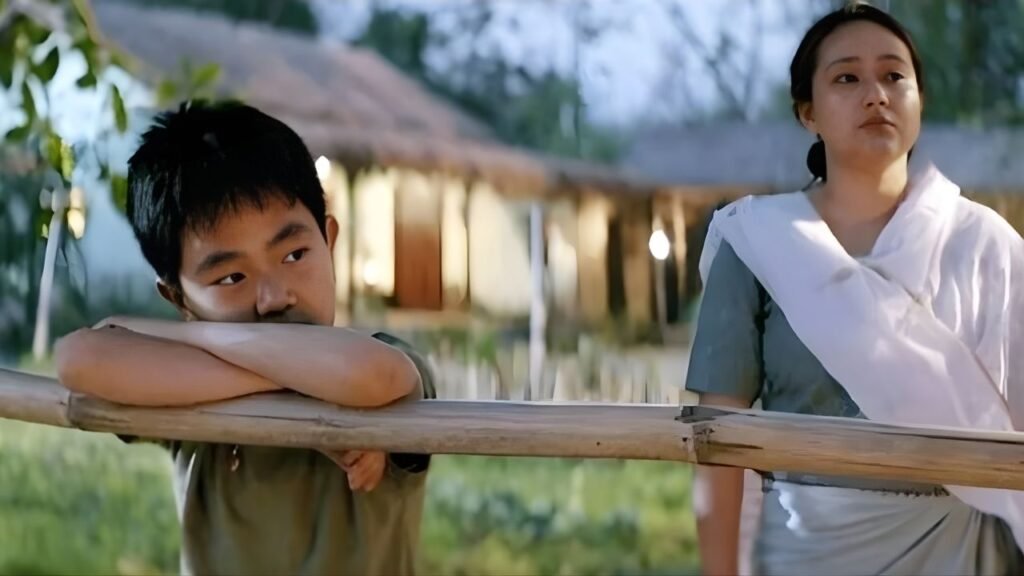

The Boong Movie Review reveals a film that unfolds gently but leaves a lasting emotional impact. According to early festival screenings and critics’ reactions, Boong stands out for its patient storytelling and deeply human perspective on childhood.
Directed by Lakshmipriya Devi, the film is set in the scenic yet complex landscape of Manipur. It follows a young boy named Boong, played by Gugun Kipgen, who believes that finding his missing father will restore happiness to his mother’s life.
Rather than relying on dramatic twists, the film slowly draws viewers into a world where small moments, quiet observations, and childhood curiosity carry emotional weight.
Boong Movie Review: A Quiet Beginning Rooted In Everyday Life
One of the first things noticeable in this Boong Movie Review is how quietly the film begins.
Instead of dramatic openings or flashy visuals, the film slowly settles into the rhythms of life in a small Manipuri village. Everyday interactions—children playing, neighbours chatting, and people moving through their daily routines—create a sense of authenticity.
This observational style allows viewers to feel as if they are spending time in the village rather than simply watching a story unfold.
Many coming-of-age films rely heavily on emotional highs or dramatic conflicts. Boong, however, chooses a more patient path. It treats childhood as a phase where innocence slowly begins to encounter the complicated realities of the adult world.The film finds beauty in simple moments where nothing extraordinary happens, yet the emotional depth continues to grow.
Boong Movie Review: The Story Of A Boy Searching For His Father
At the heart of the Boong Movie Review is the touching story of a young boy determined to bring happiness back to his family.
Boong lives with his mother Mandakini, played by Bala Hijam, in a small village. Years ago, Boong’s father disappeared under mysterious circumstances.Most villagers have accepted that the man is likely dead. But Boong refuses to believe that story.
Instead, he clings to hope. As he grows older, he keeps hearing different rumours about where his father might be. These stories fuel his imagination and determination.Eventually, Boong decides he will find his father and bring him back home as a gift to his mother.
With the help of his best friend Raju, played by Angom Sanamatum, Boong leaves the familiar world of his village and begins a journey that takes him through nearby towns and border areas.Along the way, the boys meet strangers, face confusing situations, and gradually begin to understand that the world outside their village is far more complicated than they imagined.

Boong Movie Review: Childhood Curiosity Meets Harsh Realities
A key highlight of the Boong Movie Review is how the film presents a child’s perspective within a complex social environment.The story unfolds in a region that carries its own political tensions and uncertainties. Yet the film never forces these issues into the foreground.
Instead, they exist quietly in the background—visible through brief conversations, passing encounters, and subtle environmental details.From Boong’s point of view, these elements are confusing and mysterious rather than clearly defined problems.
This narrative approach allows the audience to experience the world exactly as Boong does: full of questions, half-understood events, and moments of curiosity.The contrast between childhood innocence and the adult world’s complexities becomes one of the film’s most powerful themes.
Performances That Bring Authenticity To Boong
A major strength highlighted in this Boong Movie Review is the film’s performances.
Young actor Gugun Kipgen brings remarkable sincerity to the role of Boong. His portrayal captures both the mischievous energy and emotional vulnerability of childhood.Whether he is joking with his friend or quietly thinking about his father, the performance feels natural and believable.
Bala Hijam’s performance as Mandakini adds emotional depth to the film. Her character carries the quiet burden of loss while trying to maintain stability for her son.The chemistry between the actors creates a believable family dynamic that anchors the story emotionally.
Lakshmipriya Devi’s Sensitive Direction
Director Lakshmipriya Devi approaches the story with impressive restraint.
Rather than pushing the narrative toward melodrama, she allows the characters and environment to shape the emotional experience. Her direction emphasises observation, silence, and subtle interactions.
This style gives the film an almost documentary-like quality at times.
Scenes often linger longer than expected, encouraging viewers to absorb the atmosphere and understand the characters’ emotional states.Such patience in storytelling is rare in modern cinema but works beautifully for this particular narrative.
Why Boong Stands Out Among Coming-of-Age Films
The Boong Movie Review highlights how the film distinguishes itself from many coming-of-age stories.
While many films in the genre rely on dramatic turning points, Boong chooses to explore the gradual transformation of childhood innocence.The story does not rush toward conclusions. Instead, it reflects how children slowly begin to understand the complexities of the world around them.
This approach gives the film a quiet emotional resonance that lingers long after the final scene.The setting of Manipur also adds a unique cultural and geographical dimension rarely explored in mainstream cinema.
Jay-Ho Verdict Of Boong Movie Review
The Boong Movie Review ultimately describes a film that values patience, observation, and emotional authenticity.
Through the journey of a young boy searching for his father, the film gently explores themes of hope, loss, and the transition from innocence to understanding.With strong performances, thoughtful direction from Lakshmipriya Devi, and a deeply human story, Boong emerges as a quietly powerful coming-of-age film.