








How a nonprofit theater movement quietly bridged cultures, careers, relationships, and second chances in Greater Boston.
On an ordinary day in Greater Boston, something quietly takes shape.
A software engineer debates morality with a dentist.
A doctor forgets her lines and bursts into laughter.
A man who spent the day building algorithms suddenly worries about how to enter a scene convincingly.
This is not a startup pitch.
This is not a networking event.
This is rehearsal.
If researchers from Harvard Medical School were sitting quietly at the back of the room, they would likely recognize familiar patterns. Studies in psychology and public health suggest that adults engaged in performing arts often experience lower stress, greater emotional resilience, and stronger human connection—what psychologists describe as creative collaboration. At SETU, no one set out to test a theory. They simply noticed the same patterns unfold, year after year, through practice, performance, and shared time on stage.
They just called it theater.
Where “Settled Life” Pauses and Something Deeper Begins
Boston’s Indian community is filled with success stories — doctors, dentists, engineers, scientists, technologists. Many arrived years ago, worked relentlessly, raised children, and built stable, admirable lives. And then, quietly, a question surfaced:
Is this all?
After careers stabilized.
After children grew independent.
After routines became predictable.
That is when many found their way to SETU.
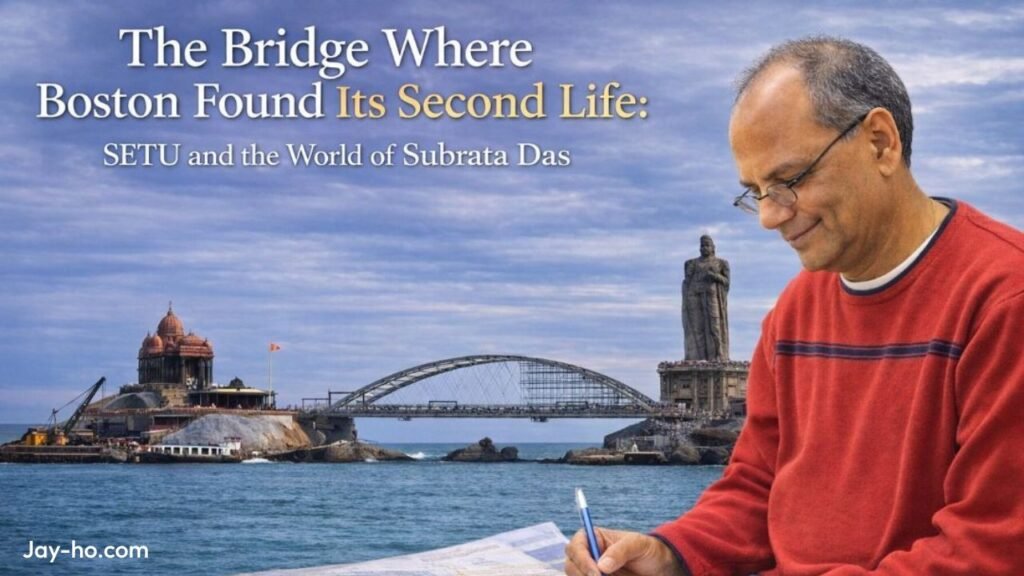
Founded in 2003, SETU means bridge in several Indian languages. Officially, its mission is to bridge Indian and Western cultures through theater. Unofficially, it became something far more personal — a bridge between professional achievement and creative expression, between pressure and play, between routine and renewal.
At the heart of this bridge is a name deeply familiar in Greater Boston’s Indian community and respected across U.S. theater circles: Subrata Das.
“Subrata Dada” and the Discipline of Serious Theater
People rarely introduce Subrata by listing credentials. They talk about him differently.
“He expects discipline.”
“He pushes you to think.”
“He treats theater seriously — because he takes people seriously.”
Under his leadership, SETU never became a casual hobby group. It became rigorous, professional-grade theater.
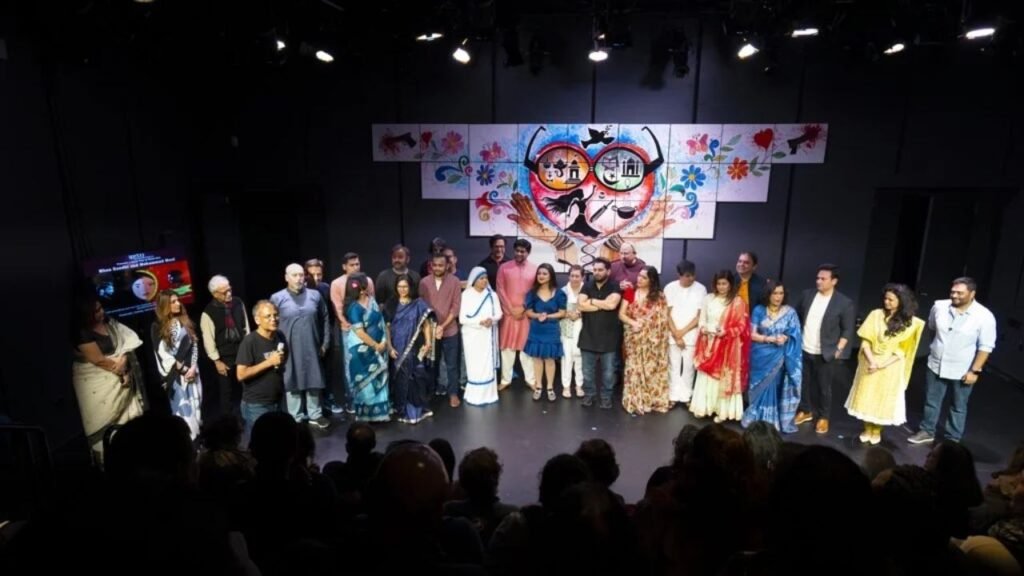
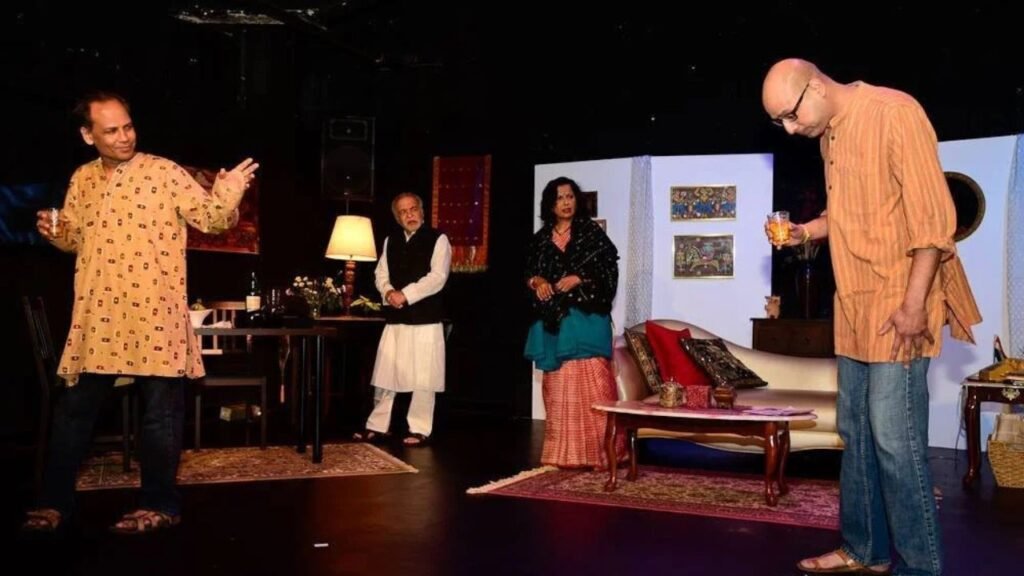
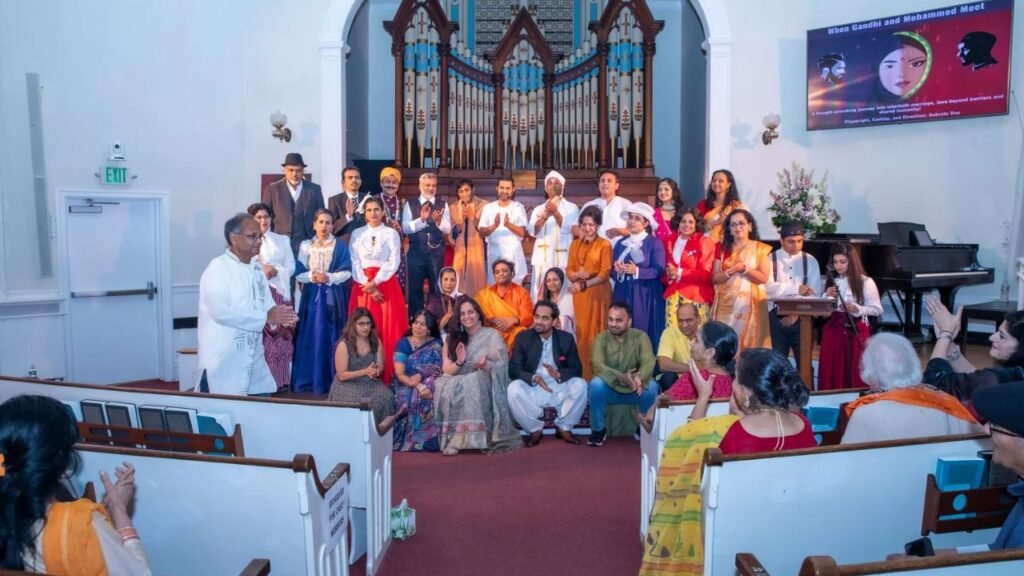
SETU’s productions are demanding — intellectually, emotionally, and technically. Plays like Kanyadaan explored caste, ideology, and family conflict with depth and restraint. Seven Steps Around the Fire confronted identity, marginalization, and social hypocrisy with courage. When Gandhi and Mohammed Meet — an interfaith love story — drew packed audiences and sparked conversations that continued long after the curtain fell. These were not “community skits.”
They were thoughtful, tightly directed productions, requiring commitment, rehearsal discipline, and emotional honesty — the kind of theater that treats its performers as capable artists, not amateurs. And that distinction mattered.
A Quiet but Powerful Space for Women to Rise
One of SETU’s most meaningful — and often understated — contributions has been the way it created space for women to step forward, speak boldly, and lead from the stage.
Many female actors who joined SETU were already accomplished professionals — doctors, scientists, engineers, educators — yet had rarely been given room to express vulnerability, authority, rebellion, or moral complexity outside their daily roles. Theater changed that.
Under Subrata’s direction, women were not cast as decorative presences or supporting characters. They carried narratives. They drove conflict. They questioned tradition. They embodied strength, doubt, courage, and resistance — sometimes all in the same role.
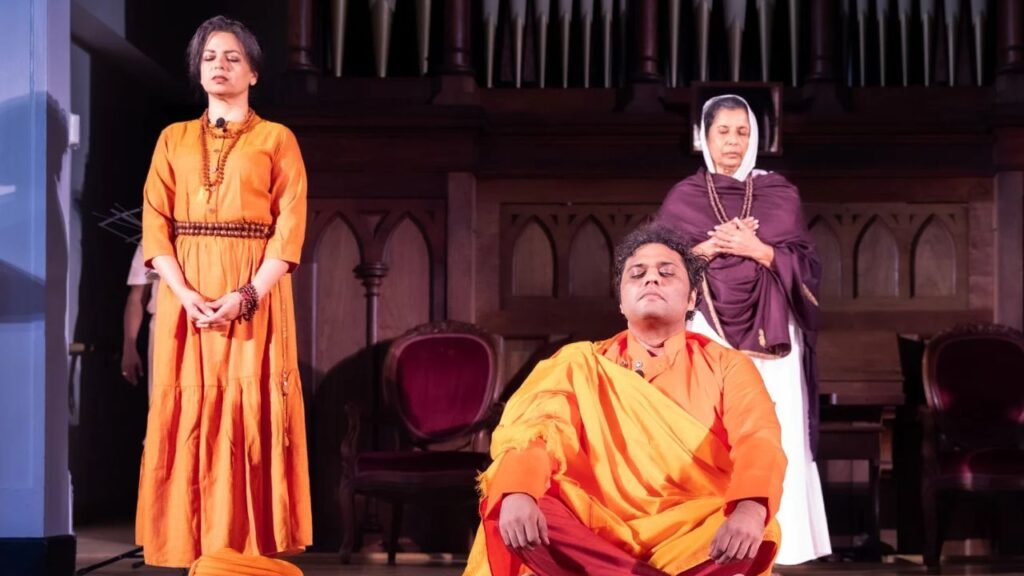
Plays like Kanyadaan and Seven Steps Around the Fire placed women at the center of difficult conversations about caste, gender, identity, and power. On stage, female actors argued, confronted, led, broke silence, and reclaimed voice — often mirroring conversations they had never been encouraged to have elsewhere.
What made this empowering was not rhetoric — it was trust.
Trust in their intellect.
Trust in their emotional depth.
Trust in their ability to command a stage.
Many women who began hesitantly found confidence not just in performance, but in life — speaking more openly, asserting boundaries, and embracing leadership beyond the theater. SETU didn’t announce empowerment. It practiced it.
The Unexpected Outcome: Lives Changed Quietly
Research from Harvard and Stanford shows that role-playing strengthens empathy and communication, activating neural pathways associated with emotional understanding. Relationship therapists use role reversal exercises. SETU simply did it under stage lights.
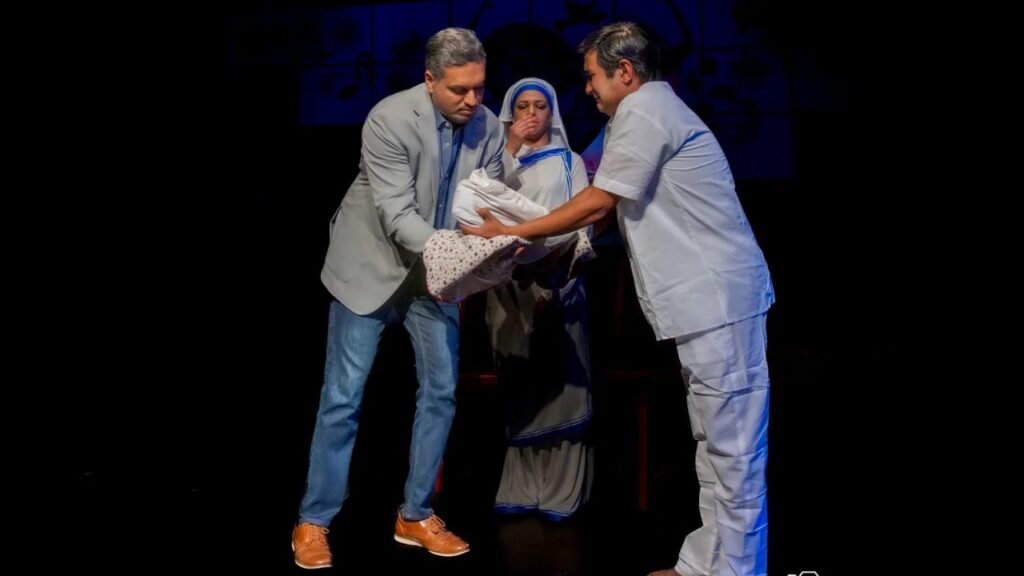
Over time, something remarkable unfolded. Couples who barely spoke began listening again — because listening was part of the scene. Professionals burnt out from work rediscovered joy without guilt. Arguments found expression through dialogue. Stress found an outlet that wasn’t silence.
A respected Boston arts patron and community supporter, Sandeep Asija, who has attended numerous SETU productions and Jay-Ho shows, once observed:
“Subrata has united so many lives. I have personally seen relationships change. Some divorces never happened because people found connection again — through SETU.”
That kind of impact rarely appears in reviews. But it lasts longer than applause.
Not Everyone Is on Stage — And That Matters
Real life, of course, doesn’t always cast both partners.
Sometimes only one spouse performs, while the other supports quietly — managing children, schedules, and everyday logistics. Sometimes the roles reverse. Sometimes one partner never steps onto the stage at all, yet remains the invisible force that makes rehearsals possible. Harvard research on long-term relationships shows that supportive participation — even without direct involvement — builds trust and emotional security.
SETU families lived this truth intuitively.
Children grew up watching parents pursue something purely for joy. Spouses learned that giving space does not mean growing apart. Applause echoed not just in theaters, but in kitchens, carpools, and late-night conversations. As one SETU member once said, smiling: “Only one of us was acting — but both of us were part of the play.”
Beyond the Stage: Cafe@SETU and a Living Community
SETU’s work extended beyond full productions.
Through cafe@SETU, its education wing, the group organized workshops, discussions, and short performances addressing social issues. SETU raised funds for charitable causes and used theater as a tool for awareness rather than instruction.
With over 200 people active in its discussion forums — many eager to act or work backstage — SETU evolved into a living cultural ecosystem. Several members went on to participate in films and professional stage productions outside the organization, carrying confidence and creative courage first discovered here.
The Reveal, Almost as an Afterthought
Only later do many discover something surprising. The man directing rehearsals, refining scripts, and shaping performances is also Dr. Subrata Das — a globally respected expert in artificial intelligence and data science.
He serves as Principal Data Scientist at Humana, is adjunct faculty at Northeastern University, holds a Ph.D. from Heriot-Watt University, and has worked at Imperial College London, Xerox Research, and MIT Lincoln Laboratory. He is also the author of influential books on analytics, decision-making agents, and safe AI systems. Yet none of this is how SETU members first know him.
Because he never led with science. He led with stories.
Perhaps it is no coincidence that his own life reflects the bridge he built for others. His wife, Janique Choux Das, shares a cross-cultural life that mirrors SETU’s spirit — open, curious, and deeply human.
Why the Bridge Still Matters
Theater visionary Peter Brook once said, “The theater is a sacred space for the human soul.”
For more than two decades, SETU has quietly been that space.
A place where professionals remembered how to play.
Where women found voice and presence.
Where couples found new language.
Where stress gave way to storytelling.
Where culture wasn’t preserved in a museum — but lived, questioned, laughed, and felt.
SETU didn’t just bridge India and the West. It bridged who people became…
with who they still wanted to be. And every evening, when the lights come on and rehearsal begins, Boston’s scientists, engineers, doctors, and dreamers step into something priceless:
A story.
A stage.
A bridge.
Editor’s Note | Jay-Ho
At Jay-Ho, we have always believed that art is not just something you watch — it is something that quietly shapes communities.
Over the years, we have witnessed countless performances and cultural initiatives across Greater Boston. Very few, however, leave a lasting imprint beyond the stage. SETU is one such rare institution.
What makes SETU special is not only the consistently high, professional quality of its productions, but the lives it has touched in ways statistics can never capture. It has offered creative refuge, built belonging, and reminded many why storytelling still matters.
We are proud to shine a light on this journey and celebrate the bridge that SETU continues to build — between cultures, generations, and lives.