








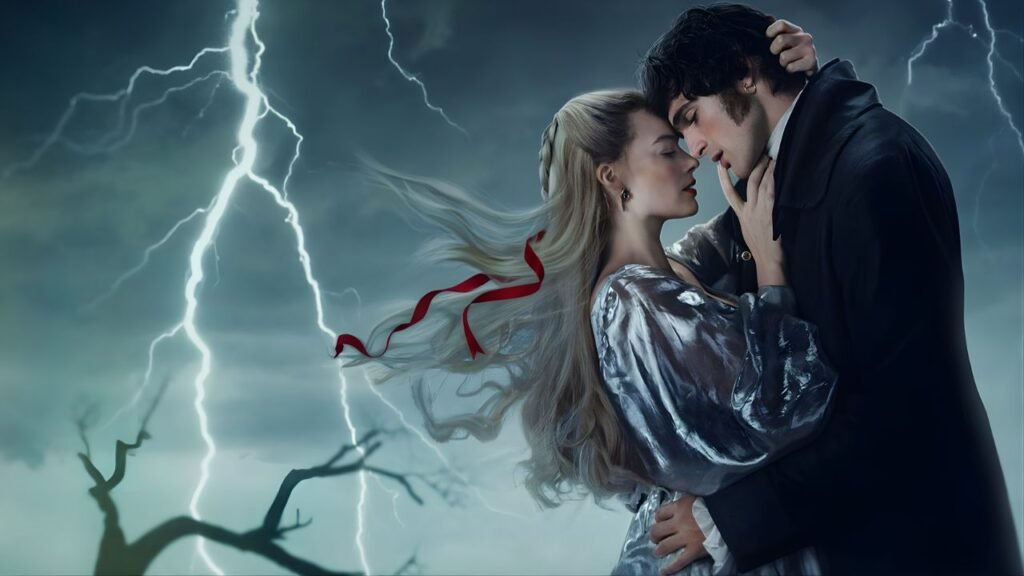

Wuthering Heights, directed by Emerald Fennell and starring Margot Robbie and Jacob Elordi, arrives with visible ambition and a promise of emotional ferocity. Adapted from Wuthering Heights, the film positions itself as a modern, visceral retelling of a literary classic. According to early critical reactions, the intent is clear: make the tragedy feel immediate rather than distant. While the film succeeds visually and benefits from committed performances, it struggles to fully capture the emotional weight and psychological complexity that make the source material timeless.
Wuthering Heights Review: A Bold but Risky Adaptation
Emerald Fennell’s Wuthering Heights is clearly mounted as serious cinema. From its bleak landscapes to its carefully controlled performances, the film signals its prestige intentions early.
Rather than leaning into the novel’s layered narration and moral ambiguity, the adaptation chooses a more direct emotional approach. The story is streamlined, the pacing tightened, and the focus narrowed primarily to the volatile relationship between Catherine and Heathcliff. This makes the film more accessible, but also less complex.
The Story Retold: Love, Pride, and Ruin
The narrative follows Catherine Earnshaw (Margot Robbie) and Heathcliff (Jacob Elordi), who grow up together at Wuthering Heights after Heathcliff is taken in as an orphan. Their bond evolves from companionship into an intense, destructive love shaped by class, pride, and emotional dependence.
Catherine’s decision to marry Edgar Linton (played by Shazad Latif) for stability fractures that bond. Heathcliff’s departure and eventual return — wealthier, colder, and consumed by resentment — pushes the story into tragedy.
The film largely sidelines the novel’s broader generational consequences, choosing instead to keep the spotlight firmly on the central romance.
Margot Robbie as Catherine Earnshaw
Margot Robbie delivers a performance driven by restlessness and inner conflict. Her Catherine is not gentle or romanticised; she is impulsive, sharp, and emotionally contradictory.
Robbie captures Catherine’s constant tension between desire and self-preservation, especially in scenes where social expectation collides with personal longing. However, the screenplay often rushes her internal transitions, leaving some emotional decisions feeling abrupt rather than inevitable.
The performance is strong, but the character is not always given enough space to fully unfold.
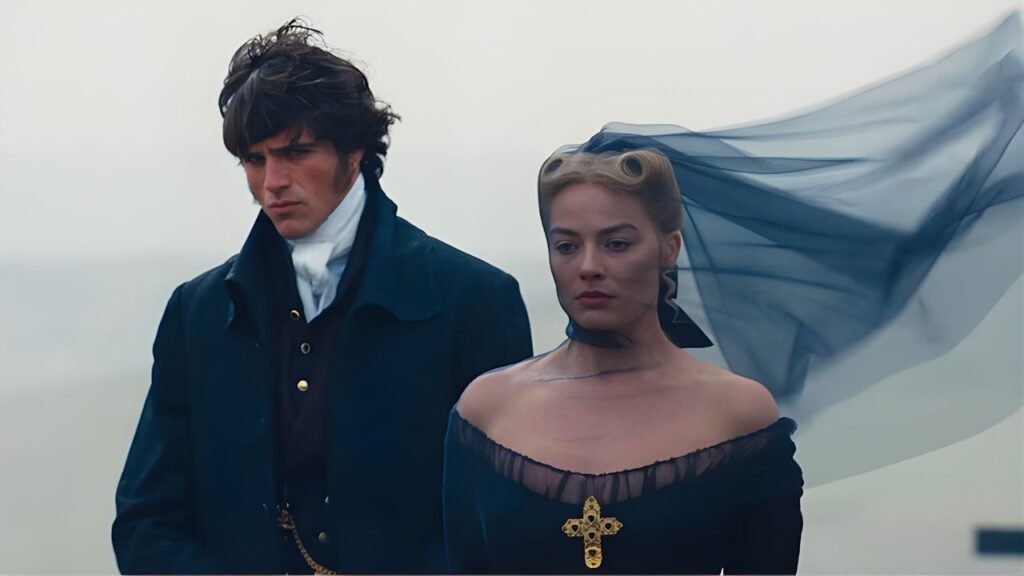
Jacob Elordi’s Heathcliff: Fire Without Fulfilment
Jacob Elordi approaches Heathcliff with physical intensity and brooding restraint. His presence dominates the screen, and the actor convincingly conveys rage, humiliation, and longing.
Where the performance falters is in emotional layering. Heathcliff’s transformation from wounded outsider to vengeful figure happens quickly, and the psychological cost of that change is underexplored. Elordi supplies the fire, but the film does not always allow the character’s inner tragedy to breathe.
The result is a Heathcliff who feels powerful in moments but incomplete as a sustained portrait.
Direction, Atmosphere, and Visual Language
Visually, Wuthering Heights is one of the film’s strongest elements. The cold landscapes, harsh interiors, and oppressive stillness of the house reflect the emotional confinement of the characters.
Fennell’s direction favours mood over exposition, allowing silence and framing to carry meaning. Several confrontation scenes are staged with impressive control. However, this visual confidence sometimes masks narrative shortcuts rather than enriching them.
The atmosphere is compelling, but it occasionally substitutes for emotional development.
When Intensity Replaces Emotional Depth
The film’s central issue lies in its storytelling approach. Emotional beats arrive quickly, conflicts escalate fast, and resolutions feel compressed.
By prioritising visible passion over psychological nuance, the adaptation loses some of the novel’s complexity. The tragedy becomes more straightforward, less layered. While individual scenes carry impact, the cumulative emotional weight never fully settles.
In trying to modernise the material, the film simplifies what was originally profound in its ambiguity.
Jay-Ho Radar
Wuthering Heights is not a failure, but it is an uneven achievement. It boasts strong performances, striking visuals, and clear directorial intent. Margot Robbie and Jacob Elordi do much of the heavy lifting, holding the film together through sheer commitment.
However, ambition alone cannot fully sustain a story this psychologically dense. The film burns brightly in moments, but the flame never spreads evenly enough to leave a lasting mark.