











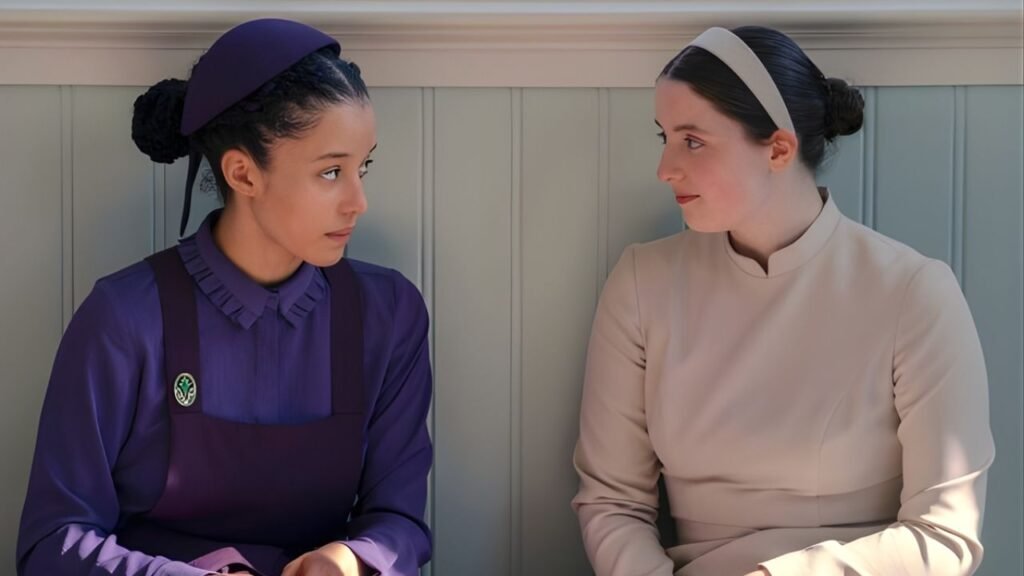

There are few fictional worlds as suffocating as Gilead. Just when it felt like its story had been told, it returns—quieter, colder, and perhaps even more unsettling.
The Testaments doesn’t explode onto the screen with dramatic shocks. Instead, it creeps in slowly, almost deliberately, pulling viewers back into a society where fear is no longer loud—it’s internalized.
And that’s precisely what makes this new chapter so powerful.
A Sequel That Refuses to Repeat the Past
As a follow-up to The Handmaid’s Tale, expectations for The Testaments were inevitably high. The original series redefined dystopian storytelling on television, blending emotional intensity with political commentary.
But instead of trying to replicate that formula, The Testaments chooses a different path.
Based on Margaret Atwood’s sequel novel, the show shifts its focus from rebellion to inheritance. It asks a more unsettling question: what happens when a generation grows up knowing nothing but oppression?
The answer unfolds gradually—and it’s deeply uncomfortable.
A New Generation Steps Into Gilead’s Shadow
At the heart of the series are two young women—Agnes and Daisy—whose lives couldn’t be more different, yet are inevitably intertwined.
Agnes has grown up within Gilead’s rigid structure. For her, the rules aren’t shocking—they’re normal. That normalization of control becomes one of the show’s most disturbing elements.
Daisy, on the other hand, arrives as an outsider. Her presence disrupts the fragile sense of order, introducing questions that Gilead prefers to keep buried.
Their relationship forms the emotional core of the series. It’s not dramatic in an obvious way, but it carries a quiet intensity that builds with each episode.
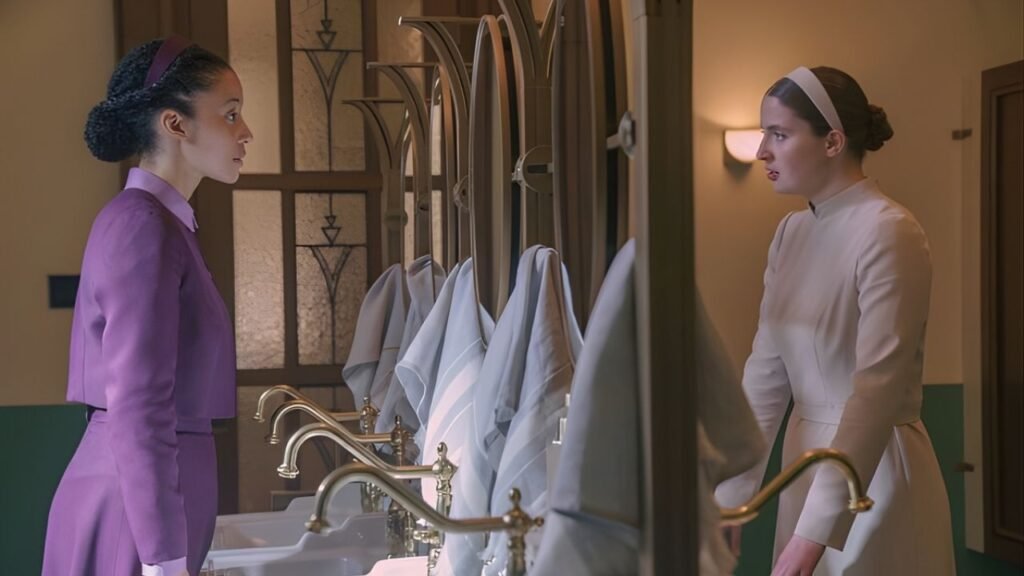
Storytelling That Chooses Restraint Over Shock
One of the most striking aspects of The Testaments is its pacing.
The first three episodes move deliberately, almost cautiously. In an era where many shows rely on instant hooks and dramatic twists, this series takes its time.
But that patience pays off.
Instead of overwhelming viewers with constant tension, the show builds unease through observation. Small details—a glance, a pause, a silence—carry as much weight as major plot developments.
This restrained storytelling gives the series its own identity, separating it from its predecessor while still honoring its tone.
The Quiet Horror of Normalized Control
If The Handmaid’s Tale was about resistance, The Testaments is about acceptance—and that’s far more chilling.
The series explores how systems of control become most effective when they are no longer questioned. For Agnes, Gilead isn’t a nightmare—it’s reality.
That perspective shifts as Daisy enters her life.
Through their interactions, the show begins to peel back layers of truth. Agnes starts to question her surroundings, uncovering secrets about her family and her place within the regime.
Daisy, meanwhile, realizes that her own presence in Gilead is not accidental. There are forces at play—larger, more complex, and far more dangerous than she initially understands.
Visual Storytelling That Speaks Volumes
Visually, The Testaments remains faithful to the stark aesthetic that defined its predecessor.
The cinematography is deliberate and controlled. The camera rarely rushes, instead lingering on still spaces and quiet moments.
This approach allows the environment to tell its own story.
Gilead is presented not through spectacle, but through absence—of color, of freedom, of noise. The silence becomes oppressive, making every small sound feel significant.
Interiors are cold and structured, reflecting the rigid hierarchy of the society. Even the framing of characters reinforces their lack of agency, often placing them within confined spaces.
It’s a visual language that doesn’t just support the narrative—it amplifies it.
Strong Performances Anchor the Narrative
While the story is subtle, the performances bring depth and authenticity.
The actors portraying Agnes and Daisy deliver nuanced performances that capture the complexity of their characters. Their evolving dynamic feels organic, never forced.
Agnes, in particular, is a fascinating character. Her journey from acceptance to awareness is portrayed with remarkable sensitivity.
Daisy’s role, meanwhile, adds an element of unpredictability. She challenges not just the system, but the audience’s understanding of it.
Together, they create a compelling emotional anchor for the series.
A Narrative Built on Questions, Not Answers
Unlike many contemporary shows, The Testaments doesn’t rush to provide clarity.
Instead, it leans into ambiguity.
Why is Daisy really in Gilead? What secrets are hidden within Agnes’s past? And how deep does the system’s control truly go?
These questions drive the narrative forward, keeping viewers engaged without relying on conventional cliffhangers.
It’s a storytelling approach that demands patience—but rewards it with depth.
How It Compares to The Handmaid’s Tale
Comparisons between The Testaments and The Handmaid’s Tale are inevitable—but perhaps unnecessary.
While both series share the same world, their focus is different.
The Handmaid’s Tale was intense, often overwhelming in its portrayal of suffering and resistance. The Testaments, on the other hand, is quieter and more introspective.
It doesn’t try to outdo its predecessor. Instead, it complements it, offering a new perspective on the same world.
This shift in tone may not appeal to everyone, especially those expecting the same level of immediate intensity. But for viewers willing to engage with its slower pace, the payoff is significant.
Why The Testaments Feels Timely
Despite being set in a fictional dystopia, The Testaments resonates strongly with contemporary audiences.
Its exploration of control, identity, and truth feels relevant in a world where information—and misinformation—shapes perception.
The idea that people can grow up accepting restrictive systems without question is particularly unsettling. It forces viewers to reflect not just on the story, but on the world around them.
That relevance is what gives the series its lasting impact.
The Strength of Emotional Storytelling
At its core, The Testaments is not just about Gilead—it’s about the people within it.
The bond between Agnes and Daisy provides the emotional foundation of the series. Their relationship evolves in subtle ways, reflecting the broader themes of trust, identity, and resistance.
It’s this human element that keeps the story grounded.
Even in a world defined by control and oppression, the series finds moments of connection and vulnerability.
Those moments, however brief, are what make the narrative resonate.
Jay-Ho Scoop
The Testaments doesn’t aim to shock—it aims to unsettle. And it succeeds.
By focusing on a new generation and adopting a more restrained storytelling style, the series carves out its own space within the Gilead universe.
It’s not an easy watch, nor is it meant to be. But for those willing to immerse themselves in its quiet intensity, it offers a deeply rewarding experience.
In revisiting Gilead, The Testaments reminds us that some stories don’t end—they evolve. And sometimes, the most powerful narratives are the ones that unfold in silence.