










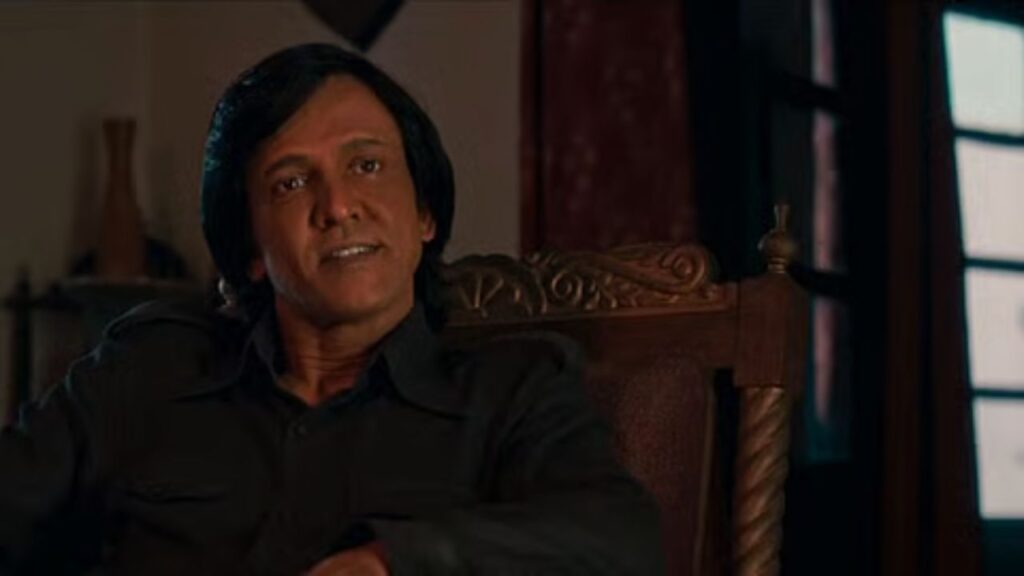

Dial 1975 has all the ingredients of a gripping political thriller: the Emergency, secret recordings, surveillance, a mysterious wireless telephone, military secrets and a morally complicated protagonist played by Kay Kay Menon.
Yet the film struggles to turn that promising setup into sustained suspense.
Directed by Navneet Behal and Vibhu Kashyap, Dial 1975 began streaming on WAVES on August 21. The film stars Kay Kay Menon, Pravessh Rana, Kirti Kulhari, the late Tom Alter, Uday Chandra and Govind Pandey.
Set against the backdrop of the Emergency, the thriller attempts to build a tense story around surveillance and the desperate fight to communicate without the state listening in. There is a strong idea buried inside the film, but the screenplay keeps adding layers until the central mystery becomes difficult to follow.
Dial 1975 Movie Review: A Fascinating Premise That Never Reaches Its Potential
The biggest strength of Dial 1975 is also its biggest missed opportunity.
The film takes us back to one of the most politically tense periods in India’s modern history and builds its story around something that sounds deceptively simple: a wireless telephone that could allow an influential politician to communicate with his allies without being monitored.
That idea immediately creates possibilities.
A government trying to control information. People attempting to communicate secretly. Recordings that could expose powerful individuals. A device capable of changing the balance of power.
There is enough material here for a tightly constructed conspiracy thriller.
Unfortunately, Dial 1975 spends too much time moving between characters, motives and subplots instead of allowing the central tension to breathe.
What could have been a sharply focused story about surveillance and political paranoia gradually becomes a complicated web of people chasing the same information for completely different reasons.
The Emergency Setting Gives Dial 1975 Its Best Atmosphere
The Emergency backdrop is one of the film’s most interesting elements.
Rather than treating the period simply as historical decoration, Dial 1975 attempts to create an atmosphere in which secrecy and mistrust are part of everyday life.
The production design helps establish that world.
There is a constant feeling that conversations can be overheard, information can disappear and the wrong person discovering the wrong secret can have serious consequences.
The early portions benefit considerably from this atmosphere.
The problem is that the screenplay does not maintain the same level of control once the various characters and their objectives begin colliding.
What Is Dial 1975 About?
The story begins with Govind, played by Kay Kay Menon, a soldier who was court-martialled during the 1962 Indo-China War after killing his own comrades.
Years later, during the Emergency, Govind crosses paths with Ram Avatar, a science teacher played by Govind Pandey.
Ram Avatar has been secretly recording conversations at the instruction of Thaper, an army officer played by Uday Chandra.
During one of these recordings, Ram Avatar discovers information about a deal involving a RAW agent and a German national.
At the centre of the deal is a wireless telephone intended for an influential politician.
The information immediately becomes dangerous.
Thaper wants the recording recovered before it reaches the wrong hands. He turns to Irish, played by the late Tom Alter, a jailer tasked with dealing with the situation.
Meanwhile, Govind learns about the secret recording and the money involved.
He kills Ram Avatar and begins his own pursuit of the tape and the deal money, hoping to use the information against the government and the army.
Irish eventually approaches Prakash, played by Pravessh Rana, who is behind bars.
Prakash is released and sent to retrieve the tape.
What initially looks like a straightforward recovery mission soon becomes considerably more complicated.
Where Dial 1975 Starts Losing Its Grip
The first act creates enough curiosity to keep you invested.
You want to know what is on the tape.
You want to understand why the wireless telephone matters so much.
And you want to know what Govind intends to do with the information.
But as the film progresses, the number of moving pieces increases without receiving enough narrative clarity.
The thriller repeatedly introduces new motivations and connections.
Instead of making the mystery more exciting, this sometimes makes it harder to understand exactly where the story is heading.
There is a difference between a complicated thriller and a confusing one.
Dial 1975 occasionally crosses that line.
When Complexity Replaces Suspense
A thriller does not necessarily become more suspenseful simply because it has more characters, secrets and twists.
Suspense comes from making audiences understand what is at stake and then forcing them to wait for the consequences.
Dial 1975 is strongest when it keeps things simple.
A character has something dangerous.
Someone else wants it.
The consequences of losing it are enormous.
Those moments work.
But the film repeatedly moves away from that clean tension and dives deeper into its network of subplots.
As a result, the audience can find itself spending more energy keeping track of the plot than worrying about what happens next.
That is particularly unfortunate because the Emergency setting provides such a naturally tense environment.
Kay Kay Menon Remains the Film’s Biggest Asset
Kay Kay Menon is one of the few performers who can make morally complicated characters compelling even when the screenplay does not provide enough depth.
His Govind is no conventional hero.
The character has a violent past, questionable motivations and an agenda that keeps shifting as the story develops.
Menon gives him the required menace and unpredictability.
There is always a sense that Govind could make a decision that completely changes the situation.
However, the screenplay does not give him enough emotional or psychological material to turn the character into something truly memorable.
Menon has previously delivered remarkable work in films dealing with political tension and the Emergency era, including Hazaaron Khwaishein Aisi.
Compared with that film, Dial 1975 feels considerably less interested in exploring the internal world of its characters.
Pravessh Rana and the Supporting Cast
Pravessh Rana brings sincerity to Prakash, a character who becomes increasingly important as the story develops.
His transition from prisoner to someone caught in a dangerous mission gives the film an opportunity to create a more personal emotional thread.
But once again, the screenplay moves too quickly between the different strands of the narrative.
Govind Pandey’s Ram Avatar makes an impression despite limited screen time, while Uday Chandra’s Thaper brings the required authority to his role.
The late Tom Alter is also a notable presence as Irish.
The ensemble is capable, but the writing does not consistently give these performances enough space to register.
The Film Looks Better Than It Holds Together
Visually, Dial 1975 understands the period it is trying to recreate.
The locations, costumes and production design contribute to the sense of a country where communication itself has become dangerous.
There is an appropriately restrained visual language in several sequences.
The film does not need extravagant set pieces to establish its world.
A room, a telephone, a recording device or a guarded conversation can become threatening when the atmosphere is right.
This is where the film shows flashes of what it could have been.
Unfortunately, the screenplay rarely sustains that tension for long.
Does Dial 1975 Work as a Political Thriller?
Partially.
The film certainly has the ingredients of a political thriller, and its Emergency setting gives the narrative an inherent sense of danger.
The idea of people trying to communicate privately in a heavily controlled environment is compelling.
But the film is more successful at establishing the possibility of suspense than delivering it consistently.
The political backdrop is interesting, the performances are dependable and the premise is strong.
The problem lies in execution.
Dial 1975 Movie Review: Final Verdict
Dial 1975 is a frustrating watch because there is a genuinely interesting thriller hiding inside it.
The Emergency-era setting works.
The idea of a secret wireless telephone is intriguing.
The performances, particularly Kay Kay Menon’s, keep the film watchable.
And the opening portions create enough mystery to make you expect a tightly wound conspiracy thriller.
But the screenplay gradually becomes overcomplicated, introducing more narrative threads than it can effectively develop.
The result is a film that has the atmosphere of a political thriller without consistently delivering the suspense of one.
For viewers interested in period thrillers and stories about political surveillance, Dial 1975 may still be worth exploring.
For those expecting a tightly plotted, edge-of-the-seat conspiracy drama, however, the film may feel like a missed opportunity.
FAQs
1. Is Dial 1975 worth watching?
Dial 1975 is worth considering for viewers who enjoy political and period thrillers. Its Emergency-era setting, performances and premise are compelling, although the complicated screenplay affects the overall impact.
2. What is Dial 1975 about?
The film is set during the Emergency and revolves around a secret recording and a wireless telephone that could allow an influential politician to communicate without state surveillance.
3. Who stars in Dial 1975?
The film stars Kay Kay Menon, Pravessh Rana, Kirti Kulhari, Tom Alter, Uday Chandra and Govind Pandey.
4. Who directed Dial 1975?
Dial 1975 is directed by Navneet Behal and Vibhu Kashyap.
5. Where can I watch Dial 1975?
Dial 1975 began streaming on WAVES on August 21.