









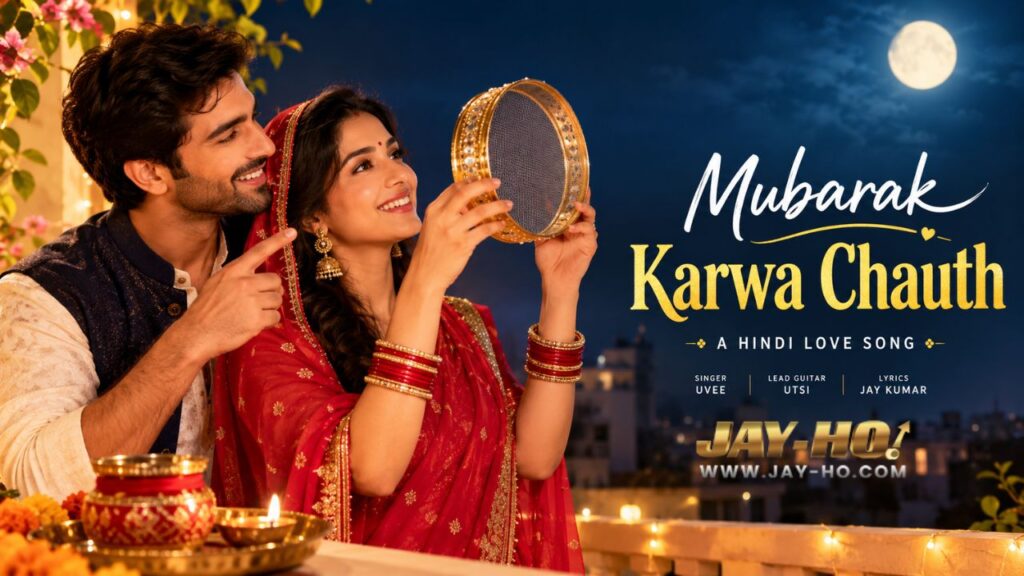

On most evenings, “I can’t see the moon” is an observation. On Karwa Chauth, it becomes the husband’s next assignment.
He checks the window, climbs to the roof, and peers between buildings. Meanwhile, the WhatsApp group keeps delivering evidence that the moon has appeared everywhere except above his house.
Then inspiration strikes.
“NASA ya Google pe chaand dikha doon?”
“Na karo bakwaas.”
Somewhere between her devotion and his disastrous suggestion, there is a love song.
Jay-Ho!’s “Mubarak Karwa Chauth” finds it. With vocals by Uvee, lead guitar by Utsi, and lyrics by Jay Kumar, this romantic Hindi Karwa Chauth song brings together festive warmth, everyday humour, and a couple whose affection comes through even when they disagree.
The opening scene is imagined. The conversation, however, may sound suspiciously familiar.
Romance After the Wedding Album
Many love songs begin with the first glance. This one begins with two people who already know each other’s expressions.
She can recognize an impractical idea before he finishes explaining it. He knows her reply is final, but will probably try one more suggestion anyway.
That familiarity gives “Mubarak Karwa Chauth” its charm.
The song draws romance from the small responsibilities of being together: noticing someone’s discomfort, taking their wishes seriously, and staying involved when an evening requires more patience than expected.
Its husband has jokes, but he also has a job to do. His wife is waiting for the moon, and he intends to find it.
The guitar-led festive sound gives these exchanges an easy rhythm before returning to the greeting at the heart of the song:
मुबारक हो तुम्हें
हाँ मुबारक करवा चौथ
It is a refrain made for singing to someone—a greeting that carries affection without requiring a grand speech.
Is Karwa Chauth India’s Answer to Valentine’s Day?
The comparison is understandable. Both occasions can inspire gifts, photographs, special clothes, and expressions of love.
Yet Karwa Chauth has its own identity. Calling it India’s “answer” to Valentine’s Day makes a distinct tradition sound as though it needs another celebration to explain its relevance.
UCLA’s MANAS cultural resource describes Karwa Chauth as an observance in which married Hindu women pray for their husbands’ welfare and longevity, with fasting, storytelling, and moon-sighting among its practices. These religious and family dimensions extend beyond a general celebration of romance.
The emotional connection is easier to appreciate than the comparison.
For couples who observe it, Karwa Chauth can create an occasion to acknowledge their shared life. Its meaning may include faith, family memories, personal choice, and affection—all within the same evening.
There is room for different expressions of love on the calendar. What matters within any celebration is the care people show each other.
That is where this song places its attention. The husband participates because the moment matters to his wife. His contribution includes companionship, a little comedy, and considerable sky inspection.
Through the Channi, a Shared Life
The opening lines move from a familiar ritual image to a more reflective thought:
चन्नी से चाँद देखा
पढ़ लिया ज़िंदगी का लेखा
“Zindagi ka lekha” evokes life’s account: its memories, experiences, adjustments, and promises.
Within the song, looking through the channi becomes a moment of recognition. A shared life contains far more than its photographs—the ordinary mornings, difficult decisions, private jokes, and disagreements that eventually become family stories.
The lyric gathers that history into a brief romantic image.
Then comes the hook’s mischievous reassurance:
कभी न आए तुम्हारी ज़िंदगी में सौत
The song is sung from the husband’s perspective. He is reassuring his wife that she will never have a co-wife or romantic rival.
It is a promise of fidelity delivered with a grin.
The line also establishes the song’s tone. This couple can express commitment through teasing. Their affection is comfortable enough to have a sense of humour.
The WhatsApp Group Has Seen It First
The first verse brings the observance into a contemporary household:
व्हॉट्सऐप वाले ग्रुप में
सबने चाँद दिखाया
Every notification raises expectations. Someone sends a photograph. Someone announces success from another city. Someone supplies advice that would be useful only if the couple could relocate immediately.
The husband’s NASA-and-Google suggestion follows a certain logic: if everyone is sharing the moon on a screen, perhaps a screen can resolve the matter.
His wife’s response makes the distinction clear. An image is available; her observance still needs to be completed.
Then the song adds a particularly good family detail:
ना मैं ना मेरी सास
ऐसे तोड़ें उपवास
Wife and mother-in-law are firmly united. The husband’s proposal has failed to attract a single vote.
The humour works because the situation is recognizable. Technology has made it easier to share the waiting. It has done very little to hurry the moon.
The Search Becomes the Love Story
The next verse gives the husband’s efforts their own momentum:
पहले खिड़की से चाँद ढूँढा
फिर छत पे जा के चाँद ढूँढा
He searches through clouds, around trees, and between tall buildings.
The recurring “chaand dhoonda” makes the passage easy to join. Each repetition adds another attempt, and you can picture him changing position with the determination of someone convinced that the next angle will solve everything.
Then the verse reveals why the search matters:
जब वो मिला तो जान में जान आई
भूखी सी आँखों में मुस्कान आई
His relief arrives with her smile.
That detail gives the scene tenderness. He has been trying to help someone he loves complete something meaningful to her. When the waiting ends, the relief belongs to both of them.
Why a Shared Laugh Belongs in a Love Song
The song’s humour has a fitting connection to relationship research.
In a 2015 study, University of North Carolina at Chapel Hill researchers Laura Kurtz and Sara Algoe examined 71 romantic couples discussing how they first met. Shared laughter was associated with greater closeness, relationship quality, and perceived support. The study identified an association, rather than proving that laughter causes stronger relationships.
It is a useful observation alongside this song because the comedy comes from something the couple experiences together.
The husband’s shortcut, the wife’s reply, and the increasingly determined moon search give listeners small moments of recognition. You may remember a similar exchange. Your partner may remember it differently.
Either way, there is probably a story.
“Mubarak Karwa Chauth” leaves space for that personal connection. Its characters are specific enough to feel real and familiar enough for listeners to find themselves in the scene.
A Glass of Water, Then an Unexpected Renewal
The romantic verse brings the focus back to a simple gesture:
पानी का गिलास पकड़ के
मैं पास तुम्हारे आया
The attention behind the action gives it meaning. He has noticed her effort and is ready when she needs him.
The next lines turn her gaze into a romantic compliment:
चन्नी के उस पार से
तुमने मुझे चाँद बनाया
For a moment, he becomes the person she sees as special.
The thought feels earned because the song has already allowed him to be an ordinary husband—with imperfect ideas and a sincere desire to help.
Then, just as the evening becomes tender, the bridge produces its most unexpected comparison:
आज फिर मेरी लाइफ इंश्योरेंस
रिन्यू करा दी
The traditional wish for a husband’s long life meets the language of annual household paperwork.
It is an affectionate joke, acknowledging her prayer for his well-being through a wonderfully ordinary metaphor. The surprise gives the line its smile: after the mehendi, the channi, and the moon, nobody was expecting an insurance renewal.
A Festive Song to Share With Your Partner
Uvee’s vocals carry the husband’s perspective through the teasing exchanges and quieter moments, while Utsi’s lead guitar contributes to the song’s bright, festive character.
The conversational lyrics keep the story moving. The repeated greeting gives listeners something easy to remember and sing together.
That makes Jay-Ho!’s “Mubarak Karwa Chauth” a natural companion for getting ready, sharing a festive message, or waiting outside as the evening’s moon updates arrive.
Play it for your partner. See which line earns the first smile.
And should the moon take its time, at least the soundtrack is ready.
मुबारक हो तुम्हें,
हाँ… मुबारक करवा चौथ!