




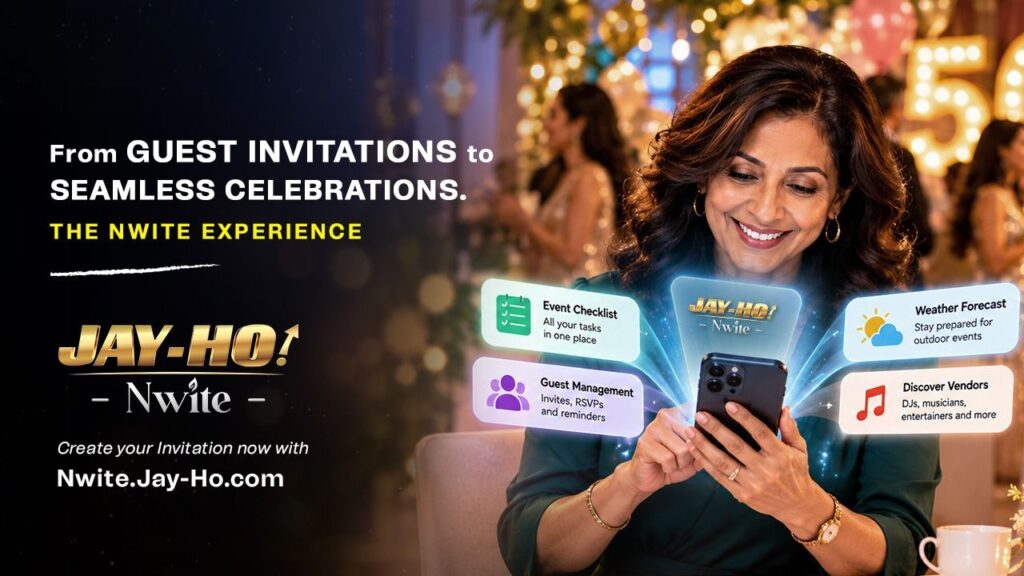

As digital invitations become commonplace, Nwite by Jay-Ho! is tackling a less obvious problem: the fragmented experience of organizing a private celebration. Its approach brings guest communication, RSVP management and event coordination into one connected experience, with more intelligent planning tools on the horizon.
A birthday invitation takes minutes to send. Organizing the birthday can take weeks.
Consider a woman planning her 50th birthday celebration. She has 120 people on her guest list, a venue to finalize, a caterer waiting for an accurate headcount, a DJ to coordinate and several friends who have promised to respond but haven’t.
The invitation was shared two weeks ago. Responses are scattered across WhatsApp conversations, text messages and phone calls. Some guests have confirmed for two people, others for four. A few have changed their plans. Meanwhile, the host is maintaining a spreadsheet, checking her calendar and mentally tracking a growing list of unfinished tasks.
She has no shortage of digital tools. In fact, she is using too many of them.
And therein lies an interesting technology problem.
We have made sending invitations remarkably easy, but the work that follows an invitation remains surprisingly disconnected.
That gap is what Nwite, a private-event invitation and planning platform developed by Jay-Ho!, is attempting to address.
Rather than treating the invitation as the finished product, Nwite treats it as the beginning of a larger experience — one that continues through guest responses, communication, preparation and eventually the celebration itself.
It is a relatively simple idea, but one with implications for how everyday events could be organized.
The Real Problem Isn’t Creating Invitations. It’s Managing What Happens Next.
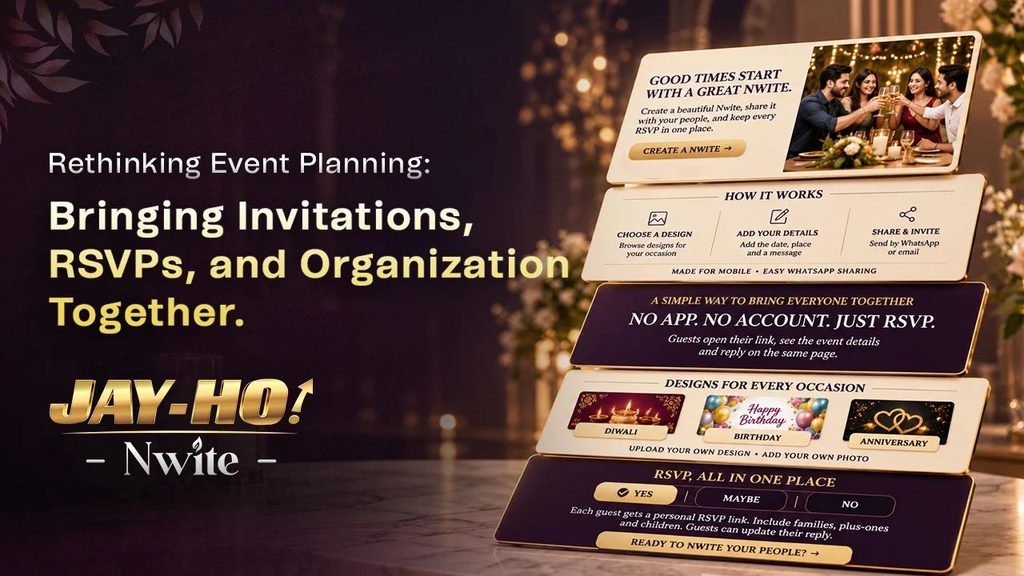
Digital invitation platforms have existed for years. Evite, Paperless Post and newer social-event platforms have helped move invitations away from printed cards and into email, messaging and mobile-friendly experiences.
The category has evolved from static invitation designs to RSVP tracking, event pages and guest communication.
Yet the typical private-event workflow still extends beyond any single invitation.
An organizer may use one application to create the invitation, another to communicate with guests, a spreadsheet to count attendees, a notes application to manage tasks and separate conversations to coordinate vendors.
Each tool may work perfectly well on its own.
The problem is that information does not necessarily move between them.
A guest changing an RSVP can affect the catering count. A venue change may require notifying everyone. An approaching deadline can create several dependent tasks. A weather forecast can determine whether an outdoor arrangement remains practical.
These are connected decisions, but hosts frequently manage them as separate activities.
From a software-design perspective, this is a problem of fragmented workflows and disconnected information.
The opportunity is not necessarily to invent another tool. It is to reduce the amount of coordination required between tools.
That distinction is central to Nwite’s product philosophy.
Why the Timing Makes Sense
The broader digital environment makes this an interesting moment to rethink personal-event planning.
According to Pew Research Center’s 2026 research on mobile device ownership, approximately 91% of U.S. adults own a smartphone, compared with 35% when Pew began tracking smartphone ownership in 2011.
Digital communication is no longer confined to younger audiences. Smartphone ownership now extends across most age groups, including 79% of adults aged 65 and older.
This matters because private celebrations often involve multiple generations. An invitation platform has to serve the person organizing the event as well as guests with very different levels of comfort using technology.
The most successful experience is not necessarily the one with the greatest number of features. It is the one that requires the least effort to understand and use.
Research source: Pew Research Center, Americans’ Use of Mobile Devices in 2026.
For Nwite, this creates both an opportunity and a design challenge: make event management powerful enough to be useful, but simple enough for an ordinary family gathering.
From Commercial Events to Personal Celebrations: The Thinking Behind Nwite
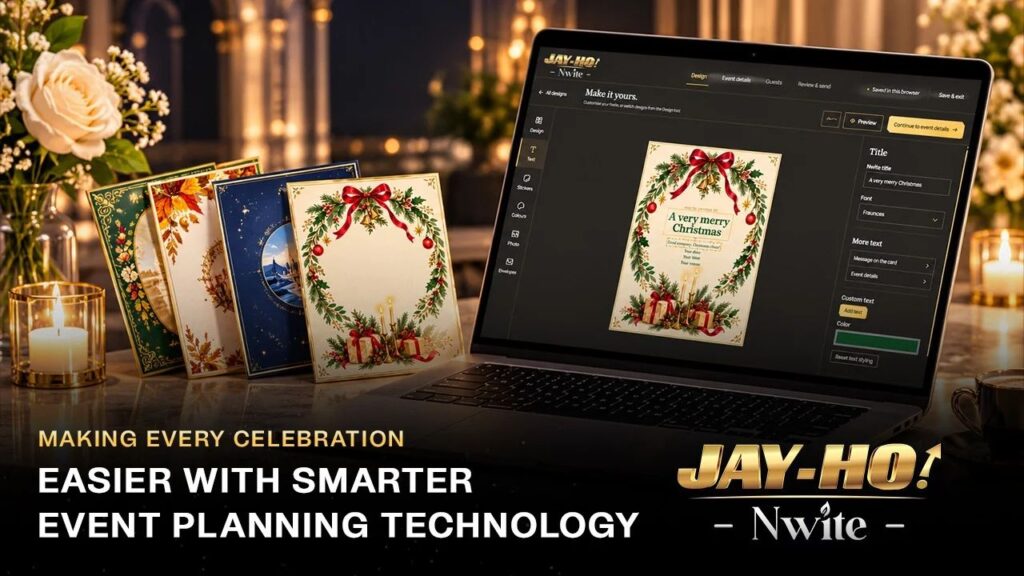
Nwite comes from Jay-Ho!, an entertainment, event-promotion and technology ecosystem that has worked with concerts, theatre productions, cultural programs and community events.
Through its ticketing and event-management activities, Jay-Ho! has encountered the operational challenges that organizers face when bringing audiences together.
Managing a theatre production with more than a thousand attendees is fundamentally different from arranging a family birthday party. The financial stakes, staffing requirements and logistics are not comparable.
But certain underlying problems are remarkably similar.
Both require accurate information, reliable communication, an understanding of attendance and coordination before the event begins.
The insight behind Nwite was that some of the organizational thinking used in professional events could be adapted to everyday celebrations.
Not by making a birthday party feel like a commercial production, but by removing unnecessary administrative work from the hosting experience.
Jay-Ho!’s longstanding philosophy, “Where Art, Innovation & Technology Converge to Create Experiences,”provides a useful framework for this approach.
Art shapes how an invitation looks and feels. Innovation challenges the way people traditionally organize gatherings. Technology connects the information and processes that make the experience work.
Nwite brings those elements into a product built specifically for private events.
Jay Kumar on the Problem Worth Solving
For Jay Kumar, Founder of Jay-Ho!, the motivation behind Nwite extends beyond entering the digital invitation market.
“We’ve spent years helping organizers bring people together through concerts, theatre and cultural events. During that journey, I realized that many of the challenges we solve for large events also exist in our own homes.
We have technology for almost everything today, yet someone planning a birthday or anniversary still has to move between messages, guest lists, reminders and multiple applications to organize one celebration.
That made me think: why can’t we bring these things together in a simple, beautiful experience?
Our philosophy at Jay-Ho! has always been ‘Where Art, Innovation & Technology Converge to Create Experiences.’ With Nwite, we’re applying that thinking to personal celebrations.
I don’t want technology to replace the personal touch of hosting. I want it to take care of the repetitive work so people have more time for each other.“
— Jay Kumar, Founder, Jay-Ho!
The distinction between replacing human interaction and supporting it is important.
A successful celebration is inherently social. The technology behind it should be useful without becoming the center of attention.
The Dashboard Approach: Turning Scattered Information Into Something Useful
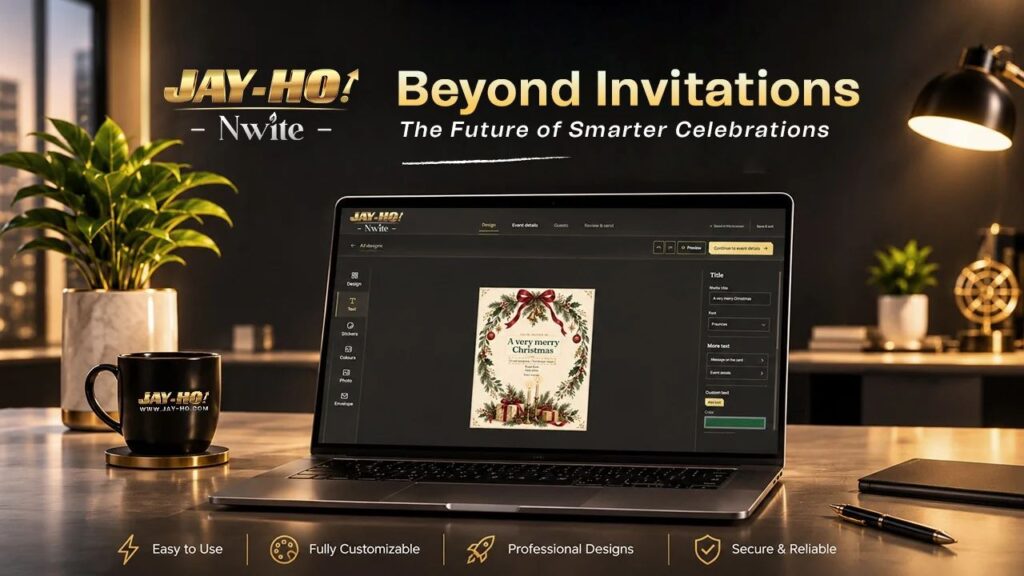
Nwite’s most interesting proposition is its organizer dashboard.
Instead of presenting the invitation as an isolated digital card, the platform connects it to the event’s operational information.
The dashboard provides visibility into guest responses, invitations, event details, reminders and activity.
Consider the fictional 50th birthday celebration introduced earlier.
The host has invited 120 guests. Of those, 86 have confirmed, 18 have yet to respond, 10 have declined and six remain undecided.
Those figures are illustrative, but they demonstrate a practical point.
A guest list containing 120 names does not necessarily tell the organizer how many people to expect.
A dashboard showing response categories makes the information more useful.
The organizer can identify guests who have not responded, review participation and make decisions with a clearer understanding of attendance.
Nwite also supports guest-list management, reminder actions and exporting guest information, allowing organizers to work with the information beyond the original invitation.
The technical principle is straightforward: information should be captured once and made useful wherever it is needed.
This reduces the need to reconstruct the same guest information from multiple conversations.
For the user, the benefit is convenience.
For a product designer, the interesting part is the relationship between data and workflow.
Why an Event Checklist Is More Important Than It Sounds
Checklists are not particularly glamorous. They are also among the most practical tools for coordinating complex activities.
Event planning involves a series of related decisions, many of which depend on others.
A caterer needs an estimated attendance figure. Seating arrangements depend on guest responses. Decorations depend on the venue. Entertainment requires timing, space and sometimes equipment arrangements.
A checklist can help turn those loosely connected responsibilities into a more manageable process.
Nwite’s broader planning vision includes a comprehensive event checklist that can guide organizers through preparations for different occasions.
For a milestone birthday, that could mean tracking venue confirmation, invitations, catering, decorations, music, cake arrangements, photography and guest reminders.
For a housewarming, the requirements would be different. A baby shower, family reunion or outdoor anniversary celebration would have its own priorities.
The opportunity lies in creating checklists that are relevant to the occasion rather than presenting every organizer with the same generic set of tasks.
The more interesting long-term possibility is connecting those tasks with event information.
For example, a catering-related task could become more meaningful when viewed alongside the number of confirmed guests. A reminder task could be linked to people who have not responded.
This is the difference between a digital to-do list and a more integrated planning system.
The former stores tasks. The latter has the potential to provide useful context around them.
Nwite’s comprehensive checklist experience remains part of its developing product vision, with the goal of making everyday event planning more structured and less dependent on memory.
Weather Forecasting: A Small Integration With Practical Consequences
Among the features planned for Nwite is an integrated weather forecast.
At first glance, weather may seem like a minor addition to an invitation platform.
For outdoor events, however, it can be a significant planning variable.
A birthday in a backyard, a graduation celebration on a lawn or an anniversary dinner on a patio may require alternative arrangements if conditions change.
Today, hosts typically check the weather separately and then decide whether they need a tent, heaters, additional shade or an indoor backup.
Integrating weather information into the event dashboard would bring that decision closer to the rest of the planning process.
There is also a reason to design such a feature carefully.
The U.S. National Oceanic and Atmospheric Administration explains that five-day weather forecasts are accurate approximately 90% of the time, while seven-day forecasts are accurate about 80% of the time. Forecasts extending ten days or longer are considerably less reliable.
Source: NOAA — How Reliable Are Weather Forecasts?.
That means a responsible event-planning feature should not simply display a long-range forecast as a certainty.
It should help hosts understand when the information becomes useful for making decisions.
For Nwite, the planned integration opens up possibilities for a more context-aware planning experience, particularly if weather conditions can eventually inform relevant checklist items.
The weather forecast integration is under development and is not yet a live Nwite feature.
One Platform, Different Kinds of Gatherings
Private events do not follow a single pattern.
A 30th birthday celebration may involve a restaurant reservation, music and a relatively small guest list.
A 50th birthday may require a venue, catering, entertainment and a more structured guest-management process.
A Diwali gathering might involve multiple families, children and traditional food arrangements. A Christmas dinner may require different preparation. A wedding-related function or family reunion introduces yet another set of requirements.
This diversity creates an interesting product challenge.
How do you build one platform without forcing every occasion into the same workflow?
The answer may lie in providing a common foundation — event details, invitations, guest information and communication — while allowing planning requirements to vary by occasion.
Nwite is pursuing this broader approach.
Its roots in culturally diverse community events also offer a useful perspective. Traditions differ, but the underlying need to invite, communicate and organize is widely shared.
The platform’s opportunity therefore extends beyond any one community or festival.
From Private Celebrations to Community Fundraising
Another dimension of Nwite is its ability to accommodate gatherings with purposes beyond social celebrations.
The platform is being used for Operation Elf Fundraiser 2026, organized by Team Monadnock, an initiative that brings people together around a charitable cause.
Unlike a birthday invitation, a fundraising event may involve financial contributions, sponsorships or paid participation.
Nwite’s organizer dashboard includes capabilities for tracking supported ticket and fundraising transactions, along with related event activity.
This expands the platform’s potential use cases while demonstrating an important design consideration.
Not every event requires payment collection. Not every event requires donations. Not every event needs the same planning tools.
A flexible event platform should make relevant functionality available without unnecessarily complicating simpler gatherings.
That balance will be important as Nwite evolves.
Beyond RSVPs: The Possibility of a Connected Event Ecosystem
Nwite’s longer-term roadmap extends into services that hosts frequently need while planning celebrations.
These may include access to entertainers, DJs, musicians, karaoke performers, magicians and other event-related vendors.
The opportunity is not merely to create a directory.
A connected event-planning ecosystem could eventually make it easier for organizers to move from identifying a requirement to finding an appropriate service provider.
For instance, a host planning a birthday might create an event, manage invitations and later explore entertainment options without beginning an entirely separate search.
Such functionality would require careful execution, including service discovery, communication and reliable coordination between hosts and providers.
These capabilities remain part of Nwite’s future direction rather than its fully available feature set.
Nevertheless, they reveal the larger ambition behind the platform: to connect activities that are currently handled through unrelated services.
The Product-Design Challenge: Simplicity Is Harder Than Adding Features
There is an important risk in building an all-in-one platform.
The more functionality a product offers, the easier it becomes to overwhelm its users.
Someone planning a small dinner does not need the same dashboard as a person organizing a 150-guest anniversary party.
An invitation platform should not require people to learn professional event-management software simply to invite twenty friends.
That creates a fundamental design challenge for Nwite.
The platform needs to be sophisticated behind the scenes while remaining approachable for ordinary users.
Guest responses should be easy to understand. Important actions should be visible. Unnecessary options should stay out of the way.
And guests should not have to navigate a complicated process merely to tell a host whether they are attending.
This is where product quality will ultimately be measured.
Not by the number of features listed on a website, but by how naturally those features fit into the experience of planning an event.
The real test will be whether Nwite can reduce coordination effort without creating new complexity.
Why This Is an Interesting Problem for Technologists
From a technology perspective, Nwite is exploring a familiar but meaningful opportunity: turning a fragmented collection of activities into a connected workflow.
The value of an integrated platform is not automatically created by placing several features on the same screen.
It comes from the relationships between those features.
An RSVP is not merely a response. It can inform attendance estimates.
Attendance information is not merely a number. It can help guide catering and seating decisions.
An event date is not merely a calendar entry. It can provide context for reminders, deadlines and weather planning.
A checklist is not merely a list of tasks. It can become more useful when connected to the event’s changing circumstances.
These relationships offer opportunities for smarter event software.
They also raise important questions about usability, data accuracy, privacy and the reliability of automated information.
For Nwite, the challenge will be to build useful connections between event information while keeping the experience simple, transparent and trustworthy.
That is a more substantial technology proposition than creating another collection of attractive invitation templates.
It is also a problem worth solving because it affects a familiar human activity: bringing people together.
How Nwite Works Today — and Where It Is Heading
Nwite currently provides a digital event experience through which hosts can create event pages, share invitations, manage guest responses and review event activity.
Organizers can use its dashboard to understand participation and take actions such as sending reminders or managing guest information.
The broader product roadmap includes comprehensive planning checklists, integrated weather forecasting and access to event-related service providers.
The distinction between current functionality and planned capabilities is important.
Nwite is an evolving platform, and its success will depend not only on its vision but also on the reliability and usefulness of the features delivered.
Users can explore the platform at nwite.jay-ho.com.
The Bigger Idea: Technology That Makes Room for Human Connection
The technology industry often measures progress through speed, automation and efficiency.
But some of the most meaningful applications of technology are less dramatic.
They make ordinary activities easier.
They reduce unnecessary effort.
They help people spend less time coordinating and more time participating.
A birthday party may not appear to be a major technology challenge. Yet the process of organizing one involves communication, changing information, multiple decisions and several people working toward the same outcome.
That makes it an interesting problem in its own right.
Nwite’s ambition is to address that problem without losing sight of why people organize celebrations in the first place.
The goal is not to turn every birthday into a professionally managed production.
It is to make the planning process sufficiently organized that the host can enjoy the occasion.
For Jay-Ho!, the move from large public events into private celebrations is therefore more than a product expansion. It is another application of the belief that has shaped its work:
Where Art, Innovation & Technology Converge to Create Experiences.
The art is in the celebration. The innovation is in rethinking the process. The technology is what helps bring everything together.
And if Nwite succeeds, its greatest achievement may be something its users barely notice.
They will simply spend less time managing their celebrations — and more time enjoying them.
Explore Nwite by Jay-Ho!: nwite.jay-ho.com
FAQs
1. What is Nwite by Jay-Ho!?
Nwite by Jay-Ho! is a digital invitation and private-event planning platform designed to help hosts create event pages, share invitations, manage guest responses and organize event information in one place.
2. What can you do with Nwite?
Hosts can create digital event pages, send invitations, manage guest lists, track RSVPs, send reminders and review event activity through an organizer dashboard.
3. Does Nwite offer RSVP management?
Yes. Nwite allows organizers to track guest responses and review attendance information, helping them understand who has confirmed, declined or is yet to respond.
4. Can Nwite help manage guest lists?
Yes. The platform supports guest-list management, reminder actions and the ability to export guest information, making it easier to organize event participation.
5. What types of events can Nwite be used for?
Nwite is designed for private celebrations and gatherings, including birthdays, anniversaries, housewarmings, baby showers, family reunions and community events.