











Daayra, starring Prithviraj Sukumaran and Kareena Kapoor Khan, explores the conflict between institutional justice and vigilante action through two police officers with opposing philosophies. While Prithviraj delivers a restrained and impactful performance and Kshitee Jog stands out as the grieving mother, the film’s central moral conflict remains underdeveloped, making its climactic confrontation less effective than expected.
Daayra Movie Review: An Important Question At Its Core
Daayra takes up a difficult question: where does the pursuit of justice end and revenge begin?
The Meghna Gulzar directorial begins with a police encounter that has already turned DCP Raman Kumar into a celebrated figure. Raman and his team claim to have eliminated four men accused of raping and killing 24-year-old Ragini Poojari.
However, the circumstances surrounding the encounter soon come under scrutiny. The operation was not quite what it initially appeared to be, and a subsequent investigation raises questions about Raman’s methods and the boundaries of police power.
An SIT is formed to investigate the encounter, with DCP Ajooni Kohli placed in charge.
That setup gives Daayra a potentially compelling foundation: two police officers operating within the same system but holding dramatically different beliefs about how justice should work.
Prithviraj Sukumaran And Kareena Kapoor Khan Represent Two Ideas Of Justice
Raman believes that justice sometimes requires decisive action beyond conventional legal procedures. Ajooni, meanwhile, places her faith in the judicial process and insists that the police cannot become the law themselves.
Their disagreement becomes the film’s central dramatic engine.
The contrast is especially interesting because neither character exists in a vacuum. Ajooni’s belief in the judiciary is partly shaped by a personal tragedy involving her father, a retired judge who was shot on court premises.
That background gives her position emotional context. However, the film does not explore this thread deeply enough to make it as influential to her character as it could have been.
Similarly, Raman’s history and motivations could have been examined with greater complexity. The film establishes his philosophy quite clearly, but rarely forces him into situations where his convictions genuinely begin to crack.

Daayra’s Biggest Problem Is Its Lack Of Moral Ambiguity
The central idea behind Daayra is strong, but the writing does not always push it far enough.
Raman and Ajooni essentially represent two opposing positions from the outset. One trusts immediate action; the other trusts institutional procedure.
For a story built around such a complicated subject, the film could have benefited from greater uncertainty. Instead, the characters remain relatively fixed in their respective positions.
This reduces the tension because viewers are not constantly forced to reconsider who is right, what justice actually means or where the line should be drawn.
The film raises those questions, but does not always allow them to evolve organically through the characters.
Prithviraj Sukumaran Is The Standout
Prithviraj Sukumaran gives the film its most consistently compelling performance.
As Raman, he avoids excessive theatricality and plays the character with restraint. His anger is rarely expressed through conventional outbursts. Instead, it sits beneath the surface, particularly when he encounters indifference from within the police system.
That controlled approach makes Raman feel more grounded than a conventional larger-than-life cop character.
The film also deserves credit for not turning either of its central officers into invincible action heroes. Despite the stylised introductions, Raman and Ajooni largely operate within a recognisable police environment.
Kareena Kapoor Khan Gets A Less Developed Character
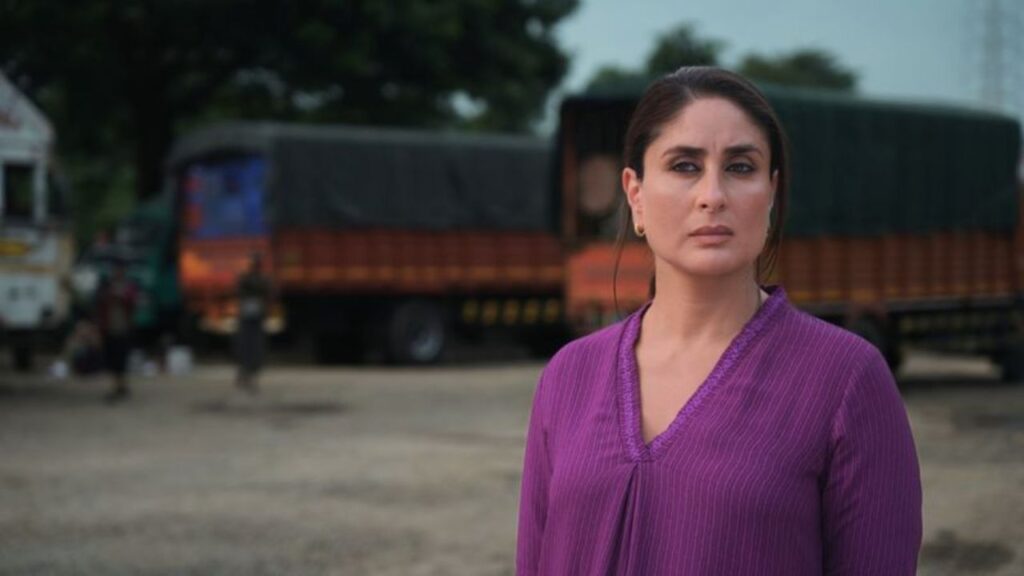
Kareena Kapoor Khan is effective as Ajooni, but the writing gives her comparatively less to work with.
While Raman receives considerable attention, Ajooni’s characterisation feels thinner. Her personal history, professional philosophy and emotional motivations are introduced but not explored with the same depth.
This creates an imbalance between the two protagonists.
One recurring element is Ajooni’s smile, which seems designed to suggest that there is something hidden beneath her composed exterior. It creates an expectation of a larger revelation, but the eventual payoff does not fully justify that setup.
The Final Confrontation Doesn’t Match The Build-Up
The biggest disappointment comes when Raman and Ajooni finally confront each other.
Given everything the film has established, their face-off should have been the moment when the competing ideas of justice collided most forcefully.
Instead, the sequence feels relatively restrained.
The problem isn’t that the confrontation lacks noise or spectacle. Rather, it doesn’t deliver enough dramatic or philosophical impact. The film spends considerable time setting up the ideological conflict, but the final exchange doesn’t push those ideas to their most challenging conclusion.
As a result, the ending feels less powerful than the premise promises.
Kshitee Jog Leaves A Strong Impression
Among the supporting cast, Kshitee Jog makes a particularly strong impact as Ragini’s mother.
She brings considerable emotional depth to a woman dealing with grief, fear, anger and helplessness. Her performance is restrained but deeply affecting, allowing the character’s pain to emerge without excessive melodrama.
Her scenes provide some of the film’s most emotionally grounded moments.
Daayra Review: Final Verdict
Daayra has the foundation of a compelling investigative drama. Its questions about revenge, justice, police power, institutional faith and media trials are relevant and potentially rich enough to support a much more layered film.
The performances, particularly Prithviraj Sukumaran’s, help keep the film engaging. Kshitee Jog is another standout.
However, the film’s central ideological conflict remains more clearly presented than deeply explored. The characters are positioned on opposite sides, but they are not challenged enough to create genuine moral uncertainty.
That ultimately affects the climax. Daayra asks big questions, but its answers and dramatic payoff don’t always carry the same weight as its premise.
Daayra Review: Key Details
| Category | Details |
| Film | Daayra |
| Director | Meghna Gulzar |
| Lead cast | Prithviraj Sukumaran, Kareena Kapoor Khan |
| Genre | Investigative drama |
| Central theme | Justice vs revenge |
| Prithviraj’s character | DCP Raman Kumar |
| Kareena’s character | DCP Ajooni Kohli |
| Supporting standout | Kshitee Jog |
| Language | Hindi and Malayalam |
| Release | September 18, 2026 |
FAQs
What is Daayra about?
Daayra is an investigative drama centred on two police officers who have opposing views about justice, law and the use of force.
Who stars in Daayra?
The film stars Prithviraj Sukumaran and Kareena Kapoor Khan in the lead roles, with Kshitee Jog also playing an important part.
Who directed Daayra?
Daayra is directed by Meghna Gulzar.
What role does Prithviraj Sukumaran play in Daayra?
Prithviraj plays DCP Raman Kumar, a police officer who believes in taking a more aggressive approach to justice.
What role does Kareena Kapoor Khan play in Daayra?
Kareena plays DCP Ajooni Kohli, an officer who places greater faith in the judicial system and the rule of law.