











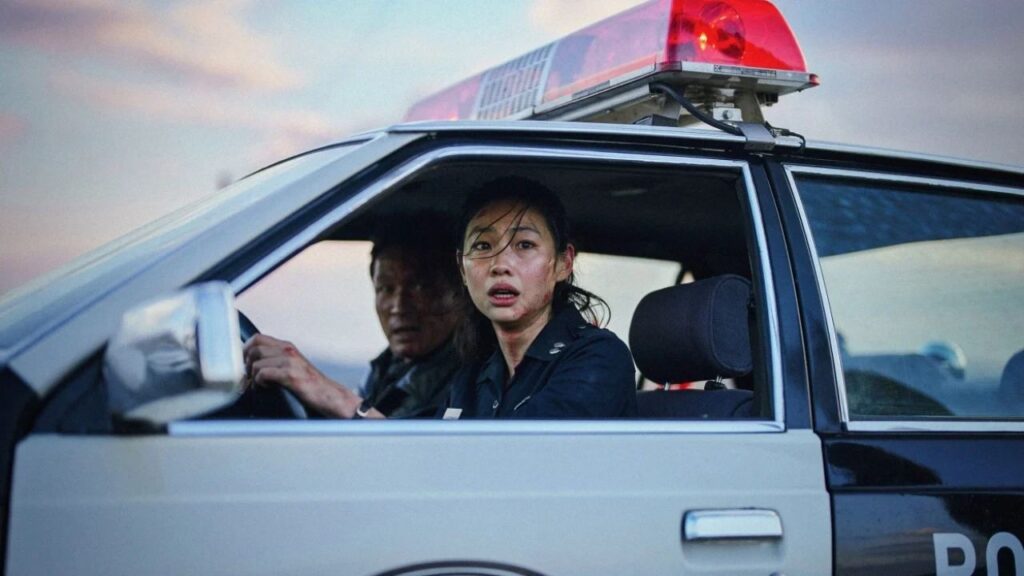

Na Hong-jin returns with Hope, a genre-bending Korean creature feature blending science fiction, horror, action and comedy. Hwang Jung-min and Jung Ho-yeon impress, but uneven pacing and sketchy characterisation weaken the 160-minute film. Its visual audacity remains a highlight.
Hope Movie Review: A Korean Town Faces an Unimaginable Threat
In Hope, even a sleepy Korean township near the Demilitarised Zone cannot enjoy a quiet day without an unidentified creature turning the neighbourhood into a demolition site. Director Na Hong-jin returns after a decade-long absence with a film that begins like a rural mystery before spiralling into an unpredictable battle involving strange creatures, terrified residents and increasingly desperate attempts to survive.
The opening establishes an atmosphere of unease through a mutilated animal, baffled hunters and a community struggling to understand what is happening around them. Hwang Jung-min plays Bum-seok, the local police chief, whose responsibilities quickly expand beyond ordinary law enforcement. When the threat grows, conventional policing offers little help against something that appears to have arrived from beyond the familiar world.
Zo In-sung plays Sung-ki, a hunter drawn into the unfolding crisis, while Jung Ho-yeon portrays Sung-ae, a rookie police officer caught in the middle of the escalating danger. Their characters must navigate confusion, fear and violence as the situation becomes increasingly difficult to control.
What initially appears to be an investigation soon erupts into vehicular mayhem, explosive confrontations and grotesque encounters. Na brings together science fiction, horror, action and broad comedy, often shifting between these modes with little warning. The result is a film that refuses to remain within the boundaries of a conventional alien-invasion thriller.
Na Hong-jin’s Unpredictable Approach to Science Fiction
One of the film’s most distinctive choices is its handling of suspense. Rather than immediately revealing the nature of the threat, Na allows the audience to experience the characters’ uncertainty. The early scenes rely on strange discoveries, unexplained destruction and anxious reactions to create tension.
This gradual build-up gives the film an unsettling quality. The residents are not prepared for what they encounter, and their limited understanding makes every new development feel potentially dangerous. The absence of clear answers also encourages viewers to question whether the apparent threat is as straightforward as it first seems.
When the revelations begin to emerge, Hope moves beyond a simple story of humans fighting monsters. Its central conflict becomes more complicated, introducing questions about prejudice, fear and the instinct to destroy whatever appears unfamiliar. The creatures are not merely devices for generating action; their presence challenges the assumptions of the people confronting them.
That shift gives the film some of its most interesting material. The human characters may see themselves as defenders protecting their community, but their responses reveal aggression, self-interest and an eagerness to turn uncertainty into hostility. The distinction between survival and unnecessary violence becomes increasingly difficult to ignore.
However, the film does not always explore these ideas with the same precision that it brings to its imagery. Its thematic ambitions are evident, but certain developments arrive amid so much action that their significance can feel less fully developed than intended.
Hwang Jung-min and Jung Ho-yeon Anchor the Chaos
Hwang Jung-min provides an important grounding presence as Bum-seok. Playing a police chief confronted with an extraordinary crisis, he conveys the strain of a man attempting to maintain control when the rules governing his world no longer seem reliable. His performance helps connect the film’s outrageous events to the practical concerns of a community under pressure.
Jung Ho-yeon brings energy to Sung-ae, whose position as a rookie officer places her in a particularly difficult situation. She must respond to events that challenge both her professional responsibilities and her understanding of the danger surrounding her. Her presence adds urgency to the film’s human perspective.
Zo In-sung’s Sung-ki contributes to the increasingly frantic struggle, particularly as the characters are forced to respond to threats that cannot be handled through ordinary methods. The ensemble works best when the film allows the characters to react to the unfolding disaster rather than pushing them immediately into another extended confrontation.
The weakness lies in character development. Some motivations and relationships receive less attention than the scale of the production demands. With so many shifting threats and tonal changes, certain characters can feel more like participants in a succession of spectacular events than fully developed individuals with compelling arcs.
The international cast includes Michael Fassbender, Alicia Vikander, Taylor Russell and Cameron Britton. Their presence adds to the film’s global profile, although the overall experience remains driven by Na’s particular blend of Korean genre filmmaking and unconventional spectacle.
A Visual Experience Filled With Grotesque Imagination
Visually, Hope is often striking. Na treats the town and its surroundings as a space where ordinary rural life can suddenly become frighteningly unfamiliar. Familiar roads, buildings and vehicles are transformed into elements of a larger nightmare, giving the destruction a tangible connection to the characters’ everyday environment.
The creature-related imagery is another major part of the film’s identity. Rather than relying exclusively on familiar alien-invasion conventions, the movie embraces grotesque encounters and unsettling revelations. This approach makes the threat feel unpredictable and reinforces the sense that the characters have entered territory they cannot fully understand.
The action sequences also reflect Na’s willingness to push situations to extremes. Chases, collisions and confrontations repeatedly disrupt the narrative, creating a sense of escalating disorder. At its best, this visual audacity gives Hope an identity that separates it from more formulaic science-fiction productions.
Yet spectacle has its limits. Some sequences continue longer than necessary, and the constant escalation occasionally reduces the impact of individual moments. When every confrontation aims to be bigger or stranger than the previous one, the film can struggle to preserve a clear sense of progression.
Where Hope Loses Its Way
At 160 minutes, Hope demands considerable patience. The first hour benefits from uncertainty and the gradual accumulation of clues, but the film becomes less disciplined as it moves deeper into its central conflict. Extended chases and repeated confrontations sometimes interrupt the narrative instead of advancing it.
The tonal shifts are equally divisive. The combination of horror, science fiction, action and comedy gives the film its distinctive character, but not every transition feels natural. A sequence designed to unsettle the audience can give way to exaggerated physical comedy, only for the film to return abruptly to disturbing imagery.
This unpredictability can be entertaining, particularly for viewers who appreciate genre films that take risks. However, it also makes emotional investment more difficult when the story does not consistently allow its dramatic moments enough room to develop.
The characterisation presents another limitation. While the main performers bring conviction to their roles, some character arcs remain sketchy. The film introduces potentially interesting conflicts but occasionally moves on before exploring their emotional or thematic consequences in sufficient depth.
A tighter edit could have strengthened the overall experience. Trimming repetitive action and giving key revelations more breathing room might have preserved the film’s sense of mystery while making its larger ideas more effective.
Is Hope Worth Watching in Theatres?
Hope is best suited to viewers who enjoy ambitious, unconventional genre cinema. Those looking for a straightforward alien-invasion film may find its tonal shifts, extended runtime and unusual narrative choices frustrating. Audiences willing to embrace a more chaotic mixture of science fiction, horror, action and comedy may find its unpredictability considerably more rewarding.
Na Hong-jin’s return is marked by visual invention and a willingness to challenge familiar genre expectations. The film’s most compelling moments emerge when its frightening creatures and spectacular destruction become part of a broader examination of human fear and hostility.
However, its ambitious ideas are not always matched by equally focused storytelling. The lengthy runtime, uneven pacing and underdeveloped character arcs prevent the film from reaching the full potential of its premise.
Final Verdict: Hope Movie Review
Hope is a strange, visually audacious and frequently unsettling creature feature that refuses to follow the usual rules of an alien-invasion thriller. Na Hong-jin combines multiple genres to create an experience that is often inventive, occasionally excessive and rarely predictable.
Hwang Jung-min and Jung Ho-yeon help anchor the escalating chaos, while the film’s grotesque imagery and unconventional approach give it a distinctive identity. Its central ideas about fear and prejudice add substance, even when the storytelling does not explore them as deeply as it could.
The result is an ambitious but uneven cinematic experience. Hope may test the patience of viewers who prefer tightly paced storytelling, but its willingness to take risks makes it a memorable option for fans of unusual science-fiction and horror films.