






How a technology-first approach is helping organizers build stronger communities, operate more efficiently, and redefine the business of live events.
The Problem We Chose to Solve
Every successful live event tells two stories.
The audience remembers the excitement, the performances, the laughter, the music, and the memories they take home. Organizers remember something very different: months of planning, negotiating artist contracts, coordinating venues, arranging travel, managing sponsors, answering attendee questions, launching marketing campaigns, handling last-minute changes, balancing budgets, and hoping everything comes together on show day.
The audience experiences a few unforgettable hours. The organizer experiences hundreds of hours behind the scenes.
At Jay-Ho!, we’ve come to believe that while the live event industry has evolved tremendously over the past decade, the technology supporting organizers has not evolved at the same pace. That realization became the starting point for Jay-Ho Amplify. But before talking about the platform itself, it’s worth understanding the problem we set out to solve.
The Economics of Live Events Have Changed
Producing a successful live event has never been inexpensive. Today, it has become significantly more challenging.
Artist fees continue to rise. Airfare, hotels, local transportation, venue rentals, insurance, security, production, catering, staffing, advertising, and payment processing all contribute to an increasingly expensive business model. Meanwhile, audiences expect better productions, smoother digital experiences, faster communication, and greater convenience than ever before.
These expectations are reasonable. The challenge is that organizers are expected to deliver more while operating under tighter financial margins. Many events that appear successful from the audience’s perspective generate surprisingly modest returns for the organizer. In some cases, even sold-out events leave very little profit after every expense has been paid.
This creates an interesting paradox: many organizers operate as commercial businesses, yet the amount of personal effort invested often resembles community service. The passion remains high, but long-term sustainability becomes increasingly difficult. The future of live events cannot depend solely on passion — it must also be supported by better business efficiency.
Trust Is the Real Currency of Live Events
Unlike many other industries, live events are built on relationships. People certainly attend because they admire an artist or enjoy a particular performance, but especially within community-driven events, another factor is equally important: they trust the organizer.
Many attendees personally know the individual or organization behind an event. They’ve attended previous programs, supported community initiatives, or simply believe in the organizer’s commitment to delivering quality experiences. Buying a ticket often represents more than purchasing admission — it represents supporting someone who has earned that trust.
Technology cannot manufacture relationships, nor should it attempt to. Authentic human connections remain one of the greatest strengths of the live event industry. Our goal is not to replace them. It is to strengthen them.
The Hidden Cost Nobody Talks About
While relationships create successful events, operations often determine whether those events become sustainable businesses.
Today’s organizers typically manage an entire collection of independent tools. One platform handles ticketing. Another sends email campaigns. WhatsApp becomes the fastest way to communicate urgent updates. SMS reminders require another service. Social media is managed separately. Digital invitations are created elsewhere. Audience data exists across multiple databases. Reports live inside different dashboards.
Each platform solves one problem. None truly understands the organizer’s complete workflow — least of all the one system that should know the most: ticketing.
Ticketing platforms know exactly who bought a ticket, which tier, when, and whether they’ve attended before. That data is arguably the richest signal an organizer has. Yet in most setups, it stops at the point of sale. To turn a buyer into a reminder, an invitation, or a personalized update, someone has to export the list, upload it somewhere else, and manually keep it in sync — again, and again, for every event.
These activities rarely appear on an event budget. Yet collectively, they consume hundreds of hours every year. Hours that could have been invested in sponsorships, partnerships, audience engagement, or creating even better experiences.
Technology should reduce operational complexity. Too often, it adds to it.
High-Touch Relationships. Low-Touch Operations.
One of the biggest misconceptions surrounding automation is that it removes the personal touch. We believe the opposite.
The live event industry will always be a relationship business. Organizers should continue spending time with sponsors, meeting artists, welcoming guests, listening to attendees, and building communities. Those interactions should always remain personal.
The repetitive work surrounding those relationships should not. Sending reminders, managing communication, organizing audience lists, scheduling campaigns, tracking engagement, and maintaining event information are precisely the kinds of activities technology should simplify.
At Jay-Ho!, we often summarize this philosophy in one sentence:
High-touch where relationships matter. Low-touch where operations repeat.
We believe that balance represents the future of successful event organizations.
A Technologist’s View of an Industry That Deserved Better Tools
Jay-Ho’s story didn’t begin with software for live events.
It began years earlier, straight out of engineering school, with a first company called KrishiUdyog.com — a bet that technology could bring order and efficiency to an industry nobody thought needed it. That first venture set a pattern that has repeated ever since: look at an industry running on habit and disconnected tools, and ask what it would look like if someone actually designed the whole workflow on purpose. Live events turned out to be the next place that question demanded an answer.
Live events entered the picture unexpectedly. What began as organizing concerts and cultural programs for the community gradually evolved into something much larger, and looking at the industry through a technologist’s lens was revealing. Why were communication tools disconnected from the ticketing data that made them necessary in the first place? Why was audience information scattered across multiple platforms? Why did organizers spend so much time on repetitive administrative work instead of the relationships that actually mattered?
We experienced the same frustrations shared by organizers everywhere: coordinating artists, negotiating venues, managing sponsors, answering attendee questions, maintaining WhatsApp groups, sending newsletters, updating social media, and constantly moving information between systems simply to keep an event running smoothly. As attendees ourselves, we saw the other side of the equation too — important updates buried in emails, shared only through messaging groups, or scattered across multiple platforms.
It became clear that the industry didn’t need another standalone application. It needed technology designed around the complete business of live events — starting from the moment a ticket is sold, not treating that moment as the end of one system’s job and the beginning of five others.
That realization became the foundation of Jay-Ho’s long-term vision, and the starting point for Jay-Ho Amplify.
Communication Is Not a Feature. It Is Infrastructure.
When most people hear the term “communication platform,” they immediately think about email campaigns. That’s only a small part of the picture.
Today’s audiences communicate through multiple channels depending on the situation. An event announcement may arrive by email. A venue update may be shared through WhatsApp. A reminder may be delivered by SMS. An invitation may arrive digitally. A highlight video may be published on social media. An attendee may receive a push notification moments before doors open. Tomorrow, entirely new channels will emerge.
The objective isn’t to build software for one channel. It’s to create a platform that intelligently manages communication regardless of where those conversations take place — and that starts from the same data your ticketing already has, instead of asking you to rebuild that picture from scratch in a separate tool.
That’s why we named it Jay-Ho Amplify. The goal isn’t simply to send messages. The goal is to amplify relationships.
This is also why we think of Amplify less as a messaging tool and more as the communication operating system for the business of live events — the layer every other tool runs on top of, rather than one more app competing for the organizer’s attention.
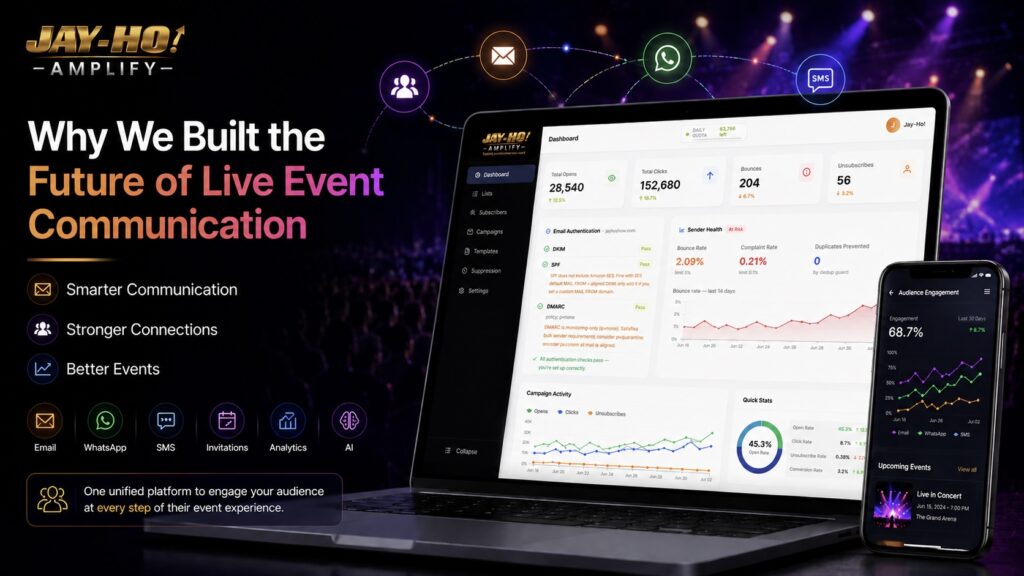
A Command Center Built on Ticketing Data
Most dashboards tell you what has already happened. We envision something different.
Picture opening one workspace where you can see ticket sales alongside communication performance in the same view — not as two reports stitched together, but as one continuous picture. A ticket sells, and the buyer is already in the right audience segment. A tier upgrade happens, and the messaging adjusts automatically. Someone checks in at the door, and the post-event follow-up knows it, without anyone exporting a spreadsheet to make that true.
That’s the difference between a communication tool bolted onto ticketing and one that was designed to sit right next to it. Organizers shouldn’t have to ask, “Which platform do I update first?” They should simply ask, “What do I want to communicate?” — and let the technology handle where that data already lives and where the message needs to go.
As additional capabilities are introduced, organizers will be able to communicate through email, WhatsApp, SMS, push notifications, in-app messaging, digital invitations, and future social integrations, all from that same unified environment — because the underlying record of who bought what, and when, never has to be recreated somewhere else.
From Campaigns to Conversations
One of the biggest limitations of traditional marketing software is that it treats every communication as a campaign. Live events don’t work that way. Every interaction builds on the previous one.
Someone may first discover an artist through a Jay-Ho article. Months later, they receive an invitation to an upcoming concert. They purchase tickets. They receive parking information before the event. They check in digitally. They watch event highlights afterward. They receive early access to the next event. They recommend the experience to friends.
Over time, that individual isn’t simply another customer. They become part of a growing community.
Jay-Ho Amplify is designed around this philosophy. Every interaction should strengthen the relationship instead of beginning from scratch — and the reason it can is that the ticketing record and the communication history are the same record, not two databases someone has to reconcile by hand.
Artificial Intelligence Should Support Organizers, Not Replace Them
Artificial intelligence is changing every industry. Live events will be no exception. We believe AI should enhance human decision-making rather than replace it.
Within Jay-Ho Amplify, artificial intelligence can help organizers draft campaigns, recommend communication timing, identify audience segments, automate repetitive workflows, predict engagement, and surface insights that would otherwise require hours of manual analysis — insights that are only possible because the underlying ticketing and communication data already live together.
Technology handles the repetitive work. Organizers remain focused on creativity, partnerships, sponsorships, artists, and community. That balance is essential.
Looking Beyond Today
Jay-Ho Amplify isn’t being built for today’s communication channels alone. Today it may include email, WhatsApp, SMS, digital invitations, and push notifications. Tomorrow it may integrate with additional social platforms, emerging messaging tools, and interfaces that don’t yet exist.
The channels will continue to evolve. The organizer’s objective will not: build trust, keep audiences informed, strengthen relationships, and grow communities. Technology should adapt around those goals — not force organizers to adapt around technology.
This is also why we think about Amplify as part of a connected foundation rather than a standalone product. When ticketing and communication are designed together from the start, an organizer isn’t maintaining separate customer records across separate systems — they’re building one increasingly clear picture of their audience, event after event.
Why We Believe This Matters
Jay-Ho didn’t build Amplify because the world needed another marketing platform. We built it because we experienced firsthand how difficult it is to operate a modern live event business using disconnected technology — where the platform that knows your audience best, your ticketing system, has historically had the least to say about how you talk to them.
Every product we develop begins with the same question: Does this help organizers spend more time creating extraordinary experiences and less time managing software?
If the answer is no, we go back to the drawing board.
We don’t believe the future of live events will be defined by who sells the most tickets. We believe it will be defined by who helps organizers build sustainable businesses, strengthen communities, operate intelligently, and create experiences that people genuinely want to return to.
Jay-Ho Amplify is one important step toward that future — not because it sends messages, but because it represents a different way of thinking about the business of live events: one where ticketing and communication were never meant to be separate in the first place.
That’s the idea behind calling it the communication operating system for the business of live events. Not another app. Not another dashboard. The layer everything else runs on — so every innovation serves one purpose: helping organizers focus on people instead of processes.