






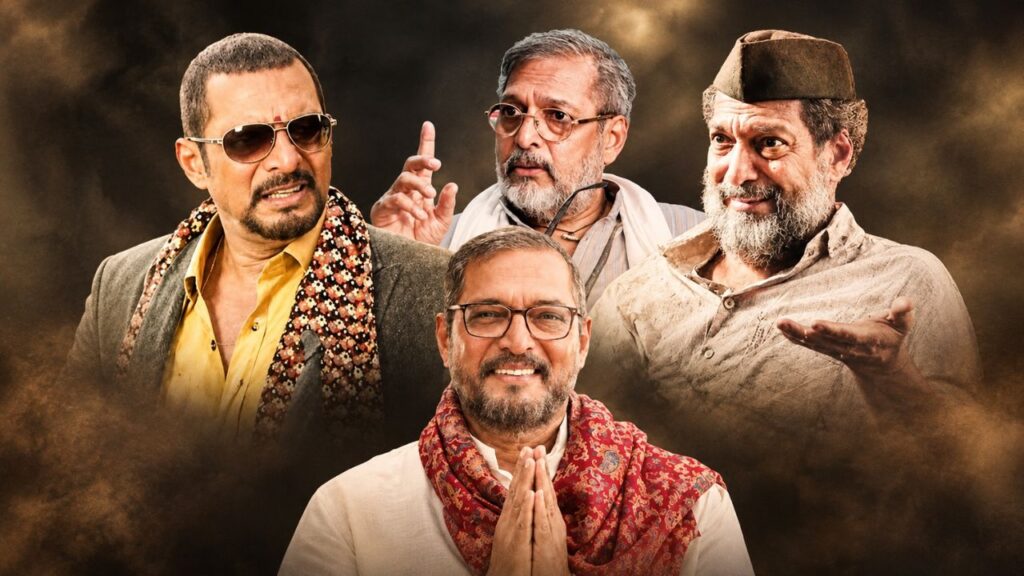

Nana Patekar died at 75 on October 8, 2026, after a cardiac arrest in Goa. His nearly five-decade career produced unforgettable performances across Hindi and Marathi cinema. From the social anger of Krantiveer and Yeshwant to the comedy of Welcome, his distinctive voice and delivery made his film dialogues instantly recognizable.
Why were Nana Patekar’s dialogues so memorable?
Nana Patekar made dialogue delivery part of the performance itself.
His pauses, changes in pitch, facial expressions and controlled aggression could turn an ordinary sentence into a defining cinematic moment. His most memorable scenes also covered an unusually wide emotional range.
He could sound furious, vulnerable, threatening or hilarious without losing his distinctive screen presence.
That versatility is why his dialogue moments continue to circulate long after the films themselves were released.
1. Yeshwant — the “mosquito” monologue
One of Nana Patekar’s most remembered performances came in Yeshwant (1997).
The scene uses a mosquito as a striking metaphor for how something seemingly insignificant can undermine a person’s sense of power and dignity.
Patekar delivers the passage with mounting frustration. The force of the performance comes from his ability to turn an everyday image into a larger criticism of social helplessness.
The scene remains one of the clearest examples of why Patekar’s delivery was as important as the words themselves.
2. Krantiveer — his attack on religious division
KrantiVeer (1994) gave Patekar one of his most politically charged performances.
In one of the film’s defining scenes, his character challenges the idea that blood can be identified by religious identity. The argument reduces a divisive social question to a basic point about shared humanity.
Patekar’s delivery is forceful because the character is not making a quiet observation. He is confronting an entire mindset.
The scene remains one of the most discussed examples of his ability to combine social commentary with dramatic intensity.
3. Krantiveer — the confrontation with death
Another memorable Krantiveer moment comes when Patekar’s character confronts people watching his apparent final moments.
The scene transforms fear into defiance. Instead of appearing defeated, the character challenges the people gathered around him.
This performance captures a quality that became central to Patekar’s screen image: characters who refuse to surrender even when circumstances turn against them.
The film’s political anger and Patekar’s delivery worked together to make these scenes particularly enduring.
4. Welcome — wealth, status and the search for a suitable son-in-law
Patekar showed a completely different side of his dialogue skills in Welcome (2007).
As Uday Shetty, he combined menace with comic timing. One of his best-known scenes begins with a proud inventory of everything his character believes he has achieved, before turning toward his personal frustration about finding the right match for his family.
The humour comes from the contrast.
Uday is introduced as a feared gangster, yet his concerns increasingly resemble those of an anxious family man.
That contradiction helped make the character one of Patekar’s most beloved comic performances.
5. Ghulam-E-Musthafa — a character defined by menace
Ghulam-E-Musthafa (1997) allowed Patekar to return to the darker side of his screen persona.
One of the film’s remembered lines revolves around the idea that life cannot simply be demanded as though it were a commodity.
The scene reflects the character’s hardened worldview and his understanding of violence, survival and power.
Patekar’s restrained intensity made even relatively short exchanges feel threatening.
6. Ab Tak Chhappan 2 — intimidation through dark humour
Patekar returned as a formidable police character in Ab Tak Chhappan 2 (2015).
A particularly memorable scene uses graphic humour to establish the threat posed by his character. The writing is deliberately provocative, but Patekar’s delivery gives it its impact.
His performance demonstrates another strength: he could make an outrageous line sound completely natural within a character’s world.
That quality was central to his appeal in crime dramas.
7. Welcome Back — turning marital frustration into comedy
Patekar’s comic range continued in Welcome Back (2015).
In one memorable passage, his character jokes about the contradictions surrounding marriage, including the way spouses can simultaneously complain about each other and express concern for each other’s wellbeing.
The humour comes from exaggerating familiar domestic frustrations.
It was a very different register from the angry performances associated with Krantiveer or Yeshwant, yet Patekar remained immediately recognizable.
8. Natsamrat — a quieter and more vulnerable Patekar
Natsamrat (2016) revealed perhaps the most emotionally vulnerable side of Patekar’s acting.
As Appasaheb Belvalkar, a retired theatre performer facing loneliness and family conflict, Patekar moved away from the explosive delivery associated with some of his Hindi films.
The film is rooted in ageing, memory, regret and the emotional cost of losing one’s place in the world.
Even the use of Shakespearean language in the performance reflected the character’s theatrical identity.
Patekar’s work in Natsamrat demonstrated that his voice could communicate pain just as effectively as anger.
The range behind Nana Patekar’s most famous dialogues
His dialogue legacy becomes clearer when the performances are viewed together.
| Film | Year | What made the dialogue memorable |
|---|---|---|
| Krantiveer | 1994 | Social anger and moral confrontation |
| Yeshwant | 1997 | Frustration with ordinary life and powerlessness |
| Ghulam-E-Musthafa | 1997 | Menace and survival |
| Welcome | 2007 | Comic timing and character contradiction |
| Ab Tak Chhappan 2 | 2015 | Dark humour and intimidation |
| Welcome Back | 2015 | Domestic comedy and exaggeration |
| Natsamrat | 2016 | Vulnerability, ageing and emotional pain |
The list also shows why reducing Patekar’s legacy to a handful of viral lines would miss the larger story.
His most important contribution was the way he inhabited dialogue.
Nana Patekar made delivery as important as the words
Many actors have delivered memorable lines. Patekar developed a delivery style that audiences could recognize within seconds.
His voice could become rough and confrontational, then suddenly quiet. He often used pauses to increase tension rather than rushing toward the next sentence.
That technique gave his characters an unpredictable quality.
It also explains why clips from films released decades ago continue to circulate on social media after his death. Contemporary tributes have again highlighted performances from Krantiveer, Yeshwant, Welcome and other films.
From intense drama to comedy, Patekar never stayed in one register
Patekar’s dialogue legacy is unusual because it crosses genres.
His intense performances made him synonymous with anger, authority and moral confrontation. His work in Welcome proved that the same performer could become a major comic attraction.
His Marathi work added another dimension, particularly through Natsamrat.
That range is arguably more important than any individual quotation.
Nana Patekar did not simply deliver famous dialogues; he gave each character a distinct rhythm, temperament and emotional weight.
Nana Patekar’s dialogue legacy will outlive the lines themselves
Nana Patekar’s death marks the loss of an actor whose performances became part of popular Indian cinema.
The memorable moments from his films are still quoted, referenced and remembered, but their real value lies in the performances surrounding them.
Whether he was confronting corruption, playing a hardened criminal, navigating an absurd family situation or portraying an ageing theatre legend, Patekar brought conviction to the screen.
That is why his most famous dialogue scenes remain memorable even when audiences remember the emotion before they remember every word.
His legacy is not simply a collection of famous lines. It is a body of performances in which voice, silence, anger, humour and vulnerability became inseparable from the characters he played.
Frequently Asked Questions
Which are Nana Patekar’s most famous dialogues?
His most remembered dialogue performances include scenes from Krantiveer, Yeshwant, Welcome, Ghulam-E-Musthafa, Ab Tak Chhappan 2, Welcome Back and Natsamrat.
Which Nana Patekar film has the famous mosquito dialogue?
The widely remembered mosquito metaphor comes from Yeshwant (1997), where Patekar uses it during a larger speech about powerlessness and everyday life.
Which Nana Patekar film features his famous religious-unity dialogue?
The well-known scene about religious identity and blood appears in Krantiveer (1994), where his character challenges communal divisions.
What was Nana Patekar’s most famous comic role?
Uday Shetty in Welcome (2007) became one of Nana Patekar’s most popular comic performances, particularly because he combined gangster-like menace with family-related humour.
Why were Nana Patekar’s dialogues so popular?
His distinctive voice, pauses, expressions and emotional intensity made his dialogue delivery highly recognizable across dramatic, crime and comedy roles.