







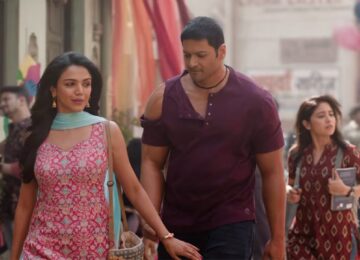
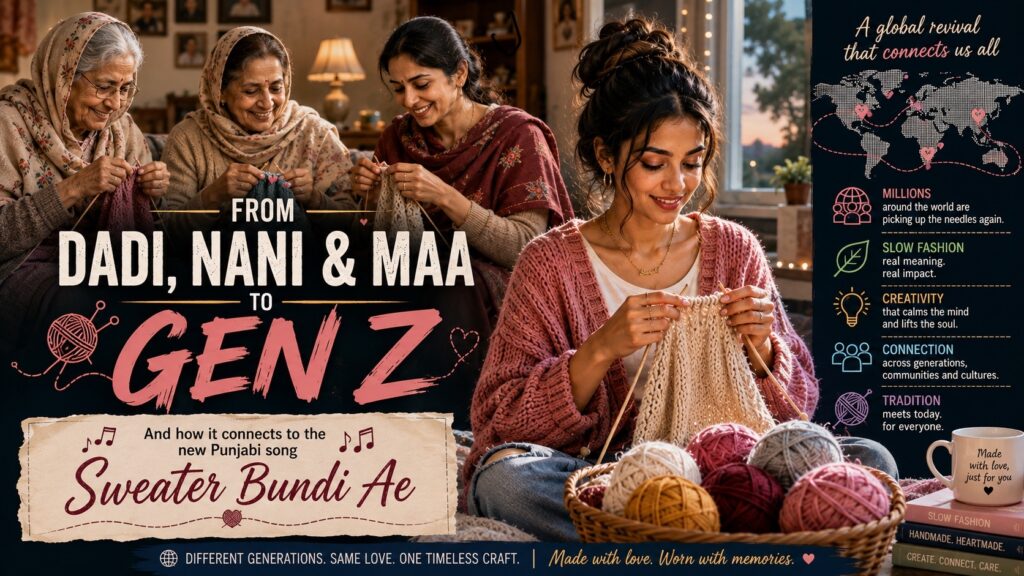

From Maa, Dadi and Nani’s hand-knitted winter sweaters to Gen Z’s fascination with slow craft, Sweater Bundi Ae by Jay Ho finds a contemporary Punjabi romance inside a tradition still practiced by millions around the world.
What does a pair of knitting needles have to do with Gen Z, digital overload, slow fashion and a new Punjabi love song? Surprisingly, quite a lot.
For generations of Indians, particularly those growing up in colder parts of the country, knitting was once an ordinary part of winter at home. Wool would appear, needles would come out, and a sweater would gradually take shape in the hands of Maa, Dadi, Nani, an aunt or someone else in the family. As inexpensive ready-made clothing became widely available and lifestyles changed, that familiar scene became less common. It was easy to assume that hand knitting was simply disappearing with the generation that practiced it.
The numbers tell a more complicated story.
One recent commercial market analysis estimated that more than 65 million people worldwide participated in knitting or crochet in 2024, with participation estimated to have increased by approximately 12 percent compared with 2020. There is no official global census of knitters and crocheters, and no reliable worldwide count of people specifically wearing hand-knitted sweaters, so the figure should be understood as an industry estimate rather than an official population statistic. Even with that qualification, the scale is remarkable.
More surprising still is who is rediscovering these crafts. Across India and elsewhere, knitting, crochet and other fibre arts are finding an audience among younger people, including Gen Z — a generation raised with smartphones, reels, instant shopping and fast fashion.
Somewhere between those two worlds — the sweater Maa once knitted at home and the handmade piece a young woman chooses to create today — lives the idea behind Sweater Bundi Ae.
A Punjabi Romance Begins With Knitting Needles
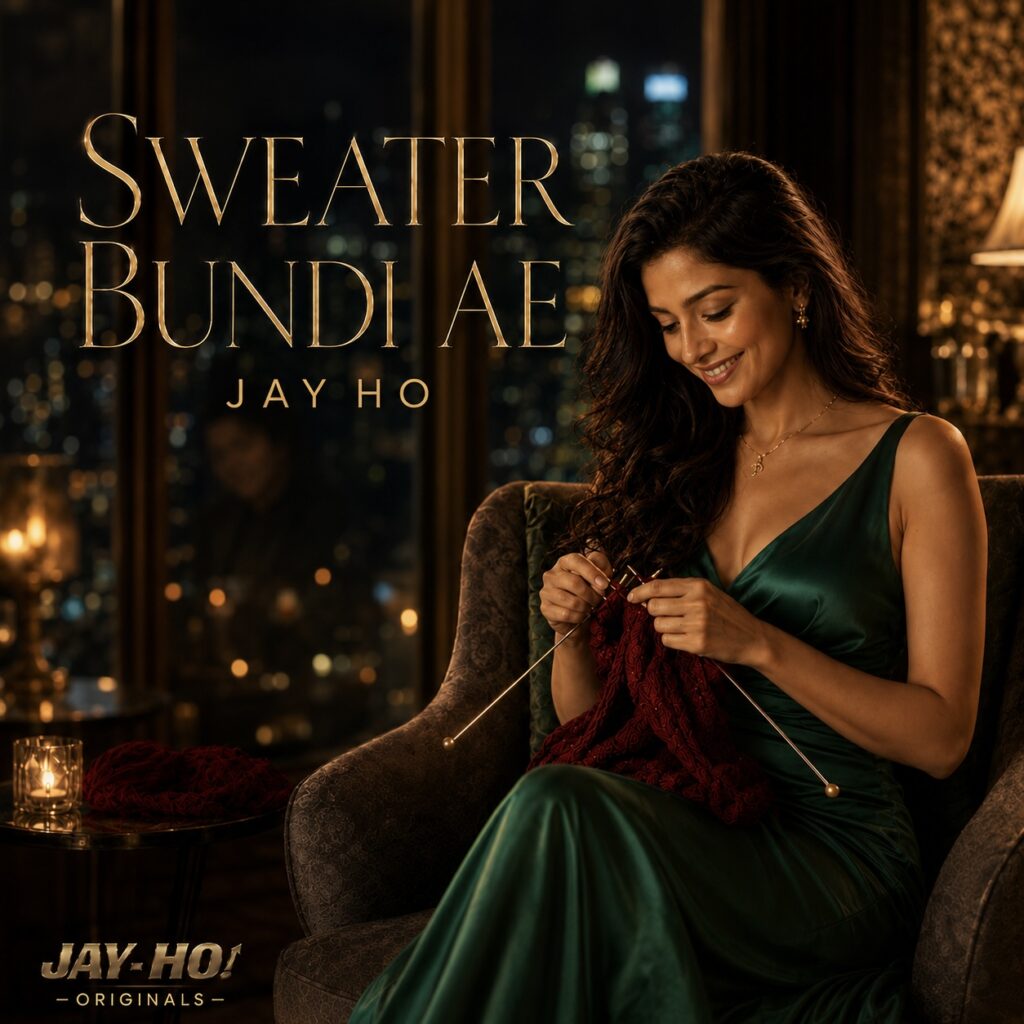
Sweater Bundi Ae, a song by Jay Ho, is written by Jay Kumar and sung by Punjabi singer Manak Saheb, with music arranged by Mike F. The song is produced by Jay Ho and released under Jay Ho Originals.
Its romantic setting is deliberately simple. On a quiet evening, a young woman sits near a window surrounded by colorful wool. She looks through the different shades and chooses the color she knows he likes. As her knitting needles move, she carefully counts the loops while occasionally stealing a glance toward him.
Then the ball of wool rolls away from her and comes toward him.
It is a tiny moment, but it establishes the personality of the song. The man is not simply waiting for his sweater to be finished; he is watching the person making it. He notices her concentration, her smile, the movement of her hands and the glances that reveal what neither person has yet needed to say directly.
The song captures the scene in its central lines:
Salaiyaan vich dhaaga paa ke
Hassdi hassdi hath chalaundi ae
Dhaage dhaage pyaar bundi ae
Jadon oh sweater bundi ae
As the sweater begins to take shape, she needs to check whether it fits. She comes closer to take his measurements, then measures him again. She places the unfinished sweater against his shoulders and looks from top to bottom to check the length.
Perhaps every measurement is necessary. Perhaps measuring has become a convenient excuse to come a little closer.
The song leaves that question unanswered, allowing an ordinary domestic scene to acquire the lightness of a romantic comedy.
India Knew This Scene Very Well
For many Indian families, particularly in northern India, this image carries an immediate cultural memory. Hand-knitted sweaters, mufflers, caps and children’s clothing were once familiar winter possessions. Making them at home could be economical and practical, but the process also became part of family life.
Ready-made clothing changed that equation. Factory-produced sweaters became inexpensive, fashionable and easily available. Families became busier, and fewer people had either the need or the time to make winter clothing at home. In its traditional domestic form, knitting became considerably less visible.
Yet declining necessity did not mean the end of the craft.
During the pandemic, India’s hand-knitting yarn industry experienced an unexpected surge. The Tribune reported in 2021 that the sector grew approximately 15–20 percent during 2020–21, following negative growth the previous year. Industry representatives attributed much of the increase to people taking up knitting as a hobby, with hobby knitters estimated at the time to represent approximately 30–35 percent of total yarn demand.
Knitting was moving from something people might once have needed to do toward something people were actively choosing to do.
Then Gen Z Entered the Story
By 2025 and 2026, Indian reporting was increasingly documenting young people embracing crochet, knitting, embroidery, tufting and other fibre crafts. Gen Z creators have been making tops, bags, flowers, accessories and home décor, attending workshops, sharing their creations online and sometimes turning their skills into small businesses.
The appeal is fascinating because it appears to contradict so many assumptions about this generation. Young people accustomed to short-form video are becoming interested in activities that can require hours of concentration. People surrounded by instant shopping are choosing to make objects slowly with their own hands. And those who spend much of their lives moving between screens are discovering hobbies that produce something physical they can actually hold.
Recent Indian coverage has described this attraction to “slow craft” partly as creativity and partly as a break from digital overstimulation. At the same time, social media has paradoxically helped the revival. Tutorials make techniques accessible to people who never learned them at home, while Instagram, YouTube and other platforms allow creators to share patterns, finished pieces and ideas with enormous communities.
A skill that once might have travelled from Dadi to Maa to daughter inside a home can now also travel from a stranger’s hands on a screen to someone learning thousands of miles away.
In May 2026, the resurgence even drew attention from India’s Union Textiles Minister Giriraj Singh, who spoke publicly about crochet and hand knitting making a comeback, linking the trend with Gen Z creators, slow fashion, demand for handmade products and economic opportunities for artisans and women entrepreneurs.
The young woman knitting in Sweater Bundi Ae, therefore, may initially remind listeners of an old family photograph. In reality, she could just as easily belong to 2026.
The Revival Goes Beyond India
The renewed interest is not uniquely Indian.
In Britain, the UK Hand Knitting Association reported that roughly one million people took up knitting during the pandemic period. An international survey conducted by Laine Publishing provides another view of the contemporary knitting community. It received responses from 4,433 knitters. Ninety-six percent of respondents used she/her pronouns, but their ages challenge the stereotype that knitting belongs exclusively to elderly women, with substantial representation across people in their thirties, forties and fifties.
Knitting’s changing audience also includes men. While women still make up a large majority of knitters in most available surveys, men are increasingly visible in contemporary knitting communities — approaching the craft through fashion, design, creativity and, sometimes, simply the pleasure of making something by hand.
British Olympic diver Tom Daley became one of the most recognizable examples after being photographed knitting between competitions, including during the Tokyo Olympics. His visibility did something useful for the craft: it challenged the assumption that knitting belongs to one gender, one age group or one generation.
Knitting had not suddenly returned from extinction. The people doing it had simply become much harder to stereotype.
Why Are People Still Knitting?
This may be the most interesting question behind the numbers.
A sweater can now be ordered online in minutes. Knitting one demands concentration, repetition and patience. A mistake can mean undoing part of the work and trying again, while a substantial project may require many hours before anything wearable emerges.
Research suggests that the process itself may explain part of its survival.
A study involving 3,545 knitters, published in the British Journal of Occupational Therapy, examined knitting in relation to personal and social wellbeing. Participants commonly associated the activity with relaxation, happiness and calmness, and more frequent knitting was significantly associated with greater reported feelings of calm and happiness. Group knitting was also connected with opportunities for social contact and communication.
Other research involving passionate knitters has identified creativity, mental engagement, identity and social connection among the recurring themes people associate with the craft.
These findings acquire particular relevance in an era of constant digital stimulation. Knitting requires a different kind of attention. The hands stay occupied, the mind follows a physical process, and progress becomes visible not as another notification or number on a screen but as an object slowly taking form.
For some younger people, an old craft may therefore be answering a very modern need.
People Are Still Making Things for Other People
Another contemporary survey brings the research particularly close to Sweater Bundi Ae.
A 2026 German survey of 2,287 adult textile-craft enthusiasts found that approximately 96 percent practiced knitting, crochet or sewing because they enjoyed doing it. Nearly 87 percent associated these activities with relaxation.
Most relevant to the song, however, was another finding: more than 80 percent made things for family members as well as themselves.
The statistic should not be misinterpreted as meaning that 80 percent of people are knitting sweaters for romantic partners. It tells us something broader: even today, making something for another person remains an important part of textile craft.
That makes the premise of Sweater Bundi Ae less nostalgic than it initially appears. Somewhere today, someone is still choosing yarn, checking measurements and making something intended for one particular person.
Then the Song Changes
Until this point, Sweater Bundi Ae can be enjoyed as a playful Punjabi romance. Then, almost without warning, watching the knitting needles opens another part of the man’s memory.
Nikke nikke hunde jadon
Maa sweater bundi si
He remembers being small and watching his mother knit sweaters. With that recollection come Dadi and Nani and the warmth associated with childhood and the women who cared for him.
The song does not equate those relationships. A mother’s love, a grandmother’s affection and romantic love occupy completely different emotional spaces. The connection is simpler and more believable: something happening in the present reminds him of something he saw long ago.
The movement of the needles is familiar. The wool is familiar. The experience of watching someone devote her time to making something specifically for him is familiar.
Years later, another person is sitting on the other end of the wool.
When Skills Become Family Memory
That emotional transition also has a broader cultural context.
Research into intergenerational textile traditions has examined how knitting, crochet, embroidery and sewing have moved through families. Older generations often learned such skills because they were useful or necessary, while younger practitioners increasingly describe creativity, enjoyment, family influence and the preservation of meaningful traditions as motivations.
Across generations, however, researchers continue to find associations between textile making and care, memory and kinship.
Traditionally, these skills were frequently taught informally. Someone watched a mother or grandmother, attempted the movement, made mistakes, received corrections and gradually learned. Today a young person may learn the same technique through an online tutorial rather than beside a family member, but the craft itself continues to move from one pair of hands to another.
That gives the Maa, Dadi and Nani section of Sweater Bundi Ae greater significance. The song is not merely nostalgic about an old piece of clothing. It captures the way an ordinary physical action can suddenly retrieve a memory that had been sitting quietly for years.
Giving an Old Image a Contemporary Punjabi Sound
For all the cultural research surrounding the idea, Sweater Bundi Ae remains first and foremost a song.
Its language is intentionally conversational and visual. The listener should be able to imagine the window, the colorful wool, the measuring, the glances, the rolling ball of yarn and the unfinished sweater without needing to see them on screen.
The musical approach follows the same idea. The subject may carry nostalgia, but the song itself does not need to sound as though it belongs to the past. Its romantic-comedy character allows the familiar image of knitting to sit inside a contemporary Punjabi musical setting.
That balance matters because Sweater Bundi Ae is not mourning a lost tradition. It is discovering that an old-looking gesture can still belong naturally in a modern romance.
The Sweater Has Its Own Story
Even the garment at the center of the song has travelled an extraordinary historical path.
The Victoria and Albert Museum traces important predecessors of the modern sweater to practical knitted garments such as guernseys or ganseys, associated particularly with fishermen who needed warm, close-fitting clothing. Knitted garments later moved into sportswear and fashion before industrial production transformed the sweater into an everyday global product.
Mass manufacturing made sweaters inexpensive, consistent and widely available. It solved the practical need so successfully that making one by hand was no longer necessary for most people.
Yet hand knitting survived.
Once necessity declined, other motivations became more visible: creativity, relaxation, individuality, tradition and the satisfaction of producing something oneself.
Two sweaters may provide exactly the same physical warmth. Their histories can nevertheless be completely different.
And Finally, She Makes This One Unmistakably His
Toward the end of Sweater Bundi Ae, the woman adds one final detail:
Seene utte sohna jeha
Jay Ho oh likhdi ae
She puts Jay Ho onto the chest of the sweater and then adds her own name a little crookedly.
That imperfection gives the image its charm. Industrial manufacturing aims for consistency: straight lettering, standardized measurements and identical products. A handmade object can carry visible evidence of the person who made it.
Her slightly crooked lettering does not need correcting. It is part of the story of this particular sweater.
There will not be another one exactly like it.
From Maa, Dadi and Nani to Gen Z
Perhaps this is where Sweater Bundi Ae becomes more than a nostalgic idea.
The knitting needles initially remind us of Maa, Dadi and Nani and of an India where handmade winter clothing was once much more visible in family life. But the story did not end when ready-made sweaters arrived. Knitting changed from necessity to choice, travelled onto social media, found new communities and acquired new meanings for a younger generation.
The tools may look familiar, but the reasons for picking them up have evolved.
For Maa or Dadi, knitting a sweater may once have been part of ordinary family life. A young woman today lives in a world of fast fashion, endless online choices and almost instant delivery. She does not have to spend hours making a sweater for someone.
And that is exactly what makes the image at the heart of Sweater Bundi Ae feel surprisingly current.
The song begins with a woman choosing wool and ends with something that could never have come off a store shelf exactly as it is. His color. His measurements. Jay Ho on the chest. Her own imperfect little signature.
The sweater may remind him of another generation.
The woman making it belongs entirely to his.
And this one was never meant for anyone else.
Here are the lyrics of Song:
Hauli hauli shaam jadon
Khidki kol oh behndi ae
Rang birange dhaageyan vichon
Meri pasand da rang chundi ae
Ikk ikk phanda gindi jaave
Chori chori takkdi ae
Rulda rulda unn da gola
Mere vall aa jaanda ae
Neevi neevi nazar ohdi
Dil vich koi raaz ae
Har phande de andar
Lukeya koi vaada ae
Salaiyaan vich dhaaga paa ke
Hassdi hassdi hath chalaundi ae
Dhaage dhaage pyaar bundi ae
Jadon ohhhhh oh
Sweater bundi ae
Vaari vaari naap oh laindi
Nede nede aaundi ae
Modhe utte rakh ke sweater
Utte thalle takkdi ae
Neevi neevi nazar ohdi
Dil vich koi raaz ae
Har phande de andar
Lukeya koi vaada ae
Salaiyaan vich dhaaga paa ke
Hassdi hassdi hath chalaundi ae
Dhaage dhaage pyaar bundi ae
Jadon ohhhhh oh
Sweater bundi ae
Nikke nikke hunde jadon
Maa sweater bundi si
Dadi nani wali narmi
Ohde hathan ch hundi si
Ajj meri sohni de hathan ch
Ohi narmi labhdi ae
Bachpan wali nighi nighi
Khushboo mud ke aaundi ae
Neevi neevi nazar ohdi
Dil vich koi raaz ae
Har phande de andar
Lukeya koi vaada ae
Salaiyaan vich dhaaga paa ke
Hassdi hassdi hath chalaundi ae
Dhaage dhaage pyaar bundi ae
Jadon ohhhhh oh
Sweater bundi ae
Seene utte sohna jeha
Jay ho oh likhdi ae
Tedha tedha apna naa likh ke
Mere dil te mohar laaundi ae
Salaiyaan vich dhaaga paa ke
Hassdi hassdi hath chalaundi ae
Dhaage dhaage pyaar bundi ae
Jadon ohhhhh oh
Sweater bundi ae
Dhaage dhaage pyaar bundi ae
Jadon ohhhhh oh
Sweater bundi ae
Naale jay ho vi kehndi ae