








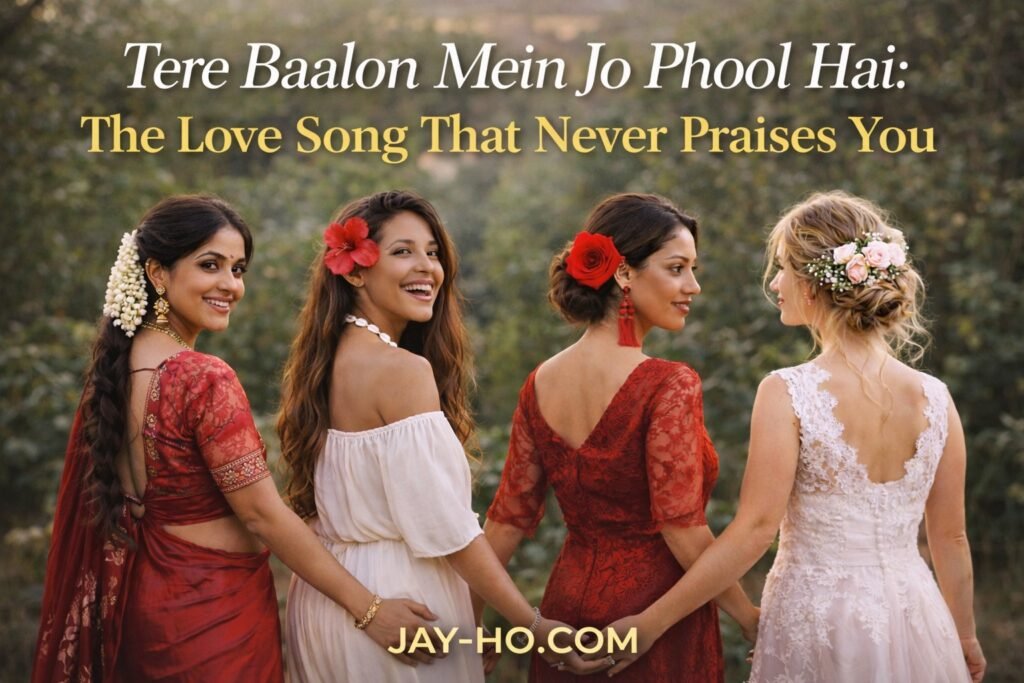

There are love songs that praise, there are songs that admire, and then there are songs that step back and let the world do the talking. “Tere Baalon Mein Jo Phool Hai” belongs to that rare space. It begins with a rule — “Apna bhi ek usool hai, Bevajah tareef karna fizool hai…” — and from that moment, the song commits to something very few romantic tracks attempt: admiration without direct compliment. What follows is not simplicity by chance, but simplicity achieved through careful thought. Every line feels effortless, yet nothing feels accidental.
A Love Song That Refuses to Compliment — Yet Says It All
The narrator chooses not to praise, but the song never feels empty. Instead, it finds a more layered way of expressing admiration. “Jab poocha hawa se… mehek aayi kidhar se, Boli… idhar idhar…” The breeze becomes the messenger, the environment becomes the narrator. This is not just poetic styling — it is a structured idea carried consistently through the song. The writer never breaks the rule he sets. Even at emotional peaks, he holds back, letting the world speak on his behalf. That restraint is where the strength lies.
The Cultural Power of Flowers in Hair

The central image — a flower in her hair — travels beautifully across cultures, as seen in the visual narrative itself. In India, the jasmine gajra reflects grace and celebration; in Hawaii, the hibiscus carries warmth, emotion, and identity; in Spain, the bold flamenco rose expresses passion and pride; and in modern bridal styling, delicate florals symbolize elegance and new beginnings. It is one of the rare symbols that feels both deeply rooted and universally understood. But the song does not use this imagery in a predictable way — it transforms it. “Jo chhoo le tujhe dhool bhi, Pal mein phool sa ho jaaye…” Here, beauty is not being compared, it is being created. She doesn’t resemble a flower; she becomes the reason flowers exist. That shift — from comparison to transformation — is subtle, but it completely redefines the emotional depth of the song.
Reverse Compliment — A Rare Narrative Choice
Most romantic songs rely on direct admiration. This one avoids it entirely. Instead of describing her, it builds a world that responds to her. This reverse compliment approach is not just creative — it demands discipline. Because once that path is chosen, there is no room for conventional lines. The song has to stay within its idea from beginning to end. And it does. “Main kya bolun… sab phool yeh keh rahe…” Even here, the narrator steps back. The admiration remains indirect, yet stronger.
Simplicity That Comes from Precision
What stands out is how natural everything feels. There is no excess, no forced cleverness, no unnecessary complexity. Each line flows into the next with clarity and ease. But that ease is the result of refinement. It reflects decisions — what to keep, what to remove, how much to say, and when to stop. The song never tries too hard, and that is exactly why it works.
Musically Alive, Not Just Pleasant
The composition supports this idea with equal clarity. Instead of turning into a soft, drifting acoustic track, the song carries energy. A strong rhythmic guitar drives the movement, supported by a tight groove that keeps the listener engaged. The arrangement feels full without being heavy, and dynamic without being distracting. The guitar work by Utsav Gambhir adds character and flow, making the song feel like something you don’t just hear — you feel and almost play along with.
Voice That Understands the Idea
Uvee’s vocal delivery aligns perfectly with the writing. There is confidence, but also control. The voice does not try to oversell emotion. It lets the lines land naturally, allowing the idea to come through clearly. That balance between expression and restraint is what keeps the song grounded.
The Writer Steps In — Seamlessly
Only later does the voice behind the writing reveal itself. Penned by Jay Kumar, the song carries a signature that blends into its philosophy: “Jay-Ho ne jo ghazal likhi, Usmein rang tere hi hain…” Even here, the compliment remains indirect. It is not about describing her — it is about acknowledging her influence.
Why This Song Stands Out
“Tere Baalon Mein Jo Phool Hai” may feel simple on the surface, but it is built on detailed thought, strong control, and a clear creative vision. It avoids easy paths, stays consistent with its idea, and balances emotion with restraint. In doing so, it creates something rare — a song that feels natural, yet carries depth. Some songs speak loudly. Some stay quietly. This one does both in its own way. It doesn’t announce its brilliance — it lets you discover it. And that is what makes it last.
Below is the YouTube link for “Tere Baloon Mein Jo Phool Hai”:
Below are the lyrics of “Tere Baloon Mein Jo Phool Hai”
Apna bhi ek usool hai
Bevajah tareef karna fizool hai
Jab poocha hawa se, mehek aayi kidhar se
Boli… idhar idhar…
Tere baalon mein jo phool hai
Tere baalon mein jo phool hai
Haan tere baalon mein jo phool hai
Tujhe dekhte hi khilte hain
Tareef karna zaroori kya
Jab yeh khud hi keh dete hain
Main chup hi rahun behtar hai
Par yeh baat mujhe kabool hai…
Jo chhoo le tujhe dhool bhi
Pal mein phool sa ho jaaye…
Tere baalon mein jo phool hai
Tere kaanon mein jo jhumka hai
Haule haule yeh jhoolta hai
Tu halka sa jab muskaye
Dil yahin pe ruk jaata hai
Jitni der tu paas rahe
Utni der samaa rehta hai
Teri halki si khamoshi bhi
Dil se dil tak kehta hai
Main kya bolun, kya bolun…
Sab phool yeh keh rahe
Tu saamne ho ya na ho
Yeh phool tera naam keh rahe
Apna bhi ek usool hai
Bevajah tareef karna fizool hai
Jab poocha hawa se, mehek aayi kidhar se
Boli… idhar idhar…
Tere baalon mein jo phool hai
Tere baalon mein jo phool hai
Haan tere baalon mein jo phool hai
Tujhe dekhte hi khilte hain
Tareef karna zaroori kya
Jab yeh khud hi keh dete hain
Main chup hi rahun behtar hai
Par yeh baat mujhe kabool hai…
Jo chhoo le tujhe dhool bhi
Pal mein phool sa ho jaaye…
Tere baalon mein jo phool hai
Teri aankhon ka jo kaajal hai
Chaandni raat bhi sharma jaaye
Tu halka sa jab nazar milaaye
Dil chupke se behak sa jaaye
Jitni der tu paas rahe
Utni der nasha sa rehta hai
Teri seedhi si aadat bhi
Dil se dil tak kehta hai
Jay-Ho ne jo ghazal likhi
Usmein rang tere hi hain
Hum kya kahen tere baare
Yeh alfaaz bhi tere hain
Apna bhi ek usool hai
Bevajah tareef karna fizool hai
Jab poocha hawa se, mehek aayi kidhar se
Boli… idhar idhar…
Tere baalon mein jo phool hai
Tere baalon mein jo phool hai
Haan tere baalon mein jo phool hai
Tujhe dekhte hi khilte hain
Tareef karna zaroori kya
Jab yeh khud hi keh dete hain
Main chup hi rahun behtar hai
Par yeh baat mujhe kabool hai…
Jo chhoo le tujhe dhool bhi
Pal mein phool sa ho jaaye…
Tere baalon mein jo phool hai