











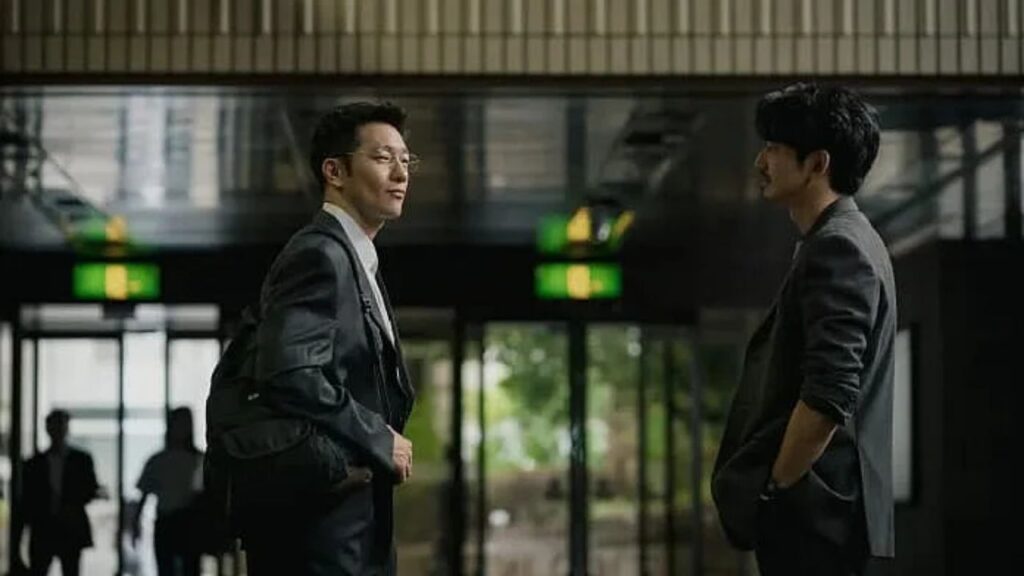

The Blue Road finale reveals the truth behind Kim Seok’s father’s murder, exposes Seo Hyun Tae’s conspiracy and delivers a heartbreaking fate for the two detectives. Here’s what the ending and 2026 epilogue mean.
Netflix’s Korean-Japanese crime thriller The Blue Road ends with a devastating revelation that changes everything Kim Seok believes about his family. What begins as an investigation into a series of gruesome murders across South Korea and Japan eventually uncovers a decades-old conspiracy involving political violence, organised crime and the forced displacement of people.
Directed by Han Jun-hee, the eight-episode series stars Son Suk-ku as South Korean detective Kim Seok and Eita Nagayama as Japanese detective Hiroshi Inose. Set against the backdrop of the 2002 FIFA World Cup, the story follows their uneasy partnership as they trace the murders across several locations, including Seoul, Tokyo, Hong Kong and Central Asia.
The investigation leads them to Seo Hyun Tae, played by Jung Jae-young, and a pharmaceutical conspiracy involving the synthetic drug Speed K. But the final episode shifts the focus from the investigation to Seok’s personal history, revealing the truth about his father’s death and the man he had trusted for years.
Does Kim Seok Die In The Blue Road Finale?
Yes. Kim Seok dies in the final confrontation with Seo Hyun Tae, making the ending particularly tragic for his partner, Inose.
The finale takes Seok to Dandelion Village in Central Asia, where Hyun Tae has been living under the alias Igor. Seok travels there believing that he is closing in on the man responsible for the conspiracy. His journey is accompanied by Anastasia, a local woman who eventually leads him into a trap.
However, Inose unexpectedly appears and saves Seok. The detectives had allowed the impression of Inose’s death to circulate as part of their plan. His funeral was staged so he could disappear from public view, protect his family and continue pursuing the investigation without alerting their target.
With Inose back in the picture, the two detectives prepare to confront Hyun Tae. Their pursuit finally brings them face to face with the man connected to the criminal network and the events that destroyed Seok’s family.
Who Killed Kim Seok’s Father? Hong Du Yeong’s Shocking Truth
One of the biggest revelations concerns Hong Du Yeong, the man Seok had regarded as his uncle and a trusted member of his family.
The finale reveals that Du Yeong was actually associated with an organisation called Gráfica. He was involved in the torture and murder of Seok’s father in 1987. After finding a photograph of Seok’s mother in his father’s wallet, Du Yeong gradually entered the family’s life and established himself as someone they could trust.
His presence was therefore built on a terrible deception. He had initially approached the family with hidden motives, but his relationship with them eventually became complicated by guilt over his past actions.
Du Yeong later attempted to move away from his earlier life, but Hyun Tae killed him. Before his death, he wanted Seok and his mother to be spared. The revelation explains why Seok’s mother continued to trust and call out for Du Yeong without knowing the truth about her husband’s murder.
For Seok, the discovery is deeply personal. The man he had considered family was connected to the violence that had shaped his childhood and his search for answers.
Why Does Inose Stop Seok From Killing Hyun Tae?
When Seok finally confronts Hyun Tae, his anger threatens to take control. Having learned about his father’s murder and Du Yeong’s betrayal, he points his gun at Hyun Tae and appears ready to take revenge.
Inose intervenes. He reminds Seok that killing Hyun Tae would turn him into a murderer and undermine the work they have done to uncover the truth. Instead, he urges his partner to let the legal system deal with the antagonist.
Seok eventually lowers his weapon, choosing not to take revenge. But the decision comes at a terrible cost. Hyun Tae uses the moment to shoot him in the stomach.
Inose immediately fires back, and Hyun Tae falls from the cliff to his death. Although the antagonist is defeated, Seok has suffered a fatal injury. He dies in Inose’s arms, having finally uncovered the truth about his father and brought the investigation to its conclusion.
Unlike Inose’s staged funeral, Seok’s death is real. His final moments underline the emotional cost of the investigation: he finds the answers he spent years searching for, but never gets the chance to return home with them.
What Happens To Anastasia In The Blue Road Epilogue?
The series moves forward to 2026, 24 years after the central investigation. Anastasia, who helped Seok during his time in Central Asia, has moved to South Korea and joined the police force.
She is eventually shown working as an instructor at a police academy. During a lesson, she discusses the 2002 murders and encourages her students to question whether the idea of a single master criminal was used to conceal deeper government involvement.
Her role in the epilogue is significant because she keeps the case alive for a new generation. Rather than treating the murders as a closed investigation, she asks future officers to examine the larger forces and institutional failures behind them.
Inose is present as Anastasia teaches. The two later visit Seok’s grave, bringing the story back to the detective whose death remains at the centre of the finale.
What Does The Blue Road Title Mean?
The title refers to a road in Central Asia associated with the suffering of Koreans who were forcibly displaced from their homeland and sent into exile. As explained in the series, the road was named after the tears of those who endured the journey, with the image of their tears turning the road blue becoming a metaphor for their suffering.
The meaning connects directly to the series’ larger themes of displacement, historical trauma and forgotten victims. Several people caught up in the conspiracy have been shaped by circumstances beyond their control, while the organisation and its operations reveal how vulnerable communities can be exploited.
The road is therefore more than a geographical reference. It represents the long-lasting consequences of forced migration and violence, connecting the personal histories of the characters to a much wider historical wound.
In the final moments, Inose’s visit to Seok’s grave reinforces the idea that the past does not lose its significance simply because time has passed. The 2002 investigation may have ended, but its consequences continue to affect the people who survived it.
What Does The Final Scene Between Inose And Seok Mean?
The final scene is an emotional reflection on the friendship that developed between two detectives who initially struggled to work together. At Seok’s grave, Inose remembers his partner and imagines an encounter with his younger self and Seok.
The moment offers a symbolic reunion rather than a suggestion that Seok has somehow survived. It gives Inose a chance to revisit the bond they formed while pursuing the truth across borders.
Ultimately, The Blue Road ends on a bittersweet note. Hyun Tae is dead, the conspiracy has been exposed to scrutiny, and Anastasia carries the case forward. But Seok does not live to see the future he helped make possible.
The series closes by returning to its central idea: history cannot simply be buried. Its consequences remain with the people who remember it, the families who suffered because of it and the generations still searching for answers.