











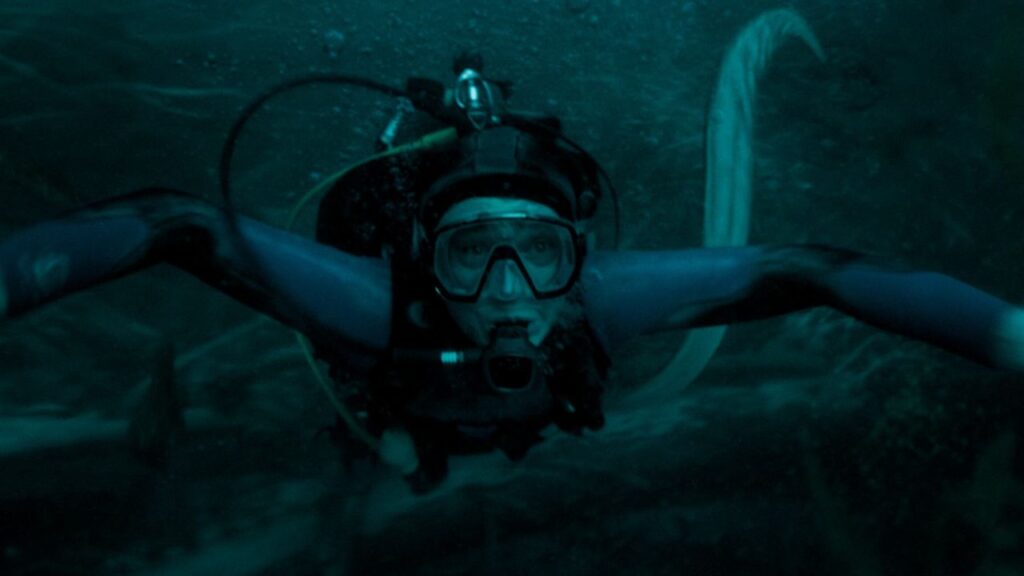

What happens when a desperate underwater mission turns into a fight for survival inside one of the ocean’s largest predators? Whalefall builds its survival thriller around this terrifying question, trapping its protagonist in an increasingly grotesque underwater nightmare while exploring the emotional scars left by a troubled relationship with his father.
Directed by Brian Duffield and adapted from Daniel Kraus’s novel, the film stars Austin Abrams as Jay Gardiner, a diver searching for his late father’s remains. When a sperm whale swallows him, his mission becomes a race against time, limited oxygen and the dangers of an environment where almost everything is working against him.
The premise is unusual enough to generate genuine suspense, and the film makes effective use of its claustrophobic setting. However, its attempts to connect the physical ordeal with a story about grief and reconciliation sometimes interrupt the tension rather than deepen it.
Whalefall Review: A Survival Thriller With a Nightmarish Premise
Jay’s underwater expedition begins with a personal purpose: he wants to find the remains of his father, Mitt, a celebrated diver whose complicated relationship with his son left lasting emotional damage.
The mission takes a horrifying turn when Jay is swallowed by a sperm whale. Suddenly, the ocean becomes only the first part of his predicament. Inside the enormous creature, he must navigate a hostile biological environment while trying to conserve his rapidly diminishing oxygen supply.
Director Brian Duffield builds much of the film’s tension around Jay’s vulnerability. The setting feels unpredictable and physically threatening, with each new obstacle forcing him to make difficult decisions. The threat is not simply that he might die, but that he may run out of time before he can find a way out.
The film’s most effective moments come when it allows the survival scenario to take centre stage. The limited space, grotesque surroundings and constant pressure create an uncomfortable viewing experience that suits the material.
Yet the central premise also places considerable demands on the screenplay. Once the initial shock settles, the film needs to keep finding fresh ways to sustain suspense. Although several sequences deliver, the narrative occasionally struggles to maintain the same intensity throughout.
Austin Abrams Delivers a Committed Performance
Austin Abrams carries much of Whalefall through a physically demanding performance as Jay. Trapped in an environment where extended conversations are hardly possible, he must communicate fear, exhaustion and desperation largely through facial expressions, breathing and physical reactions.
Abrams makes Jay’s struggle involving even when the character has limited options. His performance helps ground an extraordinary situation in recognisable human responses: panic, determination, frustration and the instinct to keep fighting when escape seems increasingly unlikely.
The character’s emotional baggage adds another layer to the ordeal. Jay is not merely trying to survive an encounter with a whale; he is also confronting memories of a father whose influence continues to shape his life. Abrams conveys that conflict with enough restraint to keep the character from becoming a simple vehicle for the film’s themes.
The performance is one of the film’s central strengths, particularly during the stretches when the action relies on physical acting rather than dialogue.
Josh Brolin Adds Complexity as Jay’s Father
Josh Brolin plays Mitt, Jay’s late father, whose influence remains central to the story despite his absence from the present-day survival ordeal.
Mitt is remembered as a formidable diver, but his relationship with Jay was marked by cruelty, pressure and complicated expectations. Brolin gives the character a mixture of authority and vulnerability, helping explain why Jay’s feelings towards his father are so difficult to resolve.
The film uses flashbacks and memories to explore their relationship, connecting Jay’s struggle to escape the whale with his struggle to understand the emotional damage left behind. At its best, this parallel gives the survival story a personal dimension beyond the immediate danger.
However, the repeated returns to the past can also interrupt the forward momentum. Just as the underwater sequences begin to build tension, the narrative shifts back to the family conflict, sometimes making the emotional material feel more insistent than necessary.
Elisabeth Shue, Jane Levy and Emily Rudd also feature in the cast, although their characters have comparatively limited room to develop within the story’s central focus on Jay and Mitt.
Whalefall’s Visual Effects and Sound Create an Unsettling Experience
The film’s visual design is essential to making its extraordinary premise work. The whale’s interior becomes a strange, hostile environment where Jay’s vulnerability is constantly reinforced by the scale and unpredictability of his surroundings.
Cinematographer Aaron Morton uses the contrast between Jay’s small physical presence and the enormous environment to emphasise his isolation. The production design and visual effects contribute to the film’s grotesque atmosphere, giving the survival sequences an unsettling quality.
The sound design and Joseph Trapanese’s score also play an important role. In a story where danger can emerge from an unfamiliar direction, sound helps establish urgency and intensify the feeling of being trapped.
Not every sequence is equally clear, however. Some visually murky passages and creature encounters prioritise spectacle over readability, occasionally making it harder to follow exactly what is happening. Even so, the technical elements help create an environment that feels sufficiently alien and threatening to sustain the film’s central concept.
What Works in Whalefall?
The strongest element is the film’s central survival scenario. Being trapped inside a sperm whale offers a striking premise, and the film uses it to create moments of claustrophobia, physical discomfort and genuine suspense.
Austin Abrams also gives the story an emotional centre, while Josh Brolin adds complexity to the family conflict that informs Jay’s actions. The visual design, sound and score further strengthen the sense of danger.
For viewers drawn to unusual survival thrillers, Whalefall offers an experience that is both visually unsettling and conceptually distinctive.
What Does Not Work in Whalefall?
The biggest weakness is the way the emotional storyline competes with the survival plot. Jay’s relationship with his father is important to the narrative, but the repeated flashbacks can slow the action at moments when the tension needs room to build.
The screenplay also occasionally pushes too hard to connect every physical ordeal to a larger emotional revelation. The result is a film that can feel more determined to explain its themes than to let the situation communicate them naturally.
Some of the creature sequences also sacrifice visual clarity for spectacle. These issues do not erase the film’s strengths, but they prevent the survival premise from delivering a consistently gripping experience.
Whalefall Final Verdict: Is It Worth Watching?
Whalefall is an unusual survival thriller that combines a nightmarish central premise with a story about grief, family conflict and the lasting influence of a difficult parent. Its strongest moments come from the tension of Jay’s predicament, Austin Abrams’s committed performance and the unsettling world created by the film’s visual and sound design.
However, the frequent flashbacks and sometimes overemphasised emotional themes weaken the pacing. The film is more consistently effective at making its audience uncomfortable than at making every emotional revelation feel earned.
For viewers who enjoy unconventional survival stories and can handle grotesque imagery, Whalefall may be worth the experience. Those looking for relentless suspense without frequent detours into family drama may find the journey less satisfying.
FAQs
1. What is Whalefall about?
Whalefall follows Jay Gardiner, a diver searching for his late father’s remains who becomes trapped inside a sperm whale and must fight to survive.
2. Who stars in Whalefall?
The supplied cast list includes Austin Abrams, Josh Brolin, Elisabeth Shue, John Ortiz, Jane Levy and Emily Rudd.
3. Who directed Whalefall?
The film is directed by Brian Duffield and adapted from Daniel Kraus’s novel.
4. What are the main strengths of Whalefall?
The survival premise, Austin Abrams’s physical performance, the unsettling visual design and the sound work are among the strengths highlighted in the supplied review.
5. Is Whalefall worth watching?
The supplied review describes it as an effective but imperfect survival thriller. Its tension and unusual premise may appeal to fans of the genre, although the flashbacks and emotional storyline can slow the pace.