











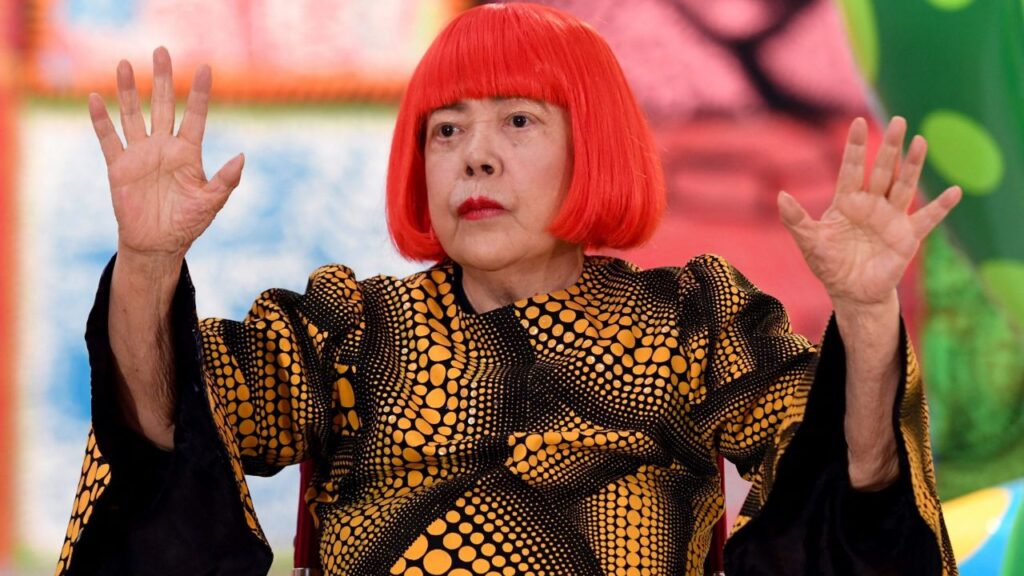

Japanese avant-garde artist Yayoi Kusama, whose distinctive world of polka dots, pumpkins and infinity mirror rooms transformed contemporary art, has died at the age of 97. Kusama died in a hospital on August 14, according to a statement from the Yayoi Kusama Museum. No cause of death was disclosed.
Known internationally for her immersive installations and instantly recognisable visual style, Kusama turned experiences of hallucinations and psychological distress into an extraordinary artistic language that made her one of Japan’s most celebrated contemporary artists.
The museum said that Kusama continued painting until her final days.
Yayoi Kusama Dies at 97 After Decades of Artistic Innovation
Born on March 22, 1929, in Matsumoto City in central Japan, Kusama experienced a difficult childhood marked by conflict within her family. She later spoke openly about experiencing hallucinations from a young age, describing visions involving flashing lights, dots and flowers.
Rather than allowing those experiences to define her only through struggle, Kusama transformed them into the foundation of her artistic practice.
In a 2017 conversation with reporters, she described continuing to see dots everywhere around her and explained that painting became her way of responding to those visions.
Her relationship with art became deeply connected to her survival. In a 2014 interview with Vogue Japan, Kusama said that drawing and making art had prevented her from ending her life and allowed her to continue living.
From Traditional Japanese Art to the Avant-Garde
During her school years, Kusama was mentored by Japanese painter Kakei Hibino. She later studied traditional Japanese painting at the Kyoto Municipal School of Arts and Crafts.
However, Kusama eventually became frustrated with what she saw as the restrictive nature of Japanese society and the limitations surrounding women artists.
Her ambitions eventually took her far beyond Japan.
In 1957, Kusama moved to New York, where she entered the city’s rapidly evolving avant-garde art scene.
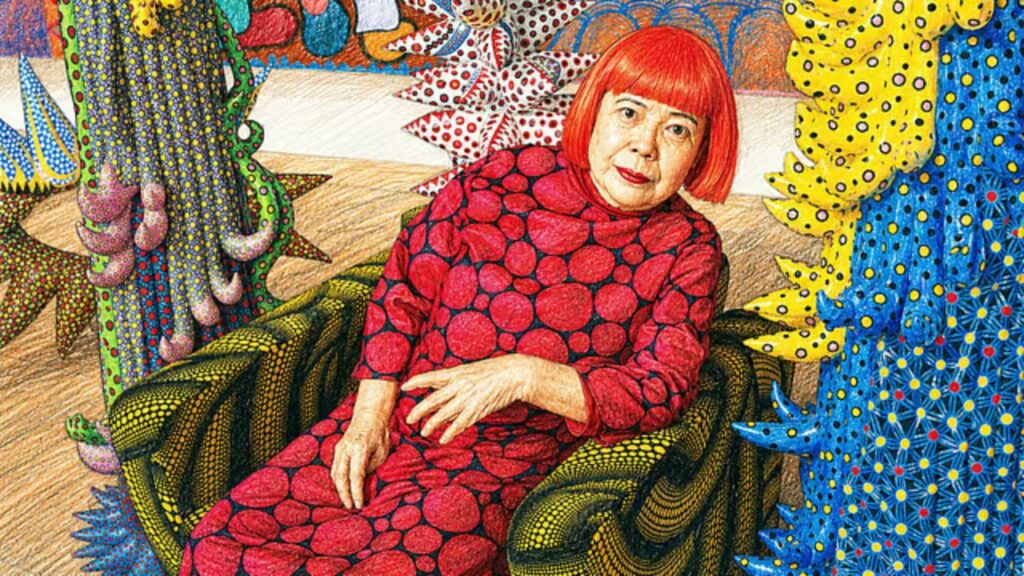
Yayoi Kusama Made Her Mark in New York
Kusama quickly established herself through experimental work that challenged conventional ideas about painting and sculpture.
She created large-scale net paintings, soft sculptures and experimental installations. She also organised happenings and body-painting events, including performances associated with anti-war and counterculture movements during the Vietnam War era.
Her work became part of the radical New York art scene of the 1960s, where she interacted with and influenced a generation of artists.
Kusama has frequently been cited as an influence on Andy Warhol, particularly because of her use of repetition and immersive visual patterns.
Her practice extended beyond visual art. She also wrote fiction and poetry, further demonstrating the breadth of her creative interests.
Kusama Returned to Japan as Her Mental Health Declined
Despite her growing reputation, Kusama’s mental health deteriorated during her years in the United States.
She returned to Japan in 1973. Four years later, she voluntarily entered a psychiatric hospital in Tokyo.
The hospital eventually became a long-term base for Kusama, but it did not bring her artistic career to an end.
Instead, she developed a routine that allowed her to continue creating. She would travel from the hospital to a nearby studio each morning, where she continued working.
Art remained central to her life and identity.
Polka Dots, Pumpkins and Infinity Mirror Rooms Made Her a Global Icon
Over the decades, Kusama developed a visual language that became instantly recognisable around the world.
Her repeated use of dots, nets and mirrored spaces transformed simple patterns into enormous environments that could make viewers feel as though they had entered an infinite universe.
Her infinity mirror rooms became particularly popular with international audiences. These immersive installations use mirrors, lights and repeated forms to create the illusion of endless space.
Her pumpkin sculptures also became closely associated with her artistic identity, with their distinctive patterns and bright colours appearing in exhibitions around the world.
What began as deeply personal imagery ultimately became a globally recognised artistic vocabulary.
Yayoi Kusama’s Art Commanded Millions
As Kusama’s international reputation grew, her exhibitions began attracting huge crowds across the world.
Her works also reached extraordinary prices at auction.
One of her paintings, Untitled (Nets) from 1959, sold for $10.5 million in 2022, reflecting the enormous commercial and cultural value attached to her work.
Kusama’s rise also represented a significant shift in how Japanese contemporary art was viewed internationally.
She became one of the rare artists whose work could appeal simultaneously to museums, collectors and a mass global audience.
A Life Defined by Art
Kusama’s story was unusual not simply because of her artistic achievements, but because of the way she transformed personal experiences into a career spanning decades.
The hallucinations she experienced throughout her life became recurring motifs. Dots, flowers, nets, repetition and infinity appeared again and again in her work.
Instead of hiding those experiences, Kusama incorporated them into her creative process.
Her work therefore became both intensely personal and remarkably universal.
Yayoi Kusama Leaves Behind a Lasting Legacy
Kusama’s death marks the end of the life of an artist who spent decades challenging traditional boundaries between painting, sculpture, performance and installation art.
From her early years in Japan to her experimental period in New York and her later international fame, she continually reinvented the possibilities of visual expression.
She also demonstrated that art could become a means of confronting fear, isolation and psychological struggle.
Even as her fame expanded and her work entered some of the world’s most prestigious collections and exhibitions, Kusama continued to maintain the disciplined routine that had sustained her creative life for decades.
Her legacy now extends far beyond Japan. The dots, pumpkins and infinite mirrored spaces that became synonymous with Yayoi Kusama have made her one of the most recognisable artists of the modern era.
Her life and work stand as a striking example of how deeply personal experiences can be transformed into art that reaches audiences across generations and borders.
FAQ
Who was Yayoi Kusama?
Yayoi Kusama was a renowned Japanese avant-garde artist known for her polka-dot paintings, pumpkin sculptures, net paintings and immersive infinity mirror room installations.
How old was Yayoi Kusama when she died?
Yayoi Kusama was 97 years old when she died.
When did Yayoi Kusama die?
According to a statement from the Yayoi Kusama Museum, Kusama died in a hospital on August 14. Her death was announced on August 27.
What was Yayoi Kusama famous for?
Kusama was particularly famous for her repeated dot patterns, pumpkins, infinity mirror rooms, large-scale installations and experimental avant-garde artwork.
Did Yayoi Kusama experience hallucinations?
Yes. Kusama openly discussed experiencing hallucinations involving dots, lights and flowers from childhood. She incorporated these experiences into her artwork.