






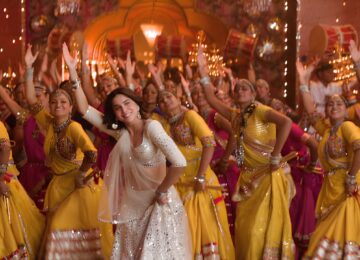






Inside Jaane Pehchaane Anjane – The Artists Behind Anupam Kher’s New Musical Comedy-Drama | Part 3
Before an actor walks onto a stage, before music finds its first note and before movement gives a scene its rhythm, there is an empty page.
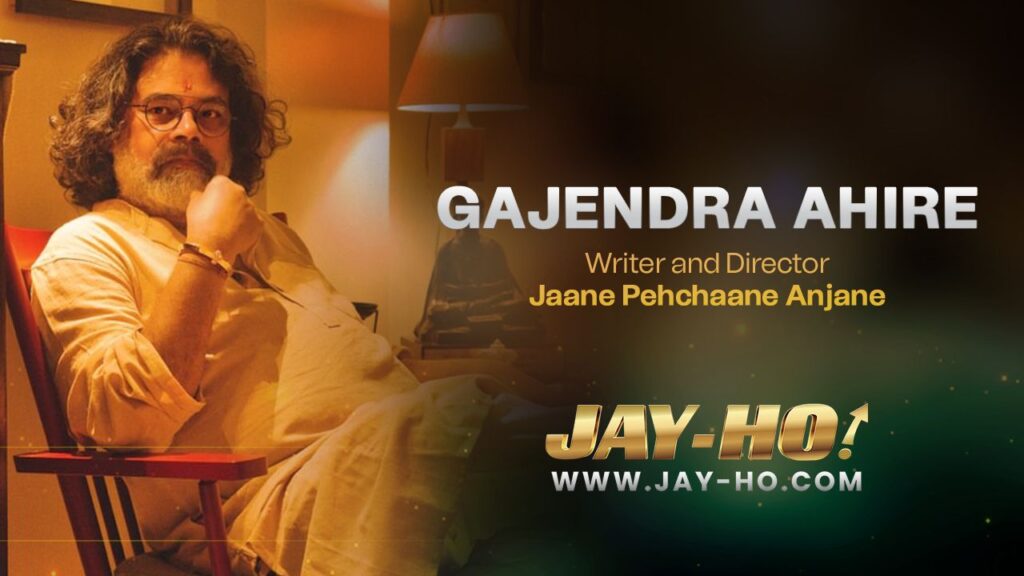
In Jaane Pehchaane Anjane, that page belonged to Gajendra Ahire.
The National Award-winning writer-director did not simply take charge of staging Anupam Kher’s new musical comedy-drama. He imagined the world its characters inhabit—the widow, the widower, the young paying guest, the woman navigating separation, and the complicated relationships that slowly grow between people living seemingly ordinary lives.
At first glance, there may be nothing extraordinary about these people.
And perhaps that is precisely the point.
For more than three decades, across theatre, television and cinema, Ahire has repeatedly turned his attention towards people we encounter every day—their loneliness, compromises, humour, contradictions, disappointments and quiet desire to be understood.
That makes Jaane Pehchaane Anjane especially interesting when placed within the larger journey of the man who wrote and directed it.
Because the play may be new, but some of the questions inside it have occupied Gajendra Ahire for years.
A Storyteller Shaped by Life Before Cinema
Gajendra Ahire’s journey as a storyteller did not begin behind a movie camera.
A graduate in Marathi literature, Ahire has spoken candidly about an extraordinary period in his early twenties when he left home and spent several years living an uncertain life, travelling, taking odd jobs and encountering people from very different circumstances.
Those years would later become a reservoir of characters, emotions and situations for his writing.
In an interview with The Indian Express, Ahire explained the importance he places on lived experience:
“You can’t replace vivid life experiences with observations or reading or imagination.”
For Ahire, stories were not something that existed only inside books or scripts. They accumulated through people, streets, conversations and circumstances—experiences he compared to drops of honey gathering over time.
At around 23, he wrote his first commercial play. Theatre opened the door to more writing, followed by television, where he went on to write more than 2,000 episodes across Hindi and Marathi programming. Among his notable television work was the popular 1990s sitcom Shrimaan Shrimati.
Long before audiences knew him as a filmmaker, therefore, Ahire had already spent years learning something fundamental to theatre and television:
How people speak to one another.
Not speeches.
Conversations.
The interruptions, pauses, irritation, humour, misunderstandings and seemingly insignificant exchanges through which relationships slowly reveal themselves.
Those instincts are very much at home in Jaane Pehchaane Anjane, where neighbouring lives become the setting for much larger questions about solitude, companionship and human connection.
Recognition Came Early, but the Stories Kept Coming
When Ahire moved into cinema, recognition followed quickly.
His first released feature as director, Not Only Mrs. Raut, received the Rajat Kamal for Best Feature Film in Marathi at the 51st National Film Awards. The Government of India citation recognised the film for its treatment of two women confronting exploitation and domination.
A few years later, Shevri, also written and directed by Ahire, won the National Film Award for Best Feature Film in Marathi at the 54th National Film Awards.
Those honours established Ahire as an important voice in Marathi cinema, but what followed was equally remarkable for its sheer creative momentum.
By 2018, he had already made 44 films. By 2020, he was speaking publicly about reaching the 50-film milestone.
Why keep moving from one film to another?
Ahire once offered an unusually revealing explanation. Finishing a film, he said, does not necessarily create a feeling of complete fulfilment. Something always seems to remain unexplored, and that sense of incompleteness pushes him towards another story.
In another interview, while approaching his 50th film, Ahire spoke about deliberately keeping his scripts fresh and original because there are always more characters to discover—characters carrying happiness as well as sadness.
That instinct—to keep looking for another human story—may explain more about Gajendra Ahire than any number attached to his filmography.
The Theme He Keeps Returning To
Look closely at Ahire’s work and another pattern begins to emerge.
Loneliness.
Not loneliness presented merely as sadness, but the quieter form of loneliness that can exist inside a family, a marriage, a home or a particular stage of life.
His film Pimpal centres on an elderly widower whose children live abroad and explores memory, belonging, ageing and the meaning of home. Ahire has spoken about the character’s changing relationship with the world around him and the emotional attachments through which he searches for comfort.
Then there is Anumati, another deeply personal exploration of ageing and companionship.
The Marathi film follows an elderly husband confronted with the possibility of losing his critically ill wife. Vikram Gokhale’s performance in the film earned him the National Film Award for Best Actor.
Years later, Ahire revisited the story in Hindi as The Signature.
And this time, the man at the centre of it was Anupam Kher.
The Signature: Where Gajendra Ahire and Anupam Kher Connected
The creative connection between Ahire and Kher predates Jaane Pehchaane Anjane.
The Signature, directed by Ahire and based on his Marathi film Anumati, starred Kher as Arvind Pathak, an elderly man whose life is thrown into emotional and financial turmoil when his wife becomes critically ill.
Ahire has recalled the moment he first narrated the story to Kher.
According to the filmmaker, Kher became so emotionally involved during the narration that before Ahire had even finished, the actor told him he wanted to do the film. Kher eventually became involved as a producer as well.
It is an interesting detail because it suggests that the relationship between the two artists was built not simply around a professional collaboration, but around a shared response to a particular kind of human story.
A story about ageing.
A story about attachment.
A story about the fear of losing companionship.
Those themes would bring them together again.
This time, in theatre.
Pimpal. Anumati. The Signature. And Now, Jaane Pehchaane Anjane.
Perhaps one of the most revealing insights into Ahire’s storytelling came only recently.
While discussing his 2026 film Sadabahar, starring Jaya Bachchan, Ahire reflected on Pimpal, Anumati and The Signature and explained that these works are connected by his continuing exploration of ageing, solitude and companionship.
“All these films are interlinked,” he said.
He spoke about what happens after a certain stage of life, when a person begins looking inward and considering what—or who—remains beside them.
In different stories, Ahire has explored companionship through marriage, memory, family and even the emotional attachment people develop towards objects left behind by those they love.
A person, he suggested, continues searching for a place where the heart can find peace.
Seen through that lens, Jaane Pehchaane Anjane begins to reveal another layer.
The play may stand on its own, but its emotional territory feels closely connected to questions Ahire has been exploring for years.
What happens when a house becomes quieter?
What do people need from one another when the conventional responsibilities of life begin to change?
Can companionship arrive at an unexpected age, or in a form we never anticipated?
Why can someone surrounded by familiar people still feel profoundly alone?
And how much do we really know about the people living just beyond our own door?
Ahire does not need extraordinary circumstances to ask these questions.
Ordinary lives are enough.
How Jaane Pehchaane Anjane Found Anupam Kher
The journey from Ahire’s idea to the production audiences now see on stage has another interesting chapter.
Anupam Kher has said that he had been looking for theatre material that could connect with people across generations. He wanted audiences to watch a play and feel, in his words, that perhaps this could be their own story.
Ahire, with whom Kher had already worked on The Signature, invited him to see a work-in-progress production.
Kher recognised its potential.
According to Kher, he then suggested transforming the production into a musical and introducing a narrator figure—a role he himself would eventually embody alongside his character within the play.
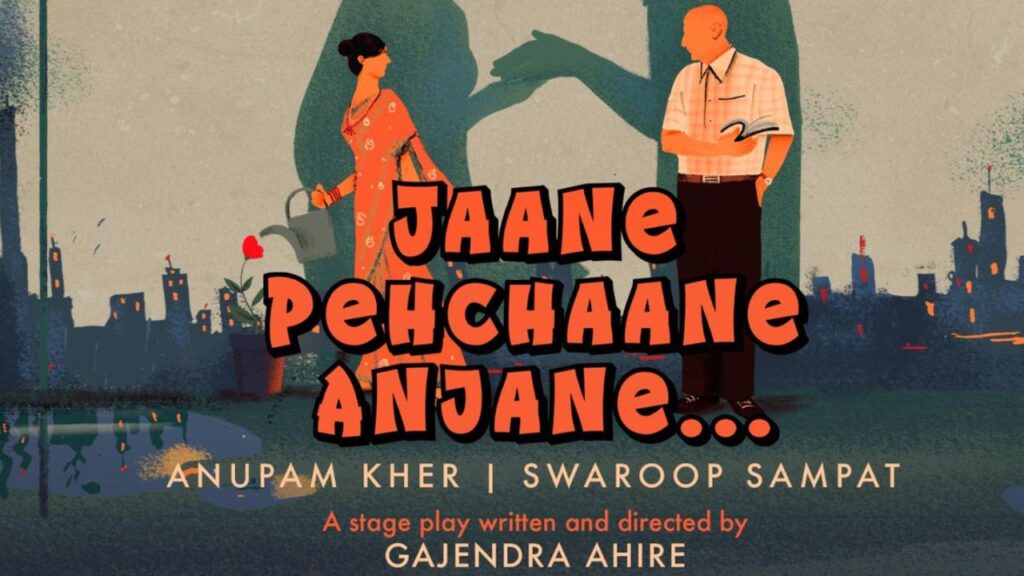
What emerged was Jaane Pehchaane Anjane, written and directed by Ahire, with music by Anu Malik and lyrics by Kausar Munir.
The production moves across three generations and examines relationships at very different stages of life. Its world includes older characters confronting loneliness and ageing, a middle generation dealing with its own emotional pressures, and younger people navigating a changing understanding of relationships.
At the centre of that world are neighbours—a widow, a widower, a young paying guest and a woman dealing with separation—each carrying solitude differently. The play uses humour, grounded realism and layered storytelling to examine gender roles, societal expectations and the human need for emotional connection.
The themes feel unmistakably contemporary.
But they also feel unmistakably Ahire.
Loneliness Does Not Mean Life Stops Being Funny
There is an important distinction here.
A play about loneliness could easily become overwhelmingly sombre.
Jaane Pehchaane Anjane does not.
Humour is woven into its world because Ahire’s characters are not ideas created to illustrate a social issue. They remain people.
People can be lonely and funny.
They can be ageing and stubborn.
They can carry grief while still wanting companionship.
They can be independent yet long for somebody to notice their absence.
They can understand the absurdity of a situation even while living through its emotional consequences.
That coexistence of humour and vulnerability is important to the play’s identity.
The NCPA describes Jaane Pehchaane Anjane as a work built through layered storytelling, sharp dialogue, humour and realism, examining the ways people search for meaning and emotional connection in everyday life.
In other words, the comedy does not sit outside the story.
It comes from recognising ourselves inside it.
The Social Observer Behind the Filmmaker
Throughout his career, Ahire has often placed personal relationships inside a wider social landscape.
His films have explored subjects ranging from ageing and gender to family structures, exploitation, faith and social change. The Indian Express has described his work as probing contemporary social realities through carefully developed characters who confront questions society often prefers not to discuss.
Yet his characters rarely feel as though they exist merely to deliver a message.
They are complicated before they are symbolic.
That distinction becomes valuable in Jaane Pehchaane Anjane.
The play can look at middle-age separation, changing gender roles, loneliness among older adults and the different ways generations approach relationships without turning itself into a lecture.
The social observation remains underneath the human interaction.
A conversation at home can reveal more than a speech.
A joke can expose discomfort.
A silence can reveal what a character cannot say.
And sometimes the person next door can become the mirror in which we unexpectedly recognise ourselves.
A Director Who Already Knows Why His Characters Exist
There is also something distinctive about Ahire’s position in Jaane Pehchaane Anjane.
He is not directing somebody else’s characters.
He wrote them.
The person deciding how a scene should unfold is also the person who first imagined why these characters behave as they do.
When Phatak speaks, when Vimal responds, when humour becomes a defence or when silence exposes vulnerability, the director guiding that moment carries with him the writer’s original understanding of what lies beneath it.
At the same time, theatre has its own way of transforming the written word.
An actor discovers something unexpected inside a line.
A pause suddenly communicates more than the dialogue.
A relationship develops chemistry in rehearsal.
An audience laughs at a moment nobody predicted would be funny.
What existed privately on a writer’s page becomes something shared between performers and hundreds of people sitting in a theatre.
That is where Ahire’s two roles—writer and director—meet.
And with performers such as Anupam Kher, Swaroop Sampat, Meghna Malik, Maya Sharma, Vikas Rawat, Shraddha Mandale and Herman De Souza inhabiting that world, the characters no longer belong only to the writer.
They begin living in front of an audience.
Familiar People. Unknown Lives.
Perhaps the title itself offers the most revealing way to understand the play.
Jaane Pehchaane Anjane.
People who seem familiar.
And yet remain unknown.
The neighbour whose door we pass every morning.
The parent whose loneliness may not be fully visible to children living thousands of miles away.
The woman navigating separation while appearing perfectly capable to everyone around her.
The young person surrounded by communication yet struggling to find meaningful connection.
The widower who has learned how to live alone but perhaps never learned how not to feel alone.
There is nothing conventionally heroic about these lives.
They are simply human.
And that is exactly what makes them worthy of a Gajendra Ahire story.
From an Empty Page to a Stage in Boston
When Jaane Pehchaane Anjane arrives in the Boston area on October 11, 2026, many in the audience will naturally come to see Anupam Kher and Swaroop Sampat perform live, alongside the accomplished ensemble surrounding them.
They will hear Anu Malik’s music and Kausar Munir’s lyrics. They will see Chirag Aggarwal’s choreography, Lehan Devadhia Tibrewal’s costumes and Nitin Nerurkar’s sets bringing another dimension to the production.
But underneath the performances, music and movement will remain something quieter.
A writer observing human beings.
Gajendra Ahire has spent decades moving between theatre, television and cinema, gathering stories along the way. National Awards and more than fifty films have marked that journey, but his creative territory has often remained remarkably intimate: the complicated distance between one person and another.
Pimpal looked at ageing and memory.
Anumati confronted love in the shadow of loss.
The Signature brought Ahire and Anupam Kher together around those same fragile human emotions.
And now Jaane Pehchaane Anjane brings the questions onto a stage, surrounded by music, humour and characters who may remind audiences of somebody they know.
Or perhaps of themselves.
That may ultimately be the most fitting way to understand the title.
We spend our lives surrounded by jaane pehchaane faces.
And yet there is always something anjane inside every human being.
Long before these characters walked onto the stage, Gajendra Ahire had been looking for them.
Jaane Pehchaane Anjane – Live in Boston
Anupam Kher Studio presents Jaane Pehchaane Anjane, written and directed by Gajendra Ahire, with music by Anu Malik and lyrics by Kausar Munir.
Starring Anupam Kher and Swaroop Sampat, alongside Meghna Malik, Maya Sharma, Vikas Rawat, Shraddha Mandale and Herman De Souza.
Sunday, October 11, 2026
The Collins Center for the Performing Arts
Andover, Massachusetts
Presented in Boston by Jay-Ho! and Dhoom Entertainment.
Tickets start at $39.
Book your tickets now and experience Jaane Pehchaane Anjane live in Boston.
FAQs
1. Who is Gajendra Ahire?
Gajendra Ahire is a National Award-winning writer, director and playwright known for his acclaimed work in Marathi cinema, television and theatre. He has written and directed Jaane Pehchaane Anjane starring Anupam Kher.
2. What is Jaane Pehchaane Anjane about?
Jaane Pehchaane Anjane is a musical comedy-drama that explores relationships, loneliness, companionship and human connections across different generations through humour, music and emotional storytelling.
3. Why is Gajendra Ahire known in Indian cinema?
Gajendra Ahire has directed more than 50 films and has won multiple National Film Awards for films including Not Only Mrs. Raut and Shevri. He is also known for writing over 2,000 television episodes.
4. What is the connection between Gajendra Ahire and Anupam Kher?
Before Jaane Pehchaane Anjane, Gajendra Ahire directed Anupam Kher in The Signature, the Hindi adaptation of his acclaimed Marathi film Anumati. Their successful collaboration led to this new musical theatre production.
4. What is the connection between Gajendra Ahire and Anupam Kher?
Before Jaane Pehchaane Anjane, Gajendra Ahire directed Anupam Kher in The Signature, the Hindi adaptation of his acclaimed Marathi film Anumati. Their successful collaboration led to this new musical theatre production.
5. When and where will Jaane Pehchaane Anjane be performed in Boston?
The play will be staged on Sunday, October 11, 2026, at the Collins Center for the Performing Arts in Andover, Massachusetts, as part of its North American tour.
6. Who are the main cast members of Jaane Pehchaane Anjane?
The production features Anupam Kher, Swaroop Sampat, Meghna Malik, Maya Sharma, Vikas Rawat, Shraddha Mandale, and Herman De Souza.
7. Who composed the music for Jaane Pehchaane Anjane?
The music has been composed by Anu Malik, while the lyrics are written by Kausar Munir. The songs are sung by Shaan, Sukhwinder Singh, and Anandi Joshi.
8. Why is Gajendra Ahire’s storytelling style unique?
Gajendra Ahire is known for creating deeply human stories that explore themes such as ageing, loneliness, relationships and emotional resilience. His work focuses on ordinary people and everyday experiences, making his stories relatable and emotionally impactful.
9. Is Jaane Pehchaane Anjane part of a series?
Yes. This article is Part 3 of the editorial series “Inside Jaane Pehchaane Anjane – The Artists Behind Anupam Kher’s New Musical Comedy-Drama,” which highlights the creative team behind the production.
10. Where can I buy tickets for Jaane Pehchaane Anjane in Boston?
Tickets for the October 11, 2026 Boston-area performance at the Collins Center for the Performing Arts are available through the event’s official ticketing platform.