








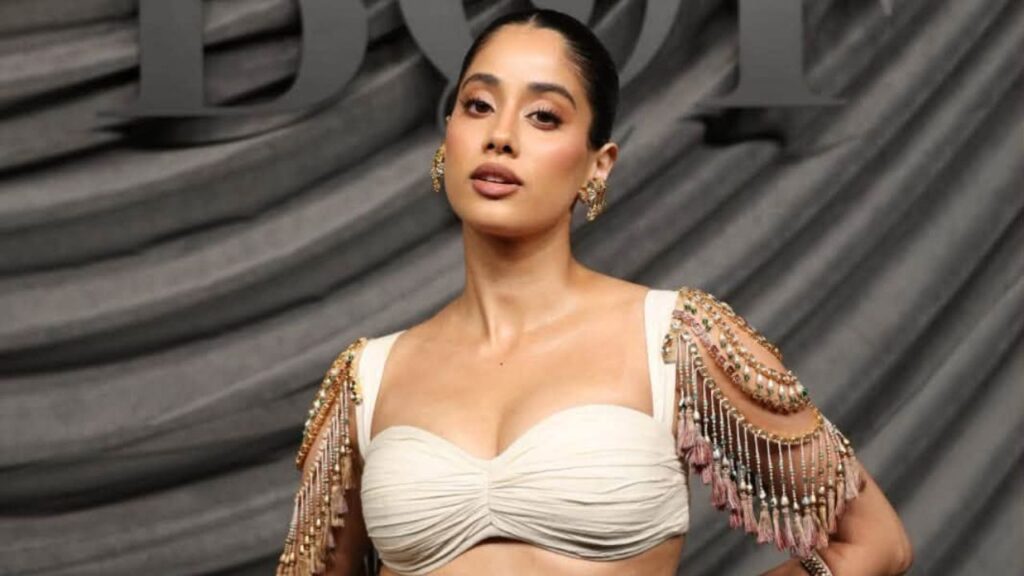

Janhvi Kapoor attended the BoF 500 Gala in Paris on October 3, 2026, wearing a custom Pankaj S Heritage creation styled by Rhea Kapoor. The ivory ensemble used 460-count Bengal muslin and reworked the traditional saree with a low drape, bare shoulders and elaborate shoulder embellishments.
Janhvi Kapoor brings Indian textile artistry to the BoF 500 Gala
Janhvi Kapoor made Indian craftsmanship the focus of her BoF 500 appearance in Paris.
The actor chose a custom creation by Pankaj S Heritage for the gala celebrating the BoF 500 Class of 2026. The event took place during Paris Fashion Week on October 3.
Her look was deliberately rooted in Indian dressing, but its construction moved away from a conventional saree silhouette.
Instead of relying on heavy layering, the ensemble used an ivory palette and sculptural styling to create its impact.
The result was a look that connected traditional Indian textiles with the visual language of an international fashion event.
What did Janhvi Kapoor wear to the BoF 500 Gala?
Janhvi wore a custom ivory saree by Pankaj S Heritage, styled by Rhea Kapoor. The garment was made from 460-count Bengal muslin, according to the styling details shared by Rhea Kapoor.
The fabric gave the outfit a lightweight and fluid appearance.
Its low-slung drape changed the proportions of the traditional six-yard silhouette. The pallu also extended dramatically toward the floor rather than following a conventional shoulder placement.
Janhvi’s shoulders remained exposed, adding a distinctly contemporary element to the otherwise traditional garment.
Key details of Janhvi’s BoF 500 outfit
| Detail | What Janhvi wore |
|---|---|
| Designer | Pankaj S Heritage |
| Styling | Rhea Kapoor |
| Fabric | 460-count Bengal muslin |
| Colour | Ivory/off-white |
| Silhouette | Modern saree |
| Drape | Low-slung with floor-length pallu |
| Embellishment | Gold, pearls, shells, emeralds, polki and tassel details |
| Event | BoF 500 Gala, Paris |
| Date | October 3, 2026 |
The styling details were shared publicly by Rhea Kapoor and independently reported by multiple outlets.
The jewellery-like sleeves became the statement feature
The most unusual part of Janhvi’s ensemble was not the saree itself. It was the elaborate embellishment extending from her shoulders toward her arms.
The adornments incorporated gold elements, pearls, shells, emeralds, polki details and tassels. They effectively transformed the blouse sleeves into a jewellery statement.
This choice also meant Janhvi did not need a conventional statement necklace.
The embellishment created a strong visual line across the shoulders while keeping the centre of the outfit relatively restrained.
That contrast helped the ivory muslin remain visible beneath the heavier decorative elements.
How did Rhea Kapoor style Janhvi Kapoor’s Paris look?
Rhea Kapoor styled Janhvi for the BoF 500 Gala and shared details of the custom ensemble on Instagram.
Janhvi kept her accessories comparatively controlled around the neckline. Gold earrings and additional wrist details complemented the embellished sleeves without competing with them.
Her hair was pulled into a sleek, centre-parted bun.
The beauty styling also stayed understated, allowing the unusual shoulder detailing and saree construction to dominate the look.
Why Janhvi’s saree matters beyond the red carpet
The strongest part of this fashion moment is the textile choice.
Janhvi could have represented Indian fashion in Paris through a heavily embellished couture gown. Instead, the look placed Bengal muslin at the centre of an international fashion conversation.
That makes the outfit relevant beyond celebrity styling.
The contemporary drape gives the garment global-fashion appeal, while the Indian textile and handcrafted detailing preserve its cultural identity.
This balance is particularly effective at an event such as the BoF 500 Gala, where designers, models, executives and other influential figures from the global fashion industry gather. The Business of Fashion describes the BoF 500 as an index of people shaping the fashion industry.
Who else represented India at the BoF 500 Gala?
Janhvi was not the only Indian presence at the Paris event.
Indian model Bhavitha Mandava made her BoF 500 debut at the gala, arriving on the red carpet with her parents in Chanel.
Reporting on the 2026 BoF 500 class also identifies Indian members including Bhavitha Mandava, P. Venkatesalu and Vidit Aatrey.
This distinction matters: Janhvi’s confirmed role was as a high-profile attendee at the gala, while the available reporting separately identifies the new Indian inductees into the 2026 class.
The wider Indian presence gave the Paris gathering an important connection to the country’s fashion and creative industries.
Janhvi’s Paris appearance comes amid a difficult week
Janhvi’s BoF 500 appearance also came shortly after an AI-manipulated video featuring her went viral online.
The video falsely depicted her in the song “Chuttamalle,” leading to widespread criticism and concern around the misuse of artificial intelligence.
Against that backdrop, her Paris appearance carried an additional layer of public attention.
Rather than allowing the controversy to define her fashion-week presence, the actor appeared at major international fashion events, including the BoF 500 Gala and Miu Miu’s Paris presentation.
Her saree appearance consequently became more than another celebrity red-carpet moment. It placed Indian design and textile craftsmanship at the centre of a major international fashion gathering.
Janhvi Kapoor’s BoF 500 look in three words: traditional, sculptural, global
Janhvi’s Paris outfit works because it does not treat traditional Indian clothing as a costume.
The saree remains recognisable, but its proportions, styling and jewellery treatment are deliberately contemporary.
The low drape gives the silhouette a fashion-editorial quality. The exposed shoulders add modernity, while the Bengal muslin keeps the garment grounded in Indian textile heritage.
The result is a strong example of how a familiar Indian garment can be reinterpreted for an international fashion audience without losing its identity.