











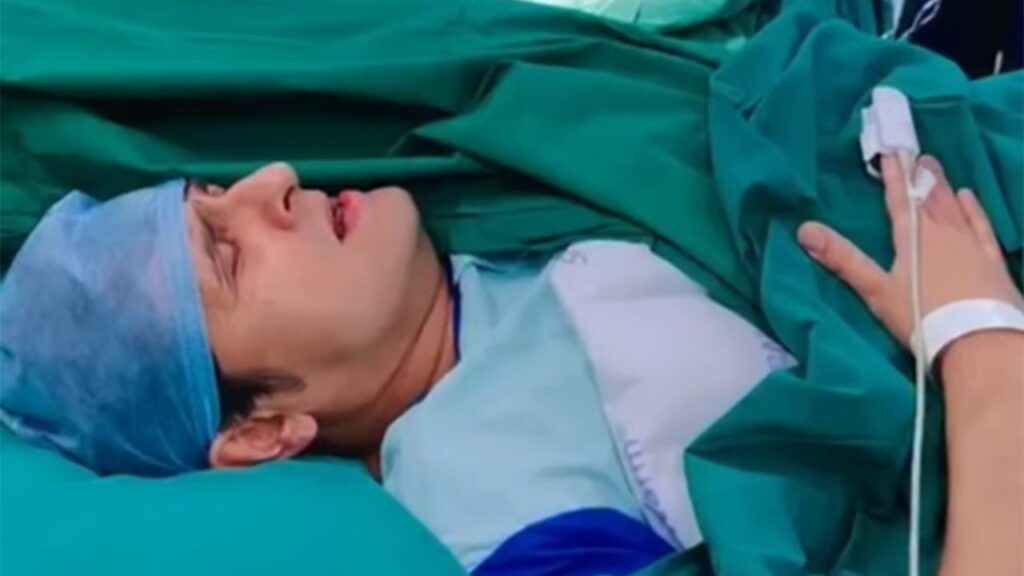

A video of singer Sonu Nigam singing Mohammed Rafi’s classic ‘Suhani Raat Dhal Chuki’ during a surgical procedure has gone viral. The unusual moment has left fans wondering how he was able to sing while doctors were operating on him.
Sonu later clarified that he was wide awake under local anaesthesia during a minor procedure to treat a recurring growth on his left ring finger. He said he sang spontaneously to ease his discomfort and entertain the medical team.
But can a person really sing during surgery? And is it safe? The answer depends on the type of surgery and the kind of anaesthesia being used.
Why Was Sonu Nigam Awake During His Surgery?
Sonu Nigam was awake because his procedure was performed under local anaesthesia, which numbs the specific area being treated while allowing the patient to remain conscious.
Unlike general anaesthesia, local anaesthesia does not make a patient unconscious. The person can remain awake and communicate with the medical team.
In Sonu’s case, the procedure involved his left ring finger. Because the surgical area was limited, local anaesthesia could be used to numb the relevant part of the body.
That allowed Sonu to remain conscious during the procedure.
His decision to sing was reportedly spontaneous rather than a required part of the surgery.
Is It Safe to Sing During a Minor Surgery?
Singing during a minor procedure can be possible when a patient is awake under local anaesthesia, but it is not something patients should do without following their surgical team’s instructions.
With local anaesthesia, the patient can generally speak and remain conscious while the targeted area is numb.
However, whether talking or singing is appropriate depends on the procedure, the patient’s condition and the surgeon’s instructions.
The most important requirement is that the patient does not interfere with the surgical field or make sudden movements.
Medical teams also continuously monitor patients during procedures and can guide them on what they can safely do.
Therefore, Sonu’s experience should not be interpreted as meaning that singing is automatically safe during every surgery.
What Is Local Anaesthesia and How Does It Work?
Local anaesthesia temporarily blocks pain sensation in a specific part of the body while the patient remains conscious.
The anaesthetic is administered around the area where the procedure is taking place.
Because the effect is localised, the patient does not necessarily lose consciousness.
This is different from general anaesthesia, where medicines are used to make the patient unconscious for the procedure.
The choice of anaesthesia depends on several factors, including the type of surgery, the area being treated and the patient’s medical condition.
Can Patients Talk or Sing Under Local Anaesthesia?
A patient who is awake under local anaesthesia may be able to talk or sing because consciousness is not removed.
Local anaesthesia mainly blocks pain signals from the targeted area.
As a result, a patient can remain alert and communicate with doctors, depending on the procedure and any additional medicines being used.
However, being able to talk does not mean every patient should talk or sing during surgery.
The surgical team decides what level of movement and interaction is appropriate.
Is Singing Also Used During Awake Brain Surgery?
Yes, patients can be asked to speak, count or perform other tasks during certain awake brain surgeries to help surgeons identify important functional areas.
Awake brain surgery, sometimes called an awake craniotomy, is very different from the minor procedure Sonu Nigam described.
In selected brain surgeries, doctors may keep a patient awake and comfortable during part of the operation.
This allows surgeons to monitor functions such as speech and movement while operating near critical areas of the brain.
During brain mapping, surgeons can stimulate specific areas and observe the patient’s response.
The patient may be asked to perform tasks such as talking, counting or identifying pictures.
These responses help the surgical team create a functional map and avoid areas that are important for essential brain functions.
Why Do Doctors Keep Some Brain Surgery Patients Awake?
Doctors may keep selected brain surgery patients awake so they can monitor important functions while operating near areas responsible for speech, movement or other abilities.
The brain contains regions that control essential functions.
If a tumour or another lesion is located close to one of these areas, surgeons may need to identify and protect the surrounding healthy tissue.
During an awake procedure, the surgical team can ask the patient to perform specific tasks while monitoring their responses.
This approach can help surgeons identify functional areas that should be preserved.
Does the Brain Feel Pain During Awake Brain Surgery?
The brain itself does not have the same pain sensation as skin or other body tissues, which is one reason awake brain surgery can be performed in selected cases.
However, the surrounding tissues, including the scalp, can feel pain.
That is why doctors use local anaesthesia and other methods to keep patients comfortable during an awake craniotomy.
The exact anaesthesia plan varies from patient to patient and is determined by the surgical and anaesthesia teams.
Is Singing During Surgery a Standard Medical Technique?
No, singing during surgery is not a standard technique for routine operations.
Sonu Nigam’s singing was related to his being awake during a minor procedure and was described as a spontaneous act.
Awake brain surgery is a specialised medical procedure in which patients may be asked to perform specific tasks for neurological monitoring.
Those tasks can include speaking, counting and other activities that help surgeons identify important functional areas.
So, the two situations should not be treated as the same medical practice.
What Happened to Sonu Nigam During the Procedure?
Sonu Nigam underwent a minor procedure for a recurring growth on his left ring finger and remained awake under local anaesthesia.
While the procedure was taking place, he sang Mohammed Rafi’s ‘Suhani Raat Dhal Chuki’.
The unexpected performance was captured on video and later went viral on social media.
Sonu explained that he sang spontaneously to make himself feel more comfortable and to entertain the doctors and medical staff.
The unusual sight of a singer performing while on an operating table quickly caught the attention of fans.
Why Did Sonu Nigam’s Surgery Video Go Viral?
Sonu Nigam’s surgery video attracted attention because it showed the singer casually performing while doctors were carrying out a medical procedure.
Seeing someone sing while apparently undergoing surgery is unusual for most people.
The video therefore prompted questions about anaesthesia, consciousness and whether a patient can safely communicate during an operation.
Sonu’s clarification helped explain why he was awake and able to sing.
His experience also sparked wider interest in the medical practice of keeping selected patients awake during certain specialised brain surgeries.
FAQ
Was Sonu Nigam awake during his surgery?
Yes. Sonu Nigam said he was awake under local anaesthesia during a minor procedure involving a recurring growth on his left ring finger.
Why was Sonu Nigam singing during surgery?
Sonu said he sang spontaneously to ease his discomfort and entertain the medical team during the procedure.
Is it safe to sing during surgery?
It depends on the type of surgery, anaesthesia and instructions from the medical team. Being awake under local anaesthesia can allow a patient to communicate, but singing is not automatically safe or appropriate during every procedure.
What is awake brain surgery?
Awake brain surgery is a specialised procedure in which a patient may be awake and comfortable during part of the operation. Surgeons can ask the patient to perform tasks such as speaking or counting to help identify important functional areas of the brain.
Why are patients awake during some brain surgeries?
Patients may be kept awake during selected brain surgeries so doctors can monitor functions such as speech and movement while operating near critical areas.