








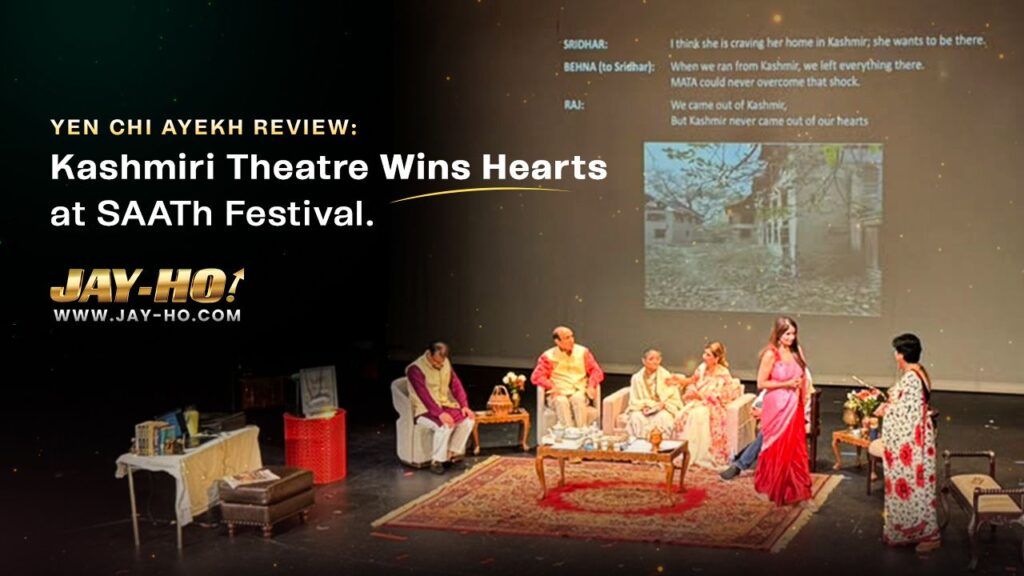

For many Kashmiri Pandit families, the 1989–90 exodus was not only about leaving a home; it was about carrying that home forward through language, food, humour, stories, and memory. Decades later, an even more personal question remains: how do children and grandchildren, born far away, understand a place they may never have seen? Yen Chi Ayekhanswers this not through a lecture, but through a family sitting together in a living room.
Presented at the Mosesian Center as part of the SAATh Festival, Yen Chi Ayekh was a small play with a large emotional reach. SAATh—South Asian-American Theatre and Storytelling Festival—is organized by Boston-based non-profit theatre group Off-Kendrik. Its purpose is to bring diverse South Asian languages, theatre traditions, and stories onto one shared stage. Within SAATh’s Multilingual Minithon, this Kashmiri production found exactly the right home: proud of its own language and identity, yet open and accessible to every person in the auditorium.
Set in a Kashmiri-American home, Yen Chi Ayekh brought alive the warmth and madness of an extended family gathering—relatives arriving after a long time, food being discussed, health advice being given, playful taunts, old memories, and the kind of arguments that only families can have with love. There were many moments when the auditorium broke into laughter and applause, especially as the familiar family banter found its mark.
Sanjay Kaul, as Raj, gave the production its emotional anchor. He played Raj’s irritation and humour with great ease, especially in his recurring complaint that life has changed “since you came,” directed at his wife Lovely Ji. On the surface, Raj is unhappy about reduced salt, sugar, oil, and spices in his meals. But Sanjay allowed us to see the feeling behind the complaint: a man who has adjusted to a new life, yet still carries the restlessness of a homeland left behind.
Bela Kaul, as Lovely Ji, brought a wonderful spark to the stage. Her movement, expressions, and playful use of old Bollywood song references created smiles and a lively vibe in the auditorium. She made Lovely Ji caring but never weak—practical, expressive, and fully capable of answering Raj’s complaints with humour and confidence. Her presence gave the play rhythm, colour, and charm.
Phoola Salman, as Mata, was quietly powerful. Her repeated wish to return “home” touched a deeper nerve. While the family sometimes sees her memories through the lens of age and forgetfulness, the audience sees something larger: for her, Kashmir is not a distant chapter in history; it remains home. Her performance carried both tenderness and the pain of a generation whose memories cannot simply be packed away.
Sudesh Kaul as Vicky, Arti Kaul as Behna, and Arvind Kaul as Sridhar completed the feeling of a lived-in family. Their interactions made the home believable—people interrupting each other, reviving old jokes, sharing news, and slipping naturally between laughter and emotion. Kamal Tikku had a brief appearance as Deepa, but it was still wonderful to hear her speak Kashmiri on stage. It showed, in a small but meaningful way, how language and culture can be embraced within a family.
The Kashmiri language was one of the play’s greatest strengths. The live English translations projected behind the actors allowed non-Kashmiri speakers to follow the dialogue, humour, and emotions without losing the authenticity of the original language. This was also a fine reflection of what SAATh does best—create a platform where regional languages remain central, while stories become accessible across communities.
The most powerful moment came with Sanjay Kaul’s closing monologue. His reference to the Monarch butterfly migration was deeply moving. It connected with Kashmiri families who have migrated to the United States, whose children may not speak the language fluently or fully understand the pain their parents and grandparents carry. His hope that theatre can help the next generation understand their roots—and perhaps one day visit the homes their grandparents came from—was emotional, relevant, and enough to leave many eyes moist.
The audience’s standing ovation at the end felt like a heartfelt acknowledgement of the entire journey—from the laughter and applause through the family scenes to the weight of the final monologue.
Congratulations to Sanjay Kaul, the full cast, Kamal Peshin for the concept, Sunayana Kachroo for the screenplay and Ladishah, and the SAATh and Off-Kendrik teams for bringing this story to the stage.
Jay-Ho! sincerely hopes Yen Chi Ayekh travels far beyond Boston. This is a story that Kashmiri communities across the United States—and audiences globally—should have the opportunity to experience. Sanjay Kaul should seriously consider taking this meaningful production on tour, because some stories deserve to travel wherever their people have made a home.
FAQ
What is Yen Chi Ayekh about?
Yen Chi Ayekh is a Kashmiri play about family, memory, migration, identity and the meaning of home. Set in a Kashmiri-American household, the play uses family conversations, humour and emotional storytelling to explore how the experience of Kashmir continues across generations.
Where was Yen Chi Ayekh performed?
Yen Chi Ayekh was presented at the Mosesian Center as part of the SAATh Festival, a South Asian-American theatre and storytelling festival organized by Boston-based theatre group Off-Kendrik.
What is the SAATh Festival?
SAATh, or the South Asian-American Theatre and Storytelling Festival, is a festival that brings South Asian languages, theatre traditions and stories together on one platform. Yen Chi Ayekh was presented as part of SAATh’s Multilingual Minithon.
What language is Yen Chi Ayekh performed in?
The play is performed in Kashmiri, with live English translations projected for the audience. This allows non-Kashmiri-speaking viewers to follow the dialogue and emotions while preserving the authenticity of the Kashmiri language.
Who are the main actors in Yen Chi Ayekh?
The cast includes Sanjay Kaul as Raj, Bela Kaul as Lovely Ji, Phoola Salman as Mata, Sudesh Kaul as Vicky, Arti Kaul as Behna, and Arvind Kaul as Sridhar. Kamal Tikku also makes an appearance as Deepa.